


Is hell eternal? For many Christians, the answer seems obvious. They were taught that people who do not believe in Jesus will be tormented in fire forever, with no hope of escape and no end to the pain. Others have heard that hell is real but temporary, or that God will eventually destroy the wicked so that they no longer exist. And still others wonder if hell will one day be emptied altogether. These are not small questions. What we believe about the eternal destiny of people says a great deal about what we believe about God.
In this post, I want to look at what Scripture says about whether hell is eternal. I will briefly describe the main answers Christians give, and then explain the view I hold. My short answer is this: the people who reject God will exist forever, because God raises everyone from the dead. But they will not be tortured forever by God. And even in that eternal existence, they will never be beyond the reach of His love. I believe this view takes the warnings of Scripture seriously while also taking seriously what Jesus reveals about the character of God.
Why People Ask Whether Hell Is Eternal
Most people who ask whether hell is eternal are not trying to escape the teaching of the Bible. They are trying to reconcile two things that seem impossible to hold together. On the one hand, they believe that God is love, as John says (1 John 4:8). On the other hand, they have been taught that this same God will torture billions of people for all eternity because they did not believe the right things during a few short decades on earth. Something about this does not fit, and many sincere Christians feel the tension deeply.
I believe this tension is a good thing. It is a sign that the Spirit is working in our hearts, teaching us to see God as Jesus revealed Him. If it would be monstrous for a person to torture someone for even a short time, it would be far more monstrous for God to torture someone forever. Since God is love, there is no cruelty in Him. So when a teaching about hell makes God look worse than the worst human tyrant, we have good reason to go back to Scripture and ask whether we have read it correctly.
Three Answers to the Question “Is Hell Eternal?”

Christians have generally given three answers to this question. The first is the traditional view, often called eternal conscious torment. It teaches that hell is a place of everlasting punishment, where the unredeemed suffer forever. The second is annihilationism, also called conditional immortality. In this view, the wicked are punished for a time and then destroyed, so that they cease to exist. Hell is eternal in its result, but not in its experience. The third is universalism, which teaches that hell, if it exists at all, is temporary and corrective, and that God will eventually bring every person into His kingdom.
Each of these views has thoughtful defenders, and each tries to honor certain texts of Scripture. I describe all three in more detail, along with a fourth view, in Three Views on Hell. But here is the short version of why I do not hold any of them. I do not hold the traditional view, because God does not torture people. I am not an annihilationist, because God is not a destroyer of the people He made. And I am not a universalist, because love cannot be forced. If God loves us, He will not override our freedom to reject Him.
What Does “Dead” Mean in the Bible?
Much of the debate about whether hell is eternal comes down to the meaning of death. Annihilationists often assume that if the wicked “die,” they must cease to exist. But in Scripture, the word “dead” does not mean “non-existent.” A dead body still exists. You can see it and touch it. Instead, “dead” means lifeless, or no longer able to do what it was made to do. Paul writes to the Ephesians that God made them alive when they “were dead in trespasses and sins” (Eph 2:1). They were not non-existent. They were living in a way that God never intended.
This helps us understand the warnings of Scripture. When God told Adam that he would die in the day he ate from the tree (Gen 2:17), Adam did not drop dead. Instead, his life became filled with toil, pain, and frustration. In a sense, physical death was later given as a kind of mercy, so that humans would not have to live forever in that condition. And physical death is not the end. Jesus said that “all who are in the graves will hear His voice and come forth” (John 5:28). Some will rise to life and some to condemnation (John 5:29), but everyone will be raised.
The Second Death and Everlasting Death

So what happens to those who are raised but still want nothing to do with God? Revelation calls this “the second death” (Rev 21:8). I do not believe the second death is annihilation. Being born again is not a second physical birth. In the same way, dying a second time is not a second end to our existence. The second death describes a life that continues to move away from what God intended. It is a life of everlasting death, just as the life Jesus gives is everlasting life. I explain this in more detail in What is the second death?
What might such a life be like? Scripture does not give us many details, and so anything we say here is speculation. But it seems likely that it would be much like life on this earth, with its broken relationships, failed plans, and empty pursuits, except that it goes on without end and no one dies. C. S. Lewis imagined something similar in The Great Divorce, where the residents of hell keep moving farther and farther from one another. He also suggested that hell’s doors are locked by those inside them. They remain there because they prefer their own way to God’s way.
What About “Everlasting Punishment”?
Of course, someone will point to the words of Jesus in Matthew 25. There He says that some “will go away into everlasting punishment, but the righteous into eternal life” (Matt 25:46). Doesn’t this settle the question? It is an important text, and we must take it seriously. But we must also read it carefully. The Greek word translated “punishment” is kolasis, which carries the idea of pruning or cutting short. It is a word with correction in the background, and it is not a word for endless torture.
The context also matters. In the Parable of the Sheep and the Goats, Jesus is judging the nations by how they cared for the poor and needy. The background is the message of the prophets, especially Ezekiel, who warned that nations which neglect the poor will be destroyed and left desolate. I believe Jesus is warning about this kind of destruction rather than describing a torture chamber after death. I walk through the whole passage in Is the everlasting fire of Matthew 25:41 a warning about hell? and you may find it helpful even if you end up disagreeing with me.
Is Hell Eternal Because God Keeps People There?
Here is where the question “is hell eternal?” often goes wrong. We imagine God as a jailer who locks people in and refuses to let them out. But the life of everlasting death is not something God inflicts on people. It is the natural result of their own choice to live without Him. God does not separate Himself from them. He is everywhere, and so He is present with them even there. They may feel separated from Him, but the separation is in their experience, not in reality. As Paul writes, nothing in all creation “shall be able to separate us from the love of God which is in Christ Jesus our Lord” (Rom 8:39).
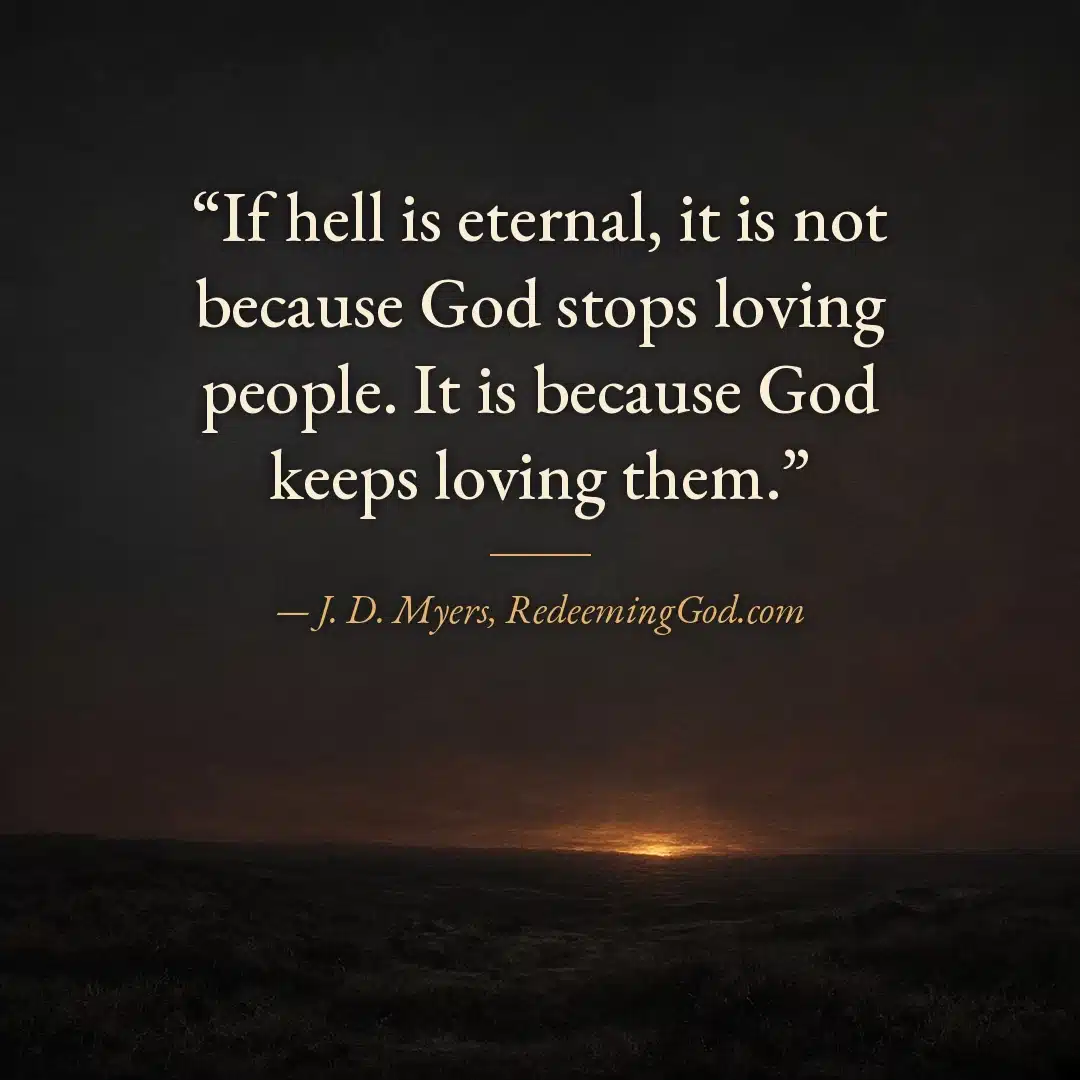
This means that if hell is eternal, it is not because God stops loving people. It is because God keeps loving them. Love gives freedom to the one who is loved. The greatest expression of love is to lay down your life for someone, and God did that in Jesus. But when people still choose to go their own way, love lets them go. God does not abandon them. He continues to walk with them into their darkness. But He will not force them to love Him, because forced love is not love at all.
Is There Hope After Death?
Many Christians believe that once a person dies, their destiny is sealed forever. They often point to Hebrews 9:27, which says that “it is appointed for men to die once, but after this the judgment.” I used to read the verse that way too. But this text only tells us that people die once and are not reincarnated. It does not say that the judgment is a single moment after which nothing can ever change. I hold this view loosely, and I cannot prove it from Scripture. But I see no reason to believe that God stops loving people, or stops inviting them home, at the moment of death.
Hell Begins Now, and So Does Eternal Life
One more thing needs to be said. Most of the passages people use to teach about hell are not primarily about the afterlife at all. They are about the destruction and death that come upon people in this life when they live outside the will of God. James can even say that the tongue “is set on fire by hell” (Jas 3:6). Hell is not only a future place. It is a kingdom of death that is already at work in the world, and it ruins lives here and now. I have written about this in my posts on Gehenna and the lake of fire.
But eternal life also begins now, and that is good news. Jesus said that “he who hears My word and believes in Him who sent Me has everlasting life, and shall not come into judgment, but has passed from death into life” (John 5:24). We do not have to wait until we die to escape the kingdom of death. And when Jesus announced His mission in Nazareth, He read from Isaiah 61 but stopped before the words about “the day of vengeance” (Luke 4:18-19; Isa 61:1-2). He came to proclaim liberty, not to threaten torment.
Learning More About Hell
So is hell eternal? I believe that those who reject God will exist forever, because everyone will be raised from the dead. And the kingdom of death they choose may continue forever, if they continue to choose it. But hell is not eternal torture, God is not the torturer, and no one is ever beyond the love of God. This is not a softer gospel. It is a gospel that looks like Jesus, and it calls us to bring the life of the kingdom of heaven into a world that is already experiencing too much hell.
If you want to go deeper, I cover all of this and much more in my book, What is Hell? The Truth About Hell and How to Avoid It. It surveys the main views of hell, looks at every key word and passage in Scripture, and explains how to avoid hell in this life and the next. If you have ever been afraid of hell, or afraid of the God who supposedly sends people there, this book will help you see God as Jesus revealed Him. Get What is Hell? on Amazon and discover the truth about hell.

Leave a Comment or Question