Every December, someone asks me, “When was Jesus born?” Most Christians already suspect that it was not on December 25. The Bible never gives us a date. Scholars cannot even agree on the year. But Luke and John left us a few clues about the time of year, and when we put those clues together with the feasts of Israel, the picture that emerges is far richer than a date on the calendar.
I should say up front that I hold this loosely. Years ago I preached a whole sermon on the date of Jesus’ birth, and I later laughed at myself for thinking it would make us better Christians. Knowing the date will not make you more like Jesus. But I still find the clues fascinating, because they show how carefully God wove the birth of His Son into the story of His people. So let us look at what the Bible says about when Jesus was born.
Was Jesus Born on December 25?
Almost certainly not. The first clue is in Luke 2:8: “Now there were in the same country shepherds living out in the fields, keeping watch over their flock by night.”
People who are familiar with shepherds in that part of the world know that shepherds do not keep their flocks out in the fields at night in the dead of winter. Sheep are out in the fields from roughly May to October. In winter, they are led down to the lowlands to shelter in caves. Even here in the United States, people rarely let sheep out of the barn in winter, because young sheep can freeze to death. The ranchers I have talked to agree that the shepherds of Luke 2 were most likely not out in the fields in December.
This does not mean the Bible is wrong. It means our dating is wrong. Jesus was born at some other time of year. (If you are wondering how December 25 became the traditional date, and whether that makes Christmas a pagan holiday, I answer that question in Is Christmas Pagan?)
What Zacharias Tells Us About When Jesus Was Born
We can narrow down the time of year further by looking at the father of John the Baptist. Luke tells us that Zacharias was a priest “of the division of Abijah” (Luke 1:5). The priests of Israel were divided into twenty-four divisions, and each division took its turn serving in the temple in Jerusalem. The division of Abijah was the eighth (1 Chr 24:10), and history tells us that it served in the month of June.
So Zacharias was in Jerusalem in June when he was chosen by lot to burn incense before the Lord. It was then that an angel appeared to him and announced that his wife Elizabeth would have a son, and that they should name him John (Luke 1:8-17). When his time of service was complete, Zacharias went home, and Elizabeth conceived in her old age (Luke 1:23-24).
If Elizabeth conceived in late June, then John was born about nine months later, in late March. And Luke tells us that Gabriel visited Mary in the sixth month of Elizabeth’s pregnancy (Luke 1:26, 36). Mary’s pregnancy was six months behind Elizabeth’s. So if John was born in late March, then Jesus was born six months later, in late September.
Jesus and the Feasts of Israel
The Jewish feasts did not only look back to what God had done for His people in the past. They also looked forward to what God had promised to do in the future. Many Bible teachers point out that the spring feasts were fulfilled at the first coming of Jesus. He was crucified at Passover, when the Passover lambs were being slaughtered. He rose from the dead as “the firstfruits of those who have fallen asleep” (1 Cor 15:20). And the Holy Spirit was poured out on the day of Pentecost (Acts 2). The fall feasts of Trumpets, Atonement, and Tabernacles are often seen as awaiting their full fulfillment when Jesus returns.
But some parts of these feasts were also foreshadowed at the birth of Jesus. Two of them stand out.
John and Passover
Passover usually falls in late March or early April on our calendars, which is right when John the Baptist would have been born. At Passover, Jewish families still set an empty place at the table, called the Seat of Elijah, because Malachi 4:5 promised that Elijah would come before the Messiah. Jesus said that Elijah did come, in the person of John (Matt 17:10-13). We do not know which day John was born, but it is interesting to think that he may have been born at Passover, as the Elijah who prepared the way for the Lord.
Jesus and the Feast of Tabernacles
Six months after Passover comes the Feast of Tabernacles, usually in late September or early October. And listen to how John describes the birth of Jesus: “And the Word became flesh and dwelt among us” (John 1:14). The Greek word for “dwelt” is skēnoō, which means “to pitch a tent” or “to tabernacle.” Just as God dwelt in the tabernacle in the wilderness, in Jesus He came to tabernacle among His people again, this time in human flesh. If Jesus was born in late September, then His birth may well have taken place during the very feast that celebrates God dwelling with His people.
Why Was There No Room in the Inn?
This also helps explain one of the most familiar lines in the Christmas story. Mary “laid Him in a manger, because there was no room for them in the inn” (Luke 2:7). The Greek word translated “inn” is kataluma. It usually refers not to a hotel, but to the guest room of a house, where traveling relatives would stay.
But kataluma can also refer to a temporary tent or booth. In the Greek translation of the Old Testament, God says that He had been moving about in a kataluma, a temporary dwelling, rather than living in a house (2 Sam 7:6; 1 Chr 17:5). If Jesus was born during the Feast of Tabernacles, it makes sense that there was no room. Hundreds of thousands of pilgrims had come to Jerusalem and the surrounding towns to live in temporary booths for the feast, and Bethlehem is only a few miles away. Every guest room and every booth would have been packed with people.
So where was Jesus born? The text does not say, except that there was a manger, a feeding trough for animals. It could have been a nearby cave used to shelter animals, or the lower level of a house, where many families kept their animals at night. I explore this more in Was Jesus Born in a Barn?
God With Us
During the Feast of Tabernacles, Jewish fathers would sit with their children in their booths and tell them the story of the wilderness. They would remind them that even when Israel wandered for forty years, God did not abandon them. “God took care of us,” they would say. “God was with us.” And they would tell their children that even though they now lived under Roman rule, God would one day come to set them free and dwell with His people forever.
And while those fathers were telling stories of hope to their wide-eyed children, there in Bethlehem, the city of David, Jesus was born, the One whose name is Immanuel, “God with us” (Matt 1:23).
So What About December 25?
If Jesus was born in late September, then He was conceived about nine months earlier. The median length of a human pregnancy is about 278 days. Count back 278 days from late September, and you land in late December. So while December 25 is probably not the day Jesus was born, it may be close to the day He was conceived in Mary by the Holy Spirit.
That date also falls near Hanukkah, the Festival of Lights. Hanukkah is not one of the feasts commanded in the Old Testament. It remembers the cleansing and rededication of the temple after the Maccabean revolt, when, according to tradition, one day’s worth of oil burned in the temple menorah for eight days. Yet the Gospel of John mentions Jesus going to Jerusalem for “the Feast of Dedication,” which is another name for Hanukkah (John 10:22). And John begins his Gospel by calling Jesus the light that “shines in the darkness” (John 1:5) and “the true Light which gives light to every man coming into the world” (John 1:9). Jesus also called Himself “the light of the world” (John 8:12; 9:5).
Could it be that God sent His Son into the womb of Mary during the Festival of Lights, to bring light into a dark world? I cannot prove it. But I love the idea that Jesus took even a holiday that God never commanded and pointed it to Himself. I write more about this in Did Jesus Fulfill Hanukkah? and in an earlier post on the date of the birth of Jesus.
Does It Matter When Jesus Was Born?
Not in the way we might think. Your faith does not depend on knowing the day, and you are free to celebrate it on December 25 with all the lights, trees, gifts, and carols you want. But the question of when Jesus was born reminds us that His birth was not random. God wove it into the story of His people, so that the feasts which looked back to God dwelling with Israel in the wilderness also looked forward to the day when God would dwell with us in the flesh.
That is the message of Christmas. God did not stay far away. He came near, pitched His tent among us, and became one of us. If you want to think about what that means for how we live, you might enjoy 4 Subversive Truths from the Birth of Jesus.
Learn More About the Date of Jesus’ Birth
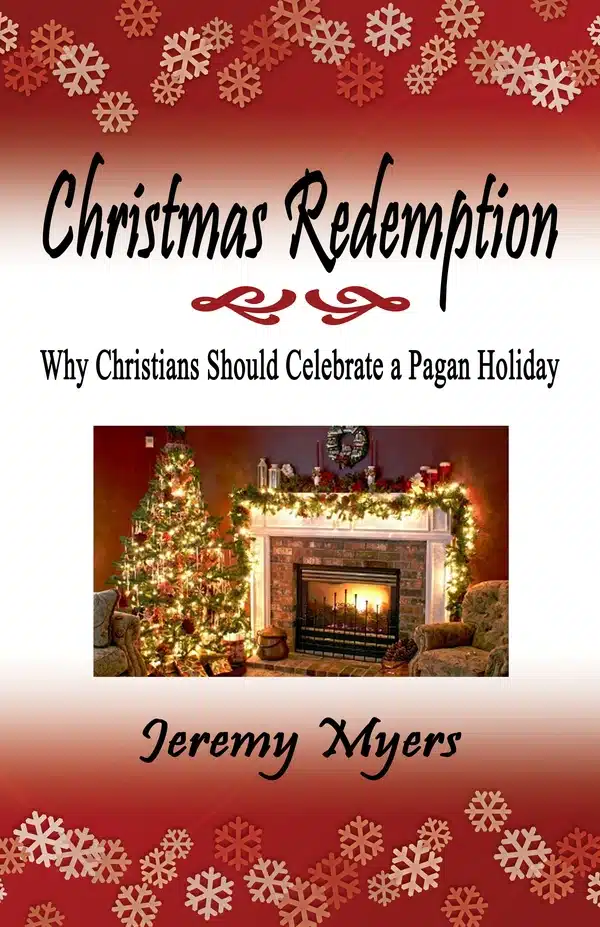
If you want to go deeper, I walk through all of these clues in my short book, Christmas Redemption: Why Christians Should Celebrate a Pagan Holiday. It also covers Saturnalia, Christmas trees, and even Santa Claus, and shows how Jesus redeems all of it. Get Christmas Redemption on Amazon and enjoy celebrating the birth of Jesus this year.
And if you want to keep studying questions like this with other people who are tired of religion and hungry for the grace of God, join the RedeemingGod.com Discipleship group. Members get access to the online discipleship community, free eBooks, audio lessons, and my online Bible and theology courses.