

How do you share the gospel in a simple way? Many Christians feel paralyzed by that question. They have heard long presentations, lists of laws, and outlines with several steps, and they are afraid of leaving something out. Others have been taught that a person must understand a large set of truths before he can believe and receive eternal life. The result is that sharing the gospel starts to feel like a lecture rather than an invitation.
The New Testament is simpler than that. When Jesus and the apostles invited people to receive eternal life, they did not require a four-step outline. They called people to believe in Jesus for everlasting life. That invitation can be spoken clearly, and it can be explained as questions arise, without turning the first conversation into a complete course in theology.
Start with the Invitation Itself
The simplest way to share the gospel is to begin where Jesus begins. He invites people to believe in Him for eternal life. That invitation has three elements: we believe, in a person, for a promise. The person is Jesus. The promise is eternal life. The response is faith.
I have explained this more fully in The Clear Gospel Invitation: Believe in Jesus for Eternal Life. The point here is that you do not need a better word than the one Scripture already uses. The New Testament almost universally describes this response as believing, or as faith. When we replace that word with others we think are clearer, such as trust, commit, repent, or surrender, we often add conditions Jesus did not include, and we risk turning faith into a work.
This is also why you do not need to follow a fixed set of “laws” in order to share the gospel. Those outlines can be useful in some settings, but they are not the biblical invitation. Jesus and Paul are already clear. Texts such as John 3:16, John 5:24, John 6:47, John 11:25-27, and Romans 4:4-5 tell a person what to believe, in whom to believe, and what is promised. If you stay close to that wording, you will not go far wrong.

Think of a Target, Not a Script
One image I have found helpful is a target, or a bull’s-eye. At the center is the invitation itself: believe in Jesus for eternal life. Around that center are many other gospel truths, some closer and some farther out. A person does not need to know everything in the outer rings in order to receive the gift in the center. The farther a truth is from the center, the less a person must understand it before believing.
This is why I have asked, in another study, how much a person needs to know in order to receive eternal life. The answer is not “as much as possible.” The answer is the invitation itself. There are other truths that help a person understand that invitation, and I have discussed those as gospel preparation truths. They are valuable. They are not a second center of the target. If a person already understands the invitation and is ready to believe, you do not have to walk them through every surrounding truth first.
In theory, a person could hear the simple invitation, believe it, and receive eternal life, even if that person knew very little else. I have sometimes used the hypothetical of someone in a remote place who hears only that Jesus gives eternal life to those who believe in Him, and who believes it. Would that person receive eternal life? According to the words of Jesus, yes. In ordinary life, of course, people usually know more than that, and they have questions that belong to the outer rings of the target. The hypothetical is only meant to keep the center clear. We must not add more to the invitation than Jesus did.
Listen, Then Move Inward
In actual conversations, the simple way is often to listen first. People rarely begin with a blank mind. They have questions about sin, about the church, about suffering, about who Jesus is, or about whether God would accept them. Those questions are not interruptions. They are usually points on the outer rings of the target. You can start where they are and move inward toward the invitation.
If someone wants to talk about how a person should live, you can agree that the Christian life matters, and then explain that this is not how a person receives eternal life. If someone is burdened by guilt, you can talk about sin and forgiveness, and then come to the promise of life in Jesus. If someone is curious about Jesus Himself, you can start with who He is, and then say what He offers. The goal is not to win an argument or to finish a script. The goal is to arrive at the center: believe in Jesus for eternal life.
This also means you can mention Jesus, mention the promise, and invite mere belief without waiting until you have covered every objection. A person may still have more to learn. All of us do. But a person does not need a complete theology in order to believe the promise Jesus made. I have a much longer practical discussion of this in How to Present the Gospel. This post is only meant to keep the method simple. Stay with the words of Jesus. Keep the center of the target in view. Answer questions as they come, and do not turn those answers into new conditions.

Keep the Invitation Clear
The reason this matters is that a complicated gospel is easy to distort. When we add extra steps, we often add extra conditions. When we delay the invitation until a person has mastered our outline, we imply that understanding a system is what saves. And when we use words other than “believe,” we can confuse the very people we are trying to help.
Sharing the gospel in a simple way does not mean being shallow, and it does not mean avoiding hard questions. It means knowing what belongs at the center and what belongs around it. Believe in Jesus for eternal life. That is the invitation. If you can say that clearly, listen to the person in front of you, and walk with them toward that center, you have shared the gospel in the way Scripture itself presents it.
Learn More in The Gospel According to Scripture
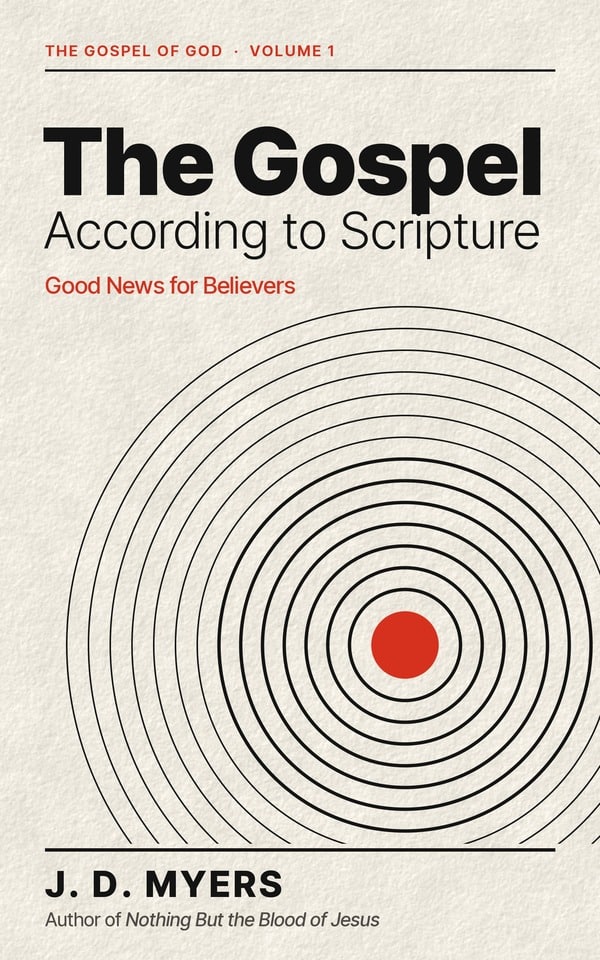
I discuss the gospel invitation, presentation truth, and how to keep the message clear in my book The Gospel According to Scripture. It is available in Kindle, paperback, and hardcover. You can also read more on the book page.
If you want to study these truths with others, join the RedeemingGod.com Discipleship group.

Leave a Comment or Question