

What does the word “gospel” mean in the Bible? Many Christians answer that question too quickly. They assume that “the gospel” is a short summary of what a person must believe in order to be born again, and then they read that meaning back into every place the word appears. The Bible’s usage is wider than that, and if we miss this, we will either shrink the gospel or confuse the invitation to receive eternal life with every other good announcement in Scripture.
The word matters because so many debates about “what is the gospel?” are really debates about which biblical uses we are treating as the one definition. Scripture can speak of the gospel in more than one way without contradicting itself. The task is to let the word mean what it means in each context, and then to keep the justifying message clear.
The Word Itself
In the New Testament, the main noun is the Greek word euangelion. It occurs 76 times in 73 verses. The related verb, euangelizō, occurs 54 times in 52 verses. The word is formed from angelos, a messenger, and the prefix eu-, meaning good or well. At its most basic level, then, the gospel is a good announcement, a good message brought by a messenger.
Our English word “gospel” comes from the old word “godspel,” meaning a good story or good news. That history is helpful, but modern English usage can also mislead us. When people today hear “the gospel,” they often think only of the message that must be believed in order to receive eternal life. The biblical word is not that narrow. It can refer to many kinds of good news, including news that is for people who have already believed. I have written a shorter definition in What is the Definition of the Gospel?, and a broader discussion in What is the Gospel?
This wider usage is already visible in the Greek translation of the Old Testament, where related words can describe a good report about a birth, a victory, or some other welcome event. The New Testament writers inherit that range of meaning. They do not invent a technical term that always and only means “the message of justification.”

One Vast Gospel, and Many Gospel Truths
It is possible, then, to speak of one great gospel, the whole good announcement of what God has done and is doing in Jesus Christ, and also to speak of many gospel truths within that announcement. Different authors emphasize different elements. In the Synoptic Gospels, the gospel is often the good news of the kingdom. Luke can even describe the announcement of Elizabeth’s conception as gospel, that is, as good news. Paul can use the word for the message he preached to unbelievers, and also for truth that is especially aimed at people who already believe. The word does not change its basic sense. The content of the announcement depends on the context.
This is why a single short formula cannot carry every biblical use of the word. I have shown, for example, that the gospel in the Gospels is not identical to a three- or four-line evangelistic summary. Jesus proclaimed the gospel of the kingdom long before the events of His death and resurrection had taken place, and that announcement was still rightly called gospel. Later, after His death and resurrection, those events become central to the good news that is preached. Both uses are biblical. They are not competitors if we stop forcing every text into one mold.
Paul’s letters show the same breadth. In Romans, much of what he calls the gospel is written to people who already believe, and it concerns how they are to live in light of what God has done. In 1 Corinthians 15, the gospel Paul says he preached is larger than the two or three verses usually quoted from it. The passage runs at least through verse 11, not only verses 3 and 4, and it includes Christ’s appearances and Paul’s own place in the message. I have discussed that text in 1 Corinthians 15:1-4 and the Gospel. The death, burial, and resurrection of Jesus are essential gospel truths. They are not the whole of what Scripture calls the gospel.
A Striking Silence in John
One of the most important facts about the word is a silence. The Gospel of John never uses the word “gospel.” That should startle us, because if any book in the Bible is concerned with how a person receives eternal life, it is John. He wrote so that people might believe in Jesus and have life in His name. Yet he does not describe that message with the word euangelion.
That silence is a warning against treating “the gospel” and “the justifying message” as exact synonyms. John gives the clearest invitations in the New Testament, and he does it without using the word we have made into a technical label. Meanwhile, other books use the word “gospel” for truths that are not, by themselves, the condition for receiving eternal life. If we do not distinguish these, we will either accuse John of omitting the gospel, or we will turn every gospel truth in Paul and the Synoptics into a requirement for being born again. Neither option is faithful to the text.

Keep the Invitation Clear, and Let the Word Be Wide
A careful reading, then, leads to two conclusions that belong together. First, the biblical word “gospel” is broad. It can cover dozens of related truths, from the kingdom of God to the death and resurrection of Jesus to the way believers are to live. I have sometimes counted around fifty such truths in Scripture, not as a new list that people must master, but as a way of showing how large the good news is. Second, the message a person must believe in order to receive eternal life is clear and specific: believe in Jesus for everlasting life. That justifying message is gospel, but it is not the only thing Scripture calls gospel.
If we keep those two conclusions together, we can preach a full gospel without confusing people about how to receive eternal life, and we can invite people to believe in Jesus without pretending that this invitation exhausts every biblical use of the word. The gospel is good news, and it is larger than a slogan. It is also clear at the point where a person receives life from Jesus. Both of those facts are good news.
Learn More in The Gospel According to Scripture
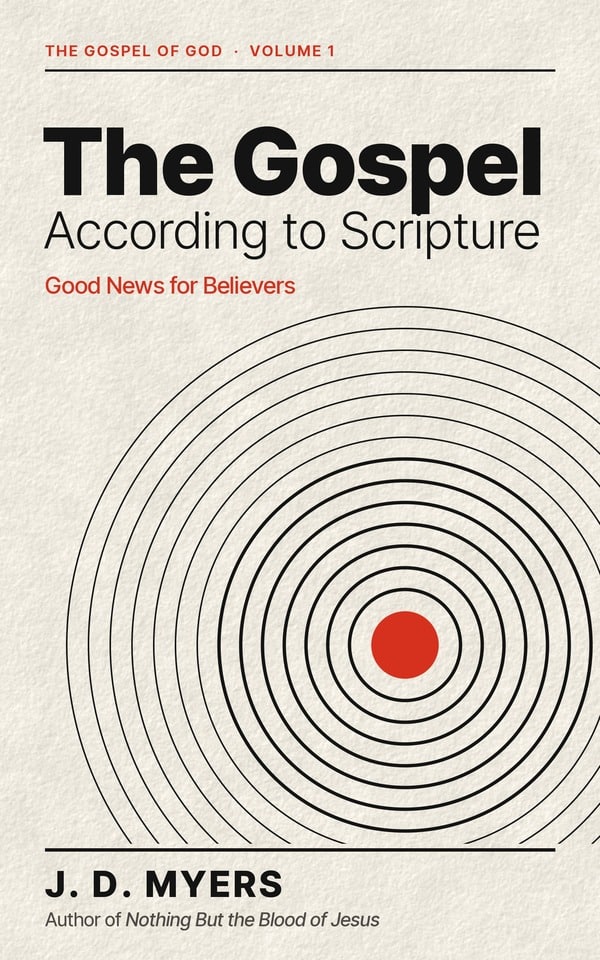
I discuss the meaning of the word “gospel,” the many gospel truths of Scripture, and the clear invitation to believe in Jesus in my book The Gospel According to Scripture. It is available in Kindle, paperback, and hardcover. You can also read more on the book page.
If you want to study these truths with others, join the RedeemingGod.com Discipleship group.

Leave a Comment or Question