
Trivia time! What’s the biggest but in the Bible? We will discover the answer to that question today in our study of Ephesians 2:4. I will also answer a quick question from a reader about the topic of Calvinism.
Question About Calvinism
I found and read your explanation of John 6:41-47. I liked the way you explain it. Can I hear more about your ideas against the doctrines of TULIP?
Yes! I have a list of the articles I’ve written on Calvinism and the doctrines of TULIP.
I eventually want to finish that series of articles and turn them into a book, but I have about ten book projects that currently have higher priority… But eventually … Lord willing.
The Biggest But in the Bible (Ephesians 2:4)
Ephesians 2:4 contains the biggest “but” in the Bible. To see why this is, let’s quickly review what we have seen so far in Ephesians 2.
Ephesians 2 is all about how God solved the greatest problem in human history. The problem, as we saw in Ephesians 2:1-3, is that humans engage in endless cycles of violence against one another, and we do all of it in God’s name. These actions are the satanic spirit, the accusatory spirit, the spirit of this age. All of society and culture is based on violence against one another, and we humans know of no other way to live.
Paul wants to tell us how to fix this problem. He explains the solution to this problem in Ephesians 2:4-10. And Paul begins talking about the solution to this problem of human violence with the two important words … “But God … ”
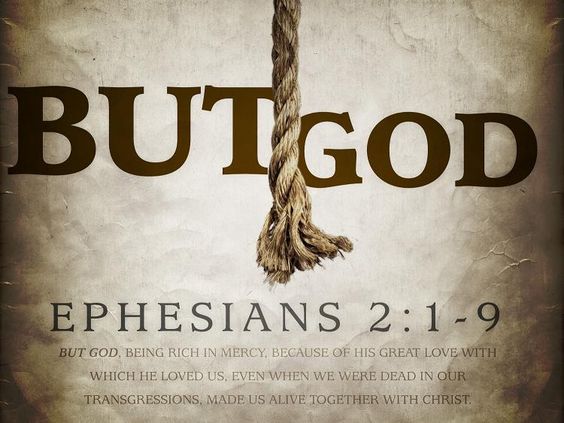
BUT God…
Sometimes the smallest words in Scripture are the most important. And this little word “But” is one of the biggest buts in Scripture. The word is a conjunction, and in this case, and adversative conjunction, showing a contrast between what Paul has just said, and what he is going to say next.
The contrast here is between how we behave as humans and how God does.
Remember, one aspect of the greatest problem we humans have is that when we engage in violence against others, we do it in God’s name. This means that when we march off to war, we do it with prayers and blessings from our pastors and priests. We engage in “Holy War” or “Just War” against our enemies. We think that when we seek to harm, stop, or even kill our enemies, we are doing God’s will.
Even when our enemy is just a neighbor or a coworker, we do this. Hopefully we don’t want to kill them or harm them, but when we have conflict with a neighbor, coworker, or even a family member, we tend to view the other person as morally inferior. They are the sinners. They are greedy and arrogant. We are the righteous ones. We are only standing up for truth and justice. Our stand for righteousness requires us to call them out, condemn their sin, and maybe even get them in trouble.
 That is the way we all behave almost all of the time. Our actions are justified and righteous, and the actions of those who oppose us are evil and wicked.
And since our actions are righteous, this means that God is on our side. And since God is on our side, this means He is against our enemy, just as we are. We assume that God wants to see them punished just as much as we do. And sometimes, we might push things a little bit to see that our enemies do receive the punishment they deserve.
But God…
Do you see why these two words are so important?
But God.
This is the way we behave and we think God is on our side … but God.
You could stop right here and almost fill in the rest yourself. If we hate our enemies, condemn our enemies, and want to see our enemies destroyed, and we think God is on our side on this, … but God … what do you think comes after that?
But God is not on our side the way we think.
But God wants nothing to do with our violence and hatred against others.
But God loves our enemies and wants to see them rescued and loved just as much as we do.
But God views our enemies the same way He views us … as objects of His love and affection, worthy of nothing but grace, mercy, forgiveness, and acceptance.
And indeed, in Ephesians 2:4-10, Paul goes on to say very similar things as we have just guessed. Indeed, right here in Ephesians 2:4, Paul mentions that God is rich in mercy, and that He acted out of His great love for us.
We must be careful to recognize that these terms of mercy and love apply to everyone in the world. We must not think that God is only rich in mercy toward us, and that He only extends His great love toward us, while in the meantime, He hates our enemies. No, the love and mercy of God are universal in their extent. They apply to all of us. To the entire human race.
And the word for love that Paul uses here, by the way, is agape. So this is God’s unconditional love for all of us. We will learn next time that God loved us even while we were in our sin. God does not wait for us to become righteous and holy before He loves us. God loves us while we are still sinners (Ephesians 2:5, Romans 5:8). There are no conditions to God’s agape love. He simply loves because He IS love and because we are objects of His love. He loves all humans all the time, regardless of what they have done, who they are, or even if they love God in return.
Here is what this means:
We hate our enemies and want to see them ruined, but God loves our enemies and wants to see them succeed.
We want to see our enemies “face justice,” but God extends mercy to them.

This is the beginning of the radical message Paul outline in Ephesians 2:4-10. He explained the problem humanity faces in Ephesians 2:1-3, and now he begins to unfold the solution to this problem. And the first initial and shocking truth is that when it comes to how we view our enemies, God is NOT on our side. Well, He is on our side, but He’s on their side too, and He doesn’t have the same view of our enemies as we do. His view of our enemies is radically different.
Do you see why this is the biggest “But” in the Bible?
Paul has described the greatest problem we humans face, and now Paul says “But God … ” is not part of this problem the way we humans think He is. Quite to the contrary, God wants to bring an end to all the violence and hatred.
When Paul says But God, he is saying that God stepped in to initiate a process of brining an end to the problem that human face. That’s why these two words are so important. They are central to the good news message about why God sent Jesus to this earth. God sent Jesus to show the world the way forward out of the human problem of violent sin.
Martin Lloyd-Jones once preached an entire sermon on these two words (See (#AmazonAdLink) God’s Way of Reconciliation, 59). Near the beginning of the sermon, he said this:
With these two words we come to the introduction to the Christian message, the peculiar, specific message which the Christian faith has to offer to us. These two words, in and of themselves, in a sense contain the whole gospel. The gospel tells us what God has done, God’s intervention; it is something that comes entirely from outside us and displays to us that wondrous and amazing and astonishing work of God which the apostle goes on to describe and to define in the following verses.
Yes, these two words are a hand grenade thrown into everything we think we know about God and His role in our life when it comes to dealing with our enemies. God has a completely different plan for how to deal with our enemies than we do. And this plan was revealed in Jesus Christ, which Paul goes on to describe in the following verses. And that is where we will pick up in our next study.