
Ever wonder what Revelation 3:5 means about getting blotted out of the Book of Life?
While I kind of don’t think there are actual “books” in which God writes people’s names, I do think the symbolism of the Book of Life is important to consider and understand.
The Book of Life vs. the Book of the Living
First, it is important to distinguish between the Book of Life and the Book of the Living. While the two books are similar in name, I think they are separate books… that is separate “symbols” in Scripture.
 By looking at the ways the two symbols are used in Scripture, it seems that “The Book of the Living” is a way of referring to all people who are alive. So when a person is born, they are in the Book of the Living, and when they die, their name is removed or blotted out from this book (cf. Ps 69:28).
The Book of Life, on the other hand, seems to refer to those who have eternal life, that is, those how have life in Christ. Some evidence for this is seen in the fact that the Book of Life is sometimes referred to as the Lamb’s Book of Life (e.g., Rev 21:27).
Also, it appears that the names of unbelievers were never written in the Book of Life (Rev 13:8; 17:8), and never will be if they die in unbelief.
So while the Book of the Living seems to refer to everyone who is alive at the time, the Book of Life refers to everyone who has eternal life (Dan 12:1; Php 4:3; Rev 21:27).
So Can My Name Be Blotted Out of the Book of Life?
But if the Book of Life contains the names of people who have eternal life, then when Revelation 3:5 talks about blotting someone’s name out of the book of life, does this mean it is possible to lose eternal life?
No. I don’t think so.
The reason is that in Revelation 3:5, Jesus is using a figure of speech called litotes. Litotes is a form of understatement, or saying something positive in a negative way.
Explanation of Litotes
We use litotes all the time. Let’s say your favorite NFL team this year is the Kansas City Chiefs, who are undefeated. And let’s say they were scheduled to play the Jacksonville Jaguars, who haven’t won a game yet. As the date for that game neared, you might say, “If Kansas City plays like they have been playing, they will certainly not lose this game.”
 This is an example of litotes. You have stated something positive — that Kansas City will sin — in a negative way: they will certainly not lose. The reason we use litotes is because it helps emphasize the positive thing we are trying to say. In the Kansas City – Jacksonville example, the use of litotes tells us that not only will Kansas City win, but the game will probably be a blowout.
But notice something else about litotes. While litotes states something positive in a negative way, this does not necessarily mean that the opposite statement is necessarily true.
In the example with Kansas City and Jacksonville, we said, “IF Kansas City plays like they have been playing, they will certainly not lose this game.” But what if Kansas City does not play like they usually do? What if they make mistakes, have turnovers, and throw a few interceptions? Does this mean that they will lose the game? Probably not. Even if Kansas City did not play the way they usually did, this does not mean they will lose. Kansas City is good enough and Jacksonville is bad enough that it is extremely unlikely that Jacksonville will win, no matter how Kansas City plays. (Sorry Jacksonville fans!)
Maybe another example that is not sports related will help.
What you think if you overheard me say, “If my wife makes me an apple pie, I will not stop loving her”? Would you assume from that statement that if she did not make me an apple pie that I would stop loving her? No, you would not. You would understand that my statement means that I do love her, and that if she makes me an apple pie, I would love it.
(And yes, my wife made me an apple pie this week! Thanks, Wendy! I LOVE You!”
This is also how we can understand Revelation 3:5
Litotes and Revelation 3:5
 In John 3:5, when Jesus that those who overcome will not be blotted out of the book of life, He is using litotes. If you read through Revelation 2-3, Jesus is pronouncing warnings and blessings to the various churches of Asia Minor, and all the blessings are for those people who overcome.
So in Revelation 3, one of the blessings pronounced on overcomers is that they will not be blotted out of the Book of Life? How is this a blessing? It is a blessing because of litotes; a positive announcement is being stated in a negative way for emphasis.
To turn it around state it positively, Jesus is saying that those who overcome will not only keep their name in the Book of Life because they are believers, but will receive greater blessings from God and greater experience of life with God. That is what Revelation 3:5 means. In fact, even in the verse itself, two of the other blessings that are promised to overcomers is that they will receive white robes and will receive special recognition before God and the host of angels. Again, we don’t know much about these blessings, but they sound spectacular.
Notice, of course, that just as with the NFL and apple pie examples above, the opposite of this litotes is not true either. Many pastors and teachers say that if someone does not overcome, then their name will be blotted out of the Book of Life. But Revelation 3:5 doesn’t say that! It is a logical fallacy from this verse. Revelation 3:5 does NOT say that those who fail to overcome will be blotted out of the Book of Life.
A statement which is true one way is not necessarily true when reversed. We saw this above. Even if the Kansas City Chiefs do not play up to their ability, this does not necessarily mean they will lose to Jacksonville. Even if my wife does not make me an apple pie, this does not mean that I will stop loving her.
So also, even if someone whose name is written in the Book of Life fails to overcome, this does not mean that their name will get blotted out of the Book of Life. When it comes to the Book of Life, there are no erasers. The names found in the Lamb’s Book of Life are written in the permanent ink of His blood.
Does this help your understanding of Revelation 3:5?


 These courses are much cheaper than what you will pay at another online Bible College or Seminary ($600-$900 per course), plus you can complete them on your own time and at your own pace.
 I have actually attended four of these online Bible colleges, and have taken classes from them. The others I have heard good things about from friends and family members who have attended them.
 The great benefit to online Bible College courses is that you can “attend class” when it is convenient for you. Though I was actually living in Dallas when I attended Dallas Theological Seminary, I always took at least one course online each semester. This means less time away from home and I could “sit in class” at 1 or 2 in the morning if necessary.

 Of course, do we Christians really believe that Jesus was right? It often seems that we do not. We often seem so intent on believing the right things, and knowing the right things, and doing the right things, and forcing other people to believe, know, and do the right things also, that we neglect to actually show love.

 2 Timothy 2:15 is a popular verse among pastors, Bible students, Bible colleges, and seminaries. In the King James Version, Paul instructs Timothy to “Study to show thyself approved unto God.”

 Of all the violent texts in the Old Testament, the portrayal of the flood in Genesis 6–8 may be the most difficult text to understand.
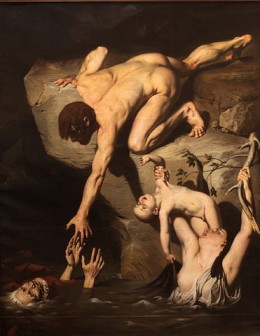 Aside from the grim image of every living thing on earth gasping for breath and choking on water as they sink beneath the waves, the flood story also paints a troubling portrait of a God who seems incompetent because He regrets that He made mankind (Didn’t He know this would happen?), and who then foolishly tries to solve the world’s addiction to evil and violence by committing the greatest atrocity of all: worldwide genocide. One author describes the story with these words: