
Redeeming God

Liberating you from bad ideas about God

Join the discipleship group
  • Join Us!
  • Scripture
  • Theology
  • My Books
  • About
  • Discipleship
  • Courses
    • What is Hell?
    • Skeleton Church
    • The Gospel According to Scripture
    • The Gospel Dictionary
    • The Re-Justification of God
    • What is Prayer?
    • Adventures in Fishing for Men
    • What are the Spiritual Gifts?
    • How to Study the Bible
    • Courses FAQ
  • Forum
    • Introduce Yourself
    • Old Testament
    • New Testament
    • Theology Questions
    • Life & Ministry

Have you persecuted a prophet today?

By Jeremy Myers
6 Comments

Have you persecuted a prophet today?
Prophet Isaiah sawed in half
The Prophet Isaiah was allegedly sawed in half.

In Acts 7, Stephen presents his defense for why he is a follower of Jesus. At one point in his speech, he says this:

Which of the prophets did your fathers not persecute? (Acts 7:52)

In other words, “Name me one prophet that our ancestors did not persecute, despise, and reject.”

What is Stephen saying? He is saying the same thing that Jesus said: “Prophets are never accepted in their hometown” (Luke 4:24). Yes, and maybe not in their home country, or even their home time era.

And “never accepted” is an understatement. Many of the prophets were hunted down, arrested, starved, tortured, and killed.

But let’s do a little thought experiment about prophets

Put yourself back at the time of Stephen. Imagine that you are standing there, listening to his speech.

As you imagine yourself there, on that day, as the mass presses upon him murderous rage, where do you picture yourself standing? What are you thinking? What are you doing?

Would you have been sticking up for what Stephen taught?

Or would you have been among those who picked up stones to kill him?

In the image below, where do you place yourself?

stoning of Stephen

Yeah, me too. I imagine myself among those who stand up for Stephen.

But notice in Acts 7, that the only one standing up for Stephen on this day was Jesus Christ (Acts 7:56). Everybody else present had been caught up on the contagion of violence and picked up stones to kill him.

Hmm….

Well, maybe all his supporters were too scared. Or weren’t allowed in to the trial.

But if we had been there, we would have been on the side of the condemned! Right?

But would we have?

If you had been present at the stoning of Stephen, would you have protected him or stoned him?

Let’s try a simpler (or harder) scenario.

Imagine yourself living in Jerusalem during the days of Jesus’ arrest and crucifixion.

Where do you imagine yourself standing?

Do you imagine yourself standing at the foot of the cross, weeping for how they have crucified your Lord?

Or do you imagine yourself standing in the mob, chanting “Crucify Him! Crucify Him! Crucify Him!”

In the image below, where do you place yourself?

crowd calls for the crucifixion of Jesus

Again, I’m with you. I imagine myself as being among those who had forsaken all to follow Him.

I imagine myself as being among those who stood by Jesus’ side no matter what. I imagine myself being among His closest followers.

… Except …

Where were all of his closest followers during the trial of Jesus?

The only disciple nearby was Peter, and he was busy denying and cursing Jesus.

Well then, we definitely would have been there with Jesus when he was crucified. Right?

Umm … Maybe not.

According to the Gospel accounts, it appears that only John showed up at the crucifixion, along with the mother of Jesus and several other women (John 19:25-27).

But you and I? We definitely would have been there, right?

Let’s be honest … probably not.

If we consider the thousands of people who just a few days before were wanting to crown Jesus as king (Matthew 21), the fact that only a few of these showed up at the cross does not provide good odds that we ourselves would have been among those few.

Even if we narrow it down to the 72 disciples that Jesus sent out to minister in the countryside, the fact that less than 5 people stood by Jesus as the cross gives us a less than a 7% chance that you or I would have been there. Since most of these were women, if you are a man, your odds are less than 1.5%.

Even among the closest twelve followers of Jesus, one betrayed Him, one denied Him, nine ran away and hid, and only one showed up at the foot of the cross.

So if you had been present at the crucifixion of Jesus, would you have wept for His death or cried out for His blood?

What does this mean?

We who claim to follow God do not have a good track record of recognizing God’s messengers, and even when we do recognize them, we have an even worse track record of standing by them when trouble comes.

Statistically, traditionally, historically, and Scripturally, rather than listen to the messengers of God, we are far more likely to reject, despise, slander, condemn, rebuke, persecute, and even kill those whom God has sent to speak His truth to us.

“No! Not us!” we say. “If we had lived in the days of Jesus, we would have recognized Him and stood by His side.”

Prophet Jeremiah in a pit
The Prophet Jeremiah in a pit

Yes, and that’s exactly what the people in the days of Jesus said about the prophets who came before Jesus … right before they turned around and killed Him (Matthew 23:30).

Do we honestly think that you and I would have done any better at recognizing and listening to Jesus (or any of the prophets) than did the vast majority of people in those days?

Most of those people likely knew the Bible better than we do. Most of them probably prayed more in one day than we do in a month. Most of them had vast portions of Scripture memorized. Most of them attended Torah study three or four times a week, and on Saturday they spent most of the day at the Synagogue (the Jewish church) in Scripture study and prayer.

Yet when prophets came, including the Messiah Himself, they didn’t recognized or heed any of these prophets, but instead, chased them out of town, made false accusations against them, had them arrested, tortured, starved, stoned, and crucified.

And we think we would have been different?

Honesty demands that we probably would have been among the crowd calling for the death of a the prophet.

Why am I saying this?

Here’s why:

If the people in the days of the prophets failed to recognize them as prophets, but instead condemned, accused, judged, criticized, and killed them, and if the people in the days of Jesus failed to recognize Him as the Messiah, but instead condemned, accused, judged, criticized, and killed him, then maybe … just maybe … the way to recognize a messenger of God to us is to look at who we Christians like to condemn, accuse, judge, criticize, and kill … and then consider that maybe … just maybe … these people are God’s messengers to us.

If we look at Scripture and history, we see that the reason God’s messengers get condemned and criticized and killed is because they never go with the religious status quo, but instead, call on the religious people to repent and change their ways, and abandon the foolish and empty chase after religious rituals and regulations.

The prophets, including Jesus, challenged the temple and its worship services, the sacrificial system to gain forgiveness, the priestly hierarchy to mediate God’s grace, the separation of people based on nationality, gender, and wealth, and basically, everything that religion requires to hold itself together.

This is why it typically was not the non-religious, secular “sinners” who reject and condemn the prophets, but the religious people who do so.

So who do you condemn? Who do you judge? Who do you label as a “sinner”? Who is it that seems to be attacking your way of reading Scripture and your understanding of how God “set things up”? Who is it that you accuse of undermining your traditions, of sacrificing your sacred cows?

Might it be possible that these people are really God’s messengers to you, that they might be God’s prophet?

Might it be possible that your enemy is your prophet and God wants you to listen to those you would rather ignore, and love those you would rather hate?

Have you persecuted a prophet today?

Don’t be too quick to answer “No.”

Affiliate Disclosure: As an Amazon Associate I earn from qualifying purchases. Thank you for supporting my work in this way!

God is Redeeming Life, Redeeming Theology Bible & Theology Topics: Acts 7, crucifixion of Jesus, Discipleship, Luke 4:24, Matthew 23:30, mimesis, prophecy, Stephen, violence

Advertisement

Nonviolent Resistance and Pacifism are Not the Same Thing

By Jeremy Myers
24 Comments

Nonviolent Resistance and Pacifism are Not the Same Thing

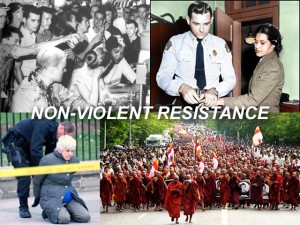
nonviolent resistanceI recently had an email exchange with a reader of this blog about pacifism and nonviolence. Usually such exchanges are better suited for the comment section of blog posts, since this allows more people to weigh in on the conversation. So, for the sake of inviting you in to the conversation, I will post our email exchange below. Please read it and then weigh in with your own thoughts.

I am interspersing my thoughts into the exchange (indicated by brackets [ … ]), and will conclude with some brief observations and clarifications.

Derek (not his real name): A question. If it is the job of the Holy Spirit to convince the world of sin (and I agree that this is the job of the Holy Spirit) are you saying that we as a nation are not to do anything about the threat to our freedom from ISIS or the other radical Muslims who say we must submit to their god? “A nation” is composed of people (some of the population being Christian) and if they do nothing against their enemies, then they will be over run by those enemies. Would just like a little clarification. Otherwise, you are correct that we should not use the “Christians are not perfect…just forgiven” as an excuse for covering for someone who has done wrong who claims to be a Christian. Of course, I assume you do believe that Christians are not perfect until God gives us our glorified body. Right or do you believe Christians can become perfect?

J. Myers: No, I am not saying that we should do nothing about ISIS. But violence will only lead to more violence. There are ways to nonviolently resist the things they are doing. Think Gandhi, Martin Luther King Jr., Nelson Mandela, etc.

[I didn’t answer his questions about Christian perfectionism. I do not believe Christians can become perfect in this life, but I didn’t want our discussion to get sidetracked onto peripheral issues.]

Derek: Please tell me one way you can nonviolently resist the radical ISIS? While nonviolence is a desired way, you approach a radical ISIS member and you most likely will lose your head.

Will be waiting your reply, as I have much to say about Gandhi, Martin Luther King Jr., and Nelson Mandela.

J. Myers: There is no โ€œone wayโ€ or even โ€œa wayโ€ that fits every situation. That is why creativity and determination are needed in nonviolent resistance.

But no, I would never recommend approaching a radical ISIS member. Why would you? Nonviolent resistance is primarily for the times when they approach you. And yes, you might lose your head. But Jesus was crucified, and in Godโ€™s economy, dying for what is right is more of a โ€œwinโ€ than killing someone else to save oneโ€™s life.

loving is not winning[Note that nonviolent resistance is not about “winning” or “defeating the enemy.” If we nonviolently resist, we may end up dead. That’s what happened to Jesus, after all. The goal of nonviolent resistance is not to “stay alive” while taking the life of someone else (if necessary), but it is rather to reveal God and love others like Jesus. It is impossible to do this if you are killing them.]

Derek: It is good that most Christians in the United States – from the beginning of the republic until today – do not hold your pacifistic viewpoints on dealing with the devils who call themselves Islamic Jihadists.

[Note the scapegoating going on in Derek’s statement. He has “de-humanized” these Muslims by calling them “devils.” We get very upset when Muslims refer to the United States as “The Great Satan,” but we do the same thing to them.]

I don’t know exactly what you mean by, “That is why creativity and determination are needed in nonviolent resistance.” I will admit, that if a person can meet one of these people who is not so radicalized, and you can tell him or her about the saving Grace of God, and that their Allah is not the real God, it is possible to win them to Christ. But how many of them are going to give you that opportunity? Not many.

[Yes. If the first words out of your mouth when you meet a Muslim include “Allah is not a real God,” it is not surprising that they will not want to hear the rest of what you have to say, and you will not “win them to Christ.” But who ever said that such words need to be included in the first conversation you have with Muslims? Or even the tenth? Or Hundredth?]

I believe that God is allowing these radical Muslims and other revolutionaries to stir up the middle east – perhaps bringing about World War III – so the people of the world who are so naรฏve, will fall for the argument that we need a World Government perhaps under the current United Nations. I believe we are in the Last Days, and if such does come about, from this World Government could come the Anti-Christ which the Scriptures tell us about. If that happens, then you should know the rest of the story.

[Here is the scapegoating again. World War III is already being blamed on the Muslims, and it hasn’t even started yet!]

Earlier, you had mentioned the “nonviolent” tactics of Gandhi, Martin Luther King, and Nelson Mandela.

Gandhi was a true believer and practitioner of “nonviolence.” However, my understanding is that he was not a “born again” Christian, despite all the good work he did. If the Scriptures are correct in their teachings (and I believe they are), then Gandhi is in torment in Hell as I write this email.

[Isn’t it strange that while Gandhi can better follow the instructions of Jesus than most Christians (even though He was Hindu), he is “in torment in Hell” right now? Yes, I know we do not receive eternal life by works, but I find this entire line of reasoning quite shocking. Also, because Gandhi wasn’t a “Christian” he apparently has nothing to teach us?]

Martin Luther King attended various meetings which were sponsored by organizations which were “communistic” in nature. While his nonviolent protests did bring about the Civil Rights movement and led to ending the wrongs of Segregation, one of the unintended consequences of such has produced Black hoodlums across America, many of whom have the idea they do not have to obey the laws of the land because their ancestors were slaves. Racial tensions are greater today, than they were during the days of Segregation. Martin Luther King was a professing Christian and Minister, and I have to give him the benefit of the doubt that at some time in his life, he trusted in the shed Blood of Christ on the Cross for forgiveness of his sins, and held to that trust for his Salvation until the day he was assassinated.

[So, Martin Luther King Jr., though he was a Christian and a pastor, can apparently be discredited too because his meetings were sponsored by communistic organizations? And what is this about the end of segregation being responsible for “black hoodlums across America”? Yikes!]

Nelson Mandela was another who was influenced by “communistic” doctrines. And while he may have been unjustifiably held in prison for many years, I do not believe he was a professing Christian, and if he was not, then we can only know what the Scriptures teach us. Despite his bringing an end to Apartheid, I understand that South Africa is as unsafe to travel to today as are some areas of New York City.

[And Mandela was a communist too, and therefore, cannot be trusted? And the end of Apartheid is responsible for violence in South Africa and even New York… ]

Nonviolence works only when your enemy agrees to become nonviolent. Nonviolence did not win us the Revolutionary War. Nonviolence did not win the Civil War for the restoration of the Union. Nonviolence did not win us World War I, and Nonviolence did not win us World War II. However, pacifism did influence our loss of some 55,000 American Soldiers in the Korean Conflict, and some 60,000 plus in the Viet-Nam War.

[Here is the whole concept of “winning” again. And the confusion of nonviolent resistance with pacifism.]

God commanded Israel to go to war against their enemies many times in the Old Testament. And while I prefer peace over war, and I wish “nonviolence” was the doctrine of all nations and tribes, there are times when a nation has to go to war to assure its citizens of security from those who will harm us. Anything less will ensure oppression and occupation from those who would kill us and destroy the way of life we have been blessed with.

[And the best trump-card of all – the violent portrayals of God in the Old Testament.]

J. Myers: I am not a pacifist. I have never claimed to be a pacifist. I do not recommend that anybody become a pacifist. Nonviolent resistance is not at all the same thing as pacifism. On the spectrum of forms of resistance, just-war is closer to pacifism than to nonviolent resistance.

Based on your comments, I see we disagree on many, many things. Thatโ€™s fine. But many of those disagreements are forming the foundation for our disagreement on this issue. This means that any further debate on this issue will be a waste of time for both of us.

Derek: “Nonviolent resistance is not at all the same thing as pacifism.”

Don’t know what planet you have just arrived from, but “Nonviolence” and “Pacifism” are the same thing. Neither are willing to take up arms to fight a threatening enemy. Don’t know how old your are, but I will be 71 at the end of this month of June. I taught American History for some 10 years at a community college. I have studied history most of my adult life. One thing I have learned from my studies, is that you cannot allow an enemy to exist. He has to be destroyed, or he will destroy you. History teaches that, and reality proves such. Both Pacifists and Nonviolence advocates refuse to admit to such.

I did not respond any further, since I saw the exchange was becoming “unproductive.”

Here are some closing thoughts:

Nonviolent resistance is primarily differentiated from pacifism by the word “resistance.” Pacifists often are content to sit back, do nothing, and let evil roll over them. They see their role in resisting evil as little more than a speed bump. They might slow down evil as it rolls over them, but they are probably not going to stop it.

Nonviolent resistance, on the other hand, is actively devoted to resisting evil and injustice in every way possible, yet without resorting to violence. There is, as you can see, a huge difference between the two.

who would Jesu shoot?The Bible does not promote pacifism, but does promote nonviolent resistance. We are to do what we can to stop evil and fight against evil, but we must not do so with the weapons of war and violence. Among many other texts, one primary place Jesus teaches this is in His instruction to love our enemies.

There are six elements to nonviolent resistance, which differentiates it from pacifism and they are summed up well by Martin Luther King Jr. (King, Stride Toward Freedom, 1958, 84-88)

First, one can resist evil without resorting to violence.

Second, nonviolence seeks to win the “friendship and understanding” of the opponent, not to humiliate him.

Third, evil itself, not the people committing evil acts, should be opposed.

Fourth, those committed to nonviolence must be willing to suffer without retaliation as suffering itself can be redemptive.

Fifth, nonviolent resistance avoids “external physical violence” and “internal violence of spirit” as well: “The nonviolent resister not only refuses to shoot his opponent but he also refuses to hate him.” The resister should be motivated by love in the sense of the Greek word agape.

The sixth principle is that the nonviolent resister must have a “deep faith in the future,” stemming from the conviction that “the universe is on the side of justice.”

Near the end of our email exchange, Derek listed several wars that had been “won” by the use of violence. The definition of “winning” is somewhat debatable. While one country might have forced another country to “lie down,” was the cost of human life on both sides “worth it”? Is this “winning”?

He points out that pacifism caused the death of thousands. I do not deny it.

But note carefully that I am not defending or recommending pacifism. I am recommending active nonviolent resistance.

nonviolent resistance

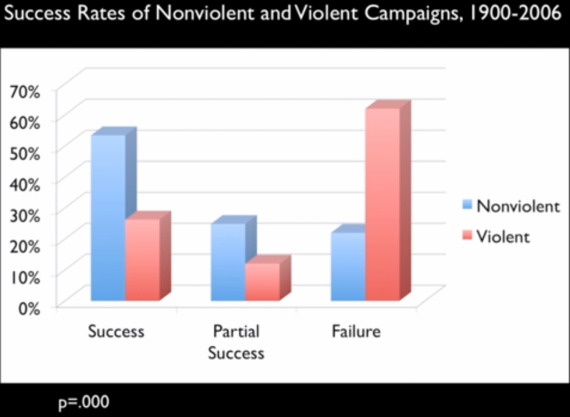
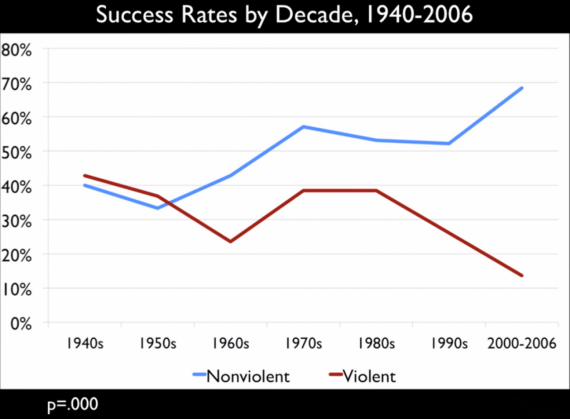
What is most surprising about nonviolent resistance is that where it has been used in human history, it has a better “success” record than does violent resistance (or war).

In one chapter of his book, Engaging the Powers (which is a book every Christian should read), Walter Wink lays out the history of nonviolent resistance and shows how when it is properly used, nonviolent resistance is more successful than war at stopping evil and violence. In fact, in many cases where violence was completely and repeatedly unsuccessful, nonviolent resistance brought about the change that violence had attempted to accomplish, but failed.

In a TED talk a few years ago, political scientist Erica Chenoweth talked about her research comparing nonviolent and violent campaigns, and she said that while she used to believe that violent resistance was more successful than nonviolent resistance, the data she collected blew her away and changed her mind forever. She said, “I collected data on all major nonviolent and violent campaigns for the overthrow of a government or a territorial liberation since 1900,” she says — hundreds of cases. “The data blew me away.” Below are some charts of her research, and you can read more about it here.

nonviolence

nonviolent resistance 2

You can watch her TED talk here:

There is so much to be said about nonviolent resistance, but I’ve said enough for now, and the only real point of this post was to invite you into the conversation I had with Derek. Where was I wrong? Where was he?

What could have (and should have) been clarified? What is your perspective on nonviolent resistance, pacifism, and war?

Leave your comments below!

Affiliate Disclosure: As an Amazon Associate I earn from qualifying purchases. Thank you for supporting my work in this way!

God is Redeeming Life Bible & Theology Topics: forgiveness, Gandhi, Jesus, love, Martin Luther King, Nelson Mandela, nonviolent resistance, pacifism, peace, violence, war

Advertisement

Your Enemy is Your Prophet

By Jeremy Myers
12 Comments

Your Enemy is Your Prophet

In His Sermon on the Mount, Jesus tells us to love our enemies (Matt 5:44).

Since love for enemies is one of the most unnatural things for a human to do, I believe that enemy-love is one of the clearest and most defining characteristics of a true follower of Jesus. Show me someone who truly understands the heart of God, and I will show you someone who loves his or her enemies.

In recent months, I have discovered that one reason we can love our enemies is because they, above all others, might tell us the truth about our actions and behavior.

Normally, we humans tend to gather around us the people who will affirm our beliefs and behavior, and tell us that everything we think, do, and say is correct and loving and godly.

love your enemiesOf course, it is true what Proverbs 27:6 says, that “Wounds from a friend can be trusted, but an enemy multiples kisses,” but this principle can often be reversed as well, in that friends often overlook our faults and failures because they love us (and maybe because they have the same issues), whereas enemies see through our self-righteous attitudes and hypocritical charades and are more willing to criticize and call us out for our many failures.

Yet when they do this, we tend to ignore what they say, because we believe they are only saying such things from spite and anger. And maybe they are.

But might there also be truth to what they are saying? If so, could it be that the criticism from our enemy is actually the voice of God to us?

I am reminded of the prophet Micaiah in 1 Kings 22. King Ahab and King Jehoshaphat were planning on going to war against Ramoth in Gilead. So they call all the prophets together to tell them whether their war will be successful or not. They have a parade of prophets — 400 of them — who tell the two kings to go to war against Ramoth, “for the Lord will deliver it into the hand of the king” (1 Kings 22:6).

King Jehoshaphat finds this a little strange that all 400 prophets say the same thing (or maybe they were not all prophesying in the name of Yahweh), so he asks if there is not a prophet of Yahweh around to ask what they should do (1 Kings 22:7).

And I love what King Ahab says. He tells King Jehoshaphat, “Oh sure… there’s Micaiah. But I hate him because he never tells me anything good.”

In other words, King Ahab viewed Micaiah as his enemy. He hated Micaiah.

Nevertheless, they had Micaiah come in, and initially, he agreed with the other 400 prophets in telling the two kings to go to war, for they would be victorious. But King Ahab knows Micaiah better than this (and I imagine that Micaiah’s tone of voice of flippant and sarcastic), so King Ahab says, “Stop lying to me. Tell the truth!” (1 Kings 22:16).

And Micaiah does. And he is the only one who prophesied correctly.

The King’s enemy was the only one who prophesied truth to the King.

I think the same thing is happening today within Christianity.

We have gathered around ourselves teachers who tell us what our itching ears want to hear, and we ignore and silence the prophetic voices who tell us what we need to hear because these prophetic voices come from those many Christians love to hate.

Our enemy is our prophet, but we ignore what he says because he is our enemy.

Like who?

Who is our prophetic enemy?

How about atheists?

Christians love to hate atheists. We feel we do not have to listen to them, because “They don’t believe in God.” They live “secular” lives. They “live in sin.” They “don’t believe the Bible.”

Atheists are prophets for Christianity.

Atheists often point out real problems with Christian theology, Christian practice, and Christian hypocrisy. They often show us how our portrait of a loving God is not very loving, how a God who accepts everybody really doesn’t, and how the values and priorities of many Christian churches and organizations do nothing to help with the real problems in this world.

In my opinion, we Christians fail to listen to the prophetic word from atheists at our own peril.

How about Muslims? Especially Muslim terrorists.

I watch the angry Muslims on TV calling for the death of America and waving signs about “the Great Satan.”

I believe they are flat-out wrong, but at the same time, I have to ask myself, “Why are they saying these things? What have we done to make them think such things about us?”

It is too “easy” of an answer to say that they are just delusional or that they have been lied to about Americans. Certainly they hear lies about us, just as we hear lies about them. But at the same time, we must listen to the complaints they have about American values, American greed, American morality, and American intervention in foreign affairs and recognize that our Muslim “enemies” might be making some good points.

This is especially true when the Christians in American offer full and complete blessings on everything the United States does overseas, including the killing of Muslims and the bombing of cities. Why is it okay for Christian leaders to call for God to bless us in killing our “Muslim enemies” but it is not okay for Muslim leaders to call for Allah to bless them in killing their Christian enemies?

Whatever happened to Jesus instruction for us to “Do unto others as you would have them do unto you”?

How about the LGBTQ community?

When they tell us that we Christians have treated them with hate and contempt, our response is, “No, we haven’t! We’re just warning you about your sin! It is loving to do so. If you don’t repent and change, God will judge you and our nation!”

Their response is, “See? That right there was hurtful. We think our lifestyle is loving, not sinful. Furthermore, it is not right to blame us for all the ill that happens to our country.”

“Well, you’re trying to put Christians out of business!”

“That’s true. Some people are doing that. Just like you Christians have done to us for hundreds of years. Are you saying it’s wrong?”

“Well, it’s wrong when you do it, but not when we do it, because God is on our side. You’re on the side of the devil.”

“That right there was hateful also.”

And the conversation goes on from there. Or more likely it stops.

But I believe that in these sorts of situations, Christians need to stop and listen to the LGBTQ community and what they say about Christian hatred. In this case, they are prophets, bringing to us a revelation from God.

Listening to Our Enemies is One Way to Love Them

In his excellent book, Engaging the Powers (I HIGHLY recommend it!), Walter Wink talks bout the gift of our enemy. He says that our enemies bring us revelations of ourselves that we cannot get from any other source:

These “revelations” (and they are precisely that) need to be treasured, because that is the gift our enemy may be able to bring us: to see aspects of ourselves that we cannot discover any other way than through our enemies. Our friends seldom tell us these things; they are our friends precisely because they are able to overlook or ignore this part of us. The enemy is thus not merely a hurdle to be leaped on the way to God. The enemy can be the way to God (Engaging the Powers, 273).

Do you have someone you consider to be your enemy? Do you know of a group of people that are considered the “enemies” of Christianity? If so, do not seek to harm, discredit, or ignore them. Instead, listen to what they have to say, for their words may in fact be the very voice of God to you and to me.

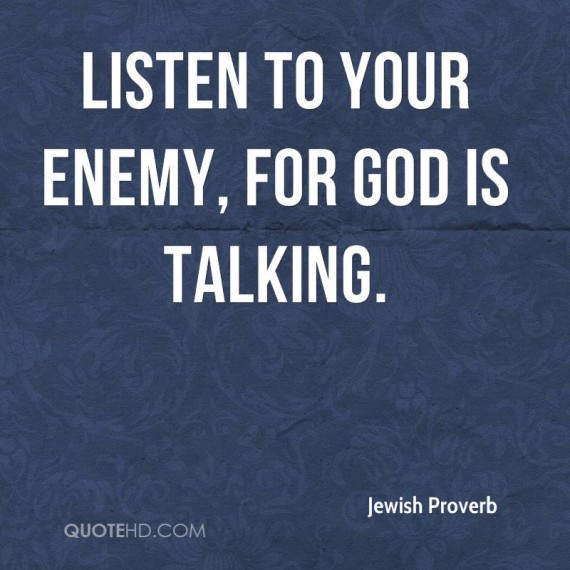
If you want to hear the voice of God, start by listening to your enemies.

listen to your enemy

Affiliate Disclosure: As an Amazon Associate I earn from qualifying purchases. Thank you for supporting my work in this way!

God is Redeeming Life Bible & Theology Topics: 1 Kings 22, love your enemies, loving others, Luke 6:27, Matthew 5:44, prophecy, Proverbs 27:6

Advertisement

Stop Calling Yourself a Christian

By Jeremy Myers
92 Comments

Stop Calling Yourself a Christian

love like JesusI think all of us “Christians” should stop referring to ourselves as “Christians.”
Nor should we ask other people if they are a “Christian.”

I have two lines of reasoning for why we should stop saying we’re Christians.

1. They were first called Christians in Antioch (Acts 11:26)

When the term “Christian” was first invented, it was coined by an outside group of “pagans” who observed the way Jesus-followers behaved and recognized the similarity between what they were doing and what Jesus did. And so they called these Jesus followers “Christians.”

In other words, the first “Christians” did not take this title for themselves; it was given to them.

The term means “little Christ,” and while some scholars think that it was maybe intended to be a derogatory term (sort of like Yankee Doodle), I do not think so. I think the people of Antioch noticed how “Christ-like” the people were who claimed to follow Him, and so they started to referring to this Christ-like followers of Jesus as “Christians.” It was a way to identify them and talk about them.

they will know you are christians by your loveThe Christians of Antioch were not known for their hate, venom, judgmentalism, or religious pride, or even for their good theology, pious life, and vast Bible knowledge. Instead, They were knowing for looking and acting and behaving like Jesus Christ, and as a result, they were “called Christians” by those who were not Christians.
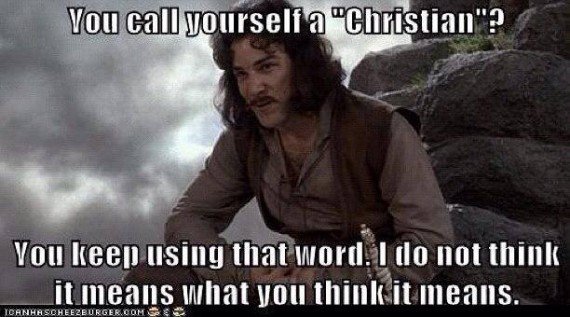

If the watching world started giving titles and nicknames to those who proclaim to follow Jesus today, what sort of titles do you think they would give us?

I am not sure I want to know … but I doubt it would be “Christian.”

But this leads me to the second line of reasoning for why we should stop calling ourselves “Christians.”

you keep calling yourself a Christian

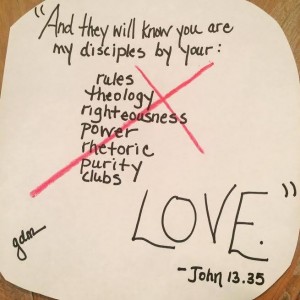
2. They will know you are Christians by your love (John 13:35)

If you truly are a “Christian” you don’t have to tell people. They will know it. How? By your love.

Those who truly act like a “Christian” do not have to tell people they are a “Christian” because people already know it. They know it by your love.

I follow Jesus t-shirtI walked by two guys in the store the other day who were both wearing Christian t-shirts. One was saying to the other, “Yeah, they all hate me at work, but that’s okay, because I’m standing up for Christ.”

Now, I cannot say for sure, but I imagine that since I heard this about five days after the United States Supreme Court ruled in favor of gay marriage, that this man’s idea of “standing up for Christ” consisted of telling his coworkers that LGBT people were headed for hell, were destroying our country, and were signs of the collapse of modern society and traditional marriage.

Some religious people think that “standing up for Christ” in today’s culture means telling others that God hates gays. Just check out some of the comments on my post from two days ago.

Look, I don’t know where you stand on the gay marriage issue. I don’t care. What I do know, however, is that wherever you stand on gay marriage, the proper response to gay people is love.

The same goes for other groups of people some Christians love to hate. Like Muslims. Whatever you may think about the Muslim religion, the proper way to treat a Muslim is with love.

Love is the proper (and only) response to ALL people, no matter what they believe or do, if we are followers of Jesus.

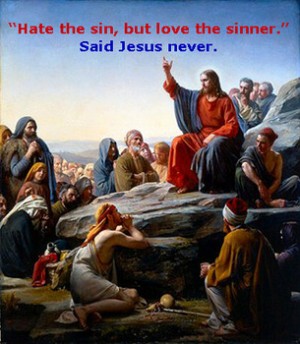
If you want to represent Jesus to people, don’t do it by hating or condemning them. (And don’t use the line about how you “Love the sinner, but hate the sin.”)

Anyway, back to the conversation I heard in the store, I wanted to tell this guy who was proud of his “stand for Christ” that just because people hate you for what you say doesn’t mean that you are standing for Christ.

In fact, in the Gospels, the only people who really hated Jesus were the religious people. Those who were condemned and judged by the religious people loved Jesus and hung out with Him and were accepted by Him.

So if the world hates you but religious people love you, you might not be following Jesus.

Also, if, like this guy in the store, you have to tell people you are a Christian by broadcasting it on your t-shirt, you’re doing it wrong.

If we want to tell people we are followers of Jesus, we do it by loving them. Just as He loves us. Unconditionally. That’s what Godly love is.

I am convinced that the person who loves others unconditionally but doesn’t claim to follow Jesus is closer to the Kingdom of God than those who claim to follow Jesus but doesn’t love others unconditionally.

love is of GodIf love is of God, and everybody who loves is born of God and knows God because God is love (1 John 4:7-8), then it only makes sense that love will be the prevailing characteristic of one who is born of God and know God!


It is not a person’s words that make him or her a Christian, or what they post on Facebook or wear on their t-shirts, or even how many Bible verses they can quote, or how often they attend church and Bible studies, or whether they can “take a stand for Christ.”

They will know we are Christians by our love, and if you have not love, they will never know you are a Christian, no matter how much you tell them you are.

Or maybe I should put it this way: If you have not love, you can never properly act like a Christian, no matter how much you tell people you are one.

The REAL Question We Should be Asking Ourselves (and others)

So the question we should be asking is not “Am I a Christian?” but rather, “Am I Christ-like?”

“Do my words sound like words Jesus might say?”

“Do my actions look like things Jesus might do?”

“Do I love unconditionally, forgive freely, serve sacrificially, and accept all?”

“Do I challenge the religious status-quo for setting up barriers to God and creating groups of us vs. them?”

“Do I break down the walls of religion by eating with the so-called ‘tax-collectors and sinners’?”

If so, then keep living in love and looking like Jesus, and maybe, just maybe, someone might call you a “Christian.”

Affiliate Disclosure: As an Amazon Associate I earn from qualifying purchases. Thank you for supporting my work in this way!

God is Redeeming Church, Redeeming Life Bible & Theology Topics: 1 John 4:7-8, Acts 11:26, Christian, Discipleship, evangelism, hate, John 13:35, looks like Jesus, love, love like Jesus, missions

Advertisement

Stop Saying You “Love the Sinner; Hate the Sin”

By Jeremy Myers
497 Comments

Stop Saying You “Love the Sinner; Hate the Sin”

love the sinner hate the sinIt is common in Christian circles to hear admonitions to “Love the Sinner; hate the sin.”
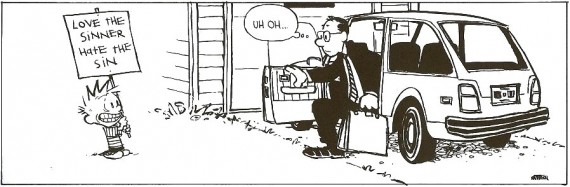
More and more I hear this said in the context of LGBT people and gay marriage.

“Oh, I don’t hate gay people, I just hate the gay lifestyle. … You know, I love the sinner, but hate the sin.”

There are so many things wrong with the “Love the Sinner; Hate the Sin” statement, I hardly know where to begin. So let’s begin with a laugh:

Calvin and Hobbs love the sinner hate the sin

Now… on with the post…

There are several things wrong with the statement, “Love the Sinner; Hate the Sin.”

Let’s begin with the word “sinner”

love the sinner hate the sinThe simple fact that we label the person we are talking about as a “sinner” indicates that we do not have love for them in the first place.

To label someone a “sinner” is to imply that they are outside of God’s grace and unless they clean up their act, cannot be forgiven.

To label someone a “sinner” reveals an “us vs. them” mentality, where you are the “righteous” person looking down your nose at the poor, wretched, ignorant “sinners” down below who just cannot get their act together. If only they would listen to what you tell them to do…

We Christians pay lip service to the idea that “We are all sinners” but we reveal that we do not really believe this when label someone else a “sinner.”

By labeling them a “sinner,” we condemn the sin of someone else as worse than our own.

Then there’s the word “hate”

love vs hateWhen a watching world says Christians are full of hate, it is not a good strategy to tell them that we don’t hate them we just hate their sin.

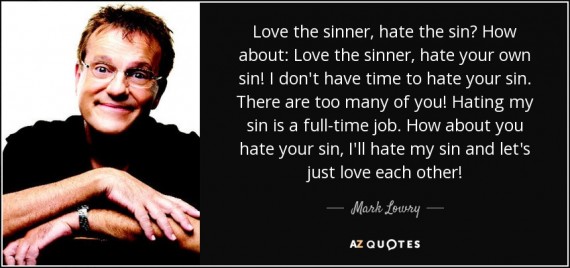
Why do we have to “hate” anything?

Is it because God “hates” sin?

Well, there are some statement like this in the Bible, but such statements require great care in understanding and applying them to life.

We have to understand why God says what He says.

We also have to recognize that even if God does “hate” (which I don’t think He does … at least, not the way we understand it), He doesn’t anywhere tell us to hate.

Furthermore, we have to recognize that when God uses this sort of language about certain sins, it is not because He that upset at the person for committing the sin, or even at the sin itself for being so “terrible.” God isn’t nearly as worked up about sin as we are. God is not in the sin-management business.

The reason God says some strong things about certain sins in the Bible is because these sins hurt us, and He loves us, and doesn’t want to see us hurt by sin.

So if you really, really want to hate someone’s sin, hate a sin which is actually hurtful to them and to others. Hate a sin like rape, murder, incest, child abuse, torture, sex slavery, or one of the other multitudes of damaging and destructive sins.

But why do we Christians sometimes focus on hating the “sins” in others that they say results in love and community? If a homosexual couple wants to get married because they say they love each other, why would we say they cannot?

“Because it destroys families!”

Really? How exactly does their love hurt your family? I suspect any problems in your family might be found a bit closer to home…

“Because it destroys the definition of marriage!”

Is it really? And even if it does, so what? What is more important? The definition of a word or a relationship between people? Don’t use an argument over the definition of a word as an excuse to hate people. That sounds an awful lot like something a Pharisee would do in the days of Jesus. Even if the definition of marriage changes, will that somehow ruin your marriage? I cannot possibly think how.

“Yeah, but … but … AIDS!!! They’re gonna get AIDS and AIDS will hurt them and so I’m just trying to warn them about the dangers of AIDS! You see? I am concerned about them! I don’t want them to get AIDS!”

… If this is how you express your concern, I think they don’t need it.

I could say so much more about this, but I must move on. Here is a post which says more: Love the Sinner, hate the sin is really just hate

love the sinner hate the sin is just hate

There is also a problem with the word “sin”

Yes, yes, “sin” is a biblical word. No, I don’t want people to stop talking about sin.

But here is what I have noticed in my own life, and among the majority of Christians.

We all have our “favorite sins” we commit.

We have sins we ourselves commit all the time that we don’t bat an eyelash at. And when someone point out to us the sin in our own life, we say, “Well, Christians aren’t perfect, you know.” Or maybe we say, “Thank God for grace!” Or possibly, “Yeah, I know that’s an issue, but God is working with me on that.” Occasionally, we may even justify our behavior and says, “What?! No, that’s not a sin! Stop judging me!”

Lots of these “favorite sins” in Christians circles are even “Pulpit approved.” That is, pastors and churches leaders raise up these “sins” as virtues to be acquired.

The sin of pride is called “healthy self-esteem.”

The sin of gluttony is called “Respecting the wife’s cooking.”

The sin of laziness is called “relaxing after work.”

The sin of greed is calling “planning for the future.”

The sin of national idolatry is called “patriotism.”

The sin of hate is called “warning them of the fires of hell.”

The sin of anger is called “standing up for what I believe.”

And so on.

These are our favorite sins, and we have baptized our sins to make them acceptable and even praiseworthy. And even when our sins our not praiseworthy, we allow ourselves excuses which we never allow to anyone else.

mark lawry on love the sin hate the sinner

And then we have our “favorite sins” we like to point out in others.

These sins are ones we typically do not commit, but we use these to make ourselves feel better about our own sin. How? We point them out in others and condemn them and their sin for all the problems in the world and in society.

Ironically, when we point out the “sin” in others, we hardly ever allow them to use the same “excuses” toward us that we use toward others about the sin in our own lives. We tell them that their sin is worse than ours. That their sin is destroying the unity in the church. That their sin is bringing down our country. That their sin is perverting our culture. That they better fix their life right now, or God is going to kill them and punish them and send them to hell to burn forever.

More ironically still, the favorite sin we love to condemn in others the most are usually the sins that are mentioned by Scripture the least, whereas the “favorite sins” we ourselves commit are the sins that get a lot of attention in Scripture.

Take the most popular “sin” in America to condemn right now: homosexuality. It is mentioned 3 times in the Bible (6 times at the most, depending on how you want to understand a few terms).

But how often are greed, pride, slander, gluttony, anger, and hatred mentioned? I don’t know, but it’s probably in the hundreds for each one.

So why have we picked out this one “sin” as the one to focus on?

Because we need a scapegoat to blame for our own sin, and the “other,” the “outsider,” the “one who is not like us,” is always the person who gets chosen to be the scapegoat.

So to bring this back around…

love and hateWhen we say, “Love the sinner; hate the sin,” what we are really saying is “I will love only those I want to love, and I will hate and despise and cast out those people who do things I have decided are worse than the things I myself do, and this way I can make myself feel better while I condemn them for all the problems that I myself have contributed to but don’t want to admit.”
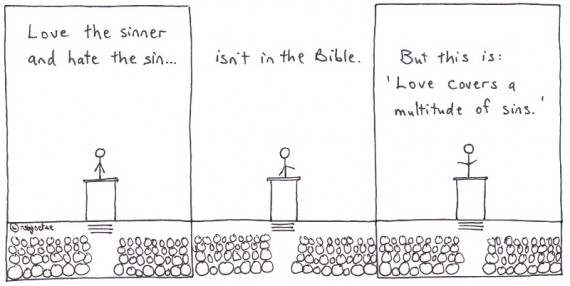

That’s my problem with the word “sin” in that statement. It sets us up in the position of God to decide which sins are worse than others, and which sins can be overlooked and which cannot. It makes us the arbiter or grace and forgiveness.

Which is the worst sin of all? When we say “Love the Sinner; Hate the Sin” we ourselves commit the worse sin possible, by setting ourselves up in the position of God to decide which sin is acceptable and which is not. We Christians must repent of this self-idolatrous, scapegoating judgmentalism of others.

And finally, the entire “Love the Sinner; Hate the Sin” statement is complete BS

If you just take the statement as a whole, it makes no sense.

People are complex creatures, and psychologically and emotionally, it is nearly impossible to separate what a person does from who a person is. This is especially true when a person is the way they are because they were born that way.

Forget homosexuality; take obesity as an example.

Many people who are overweight say that they were born with a slow metabolism, or they have some sort of disorder. Or maybe they went through some difficult times in life that were out of their control and psychologically turned to food for comfort. Or maybe they were just born with tastebuds and a stomach that really liked to eat good food.

Now imagine going up to such a person and saying, “Overeating is a sin. I love you, but I hate your fatness.” How will such a person respond?

I believe that person will be rightly offended.

Here’s the bottom line: If you love someone, you love all of them — even the lifestyle choices that might have resulted from sinful actions and behavior.

This does not mean you have to agree with what they do, but instead, you simply view the things in their life that you don’t agree with the same way you view all the sinful habits and choices you make in your own life.

And how do you want people to view you and your sin? You want to be loved while others withhold judgment.

This also is how you should view others who do things, say things, or live in ways that you think are “sinful.” Just love them, and withhold judgment.

And look, if you really want to start judging some sin somewhere, start with the whole mess in your own life first. Stop pointing out what you think is the sinful behavior in other people, and instead, work on the stuff in your own life.

I think Jesus said something about that… (You know … something about specks in their eye and a log in your own?) And when the Bible does talk about the relationship between love and sin, it says that love covers a multitude of sins. Hmmm…

just love and forgive the sin

The One Word I Like

So when it comes down to it, the only part of the “Love the Sinner; Hate the Sin” statement that I like is the word “love.”

just loveAnd why can’t that be enough? When we see someone else behaving in ways we don’t approve of and which we think is sin (and as long as it’s not illegal or harming someone), why can’t “love” be the only word that comes to our mind?

Apparently, Jesus loved this other person enough to die for them. And if He loved them, why can’t we?

So the next time you are tempted to say you “Love the Sinner; hate the sin,” just stop at love.

Affiliate Disclosure: As an Amazon Associate I earn from qualifying purchases. Thank you for supporting my work in this way!

God is Redeeming Life, Redeeming Theology Bible & Theology Topics: forgiveness, homosexuality, looks like Jesus, love, love like Jesus, Theology of Sin

Advertisement

  • « Previous Page
  • 1
  • …
  • 14
  • 15
  • 16
  • 17
  • 18
  • …
  • 35
  • Next Page »

My New Book is Out!

Get your copy on Amazon today!
Learn about the gospel and how to share it

Take my new course:

The Gospel According to Scripture
Best Books Every Christian Should Read
Study Scripture with me
Subscribe to my Podcast on iTunes
Subscribe to my Podcast on Amazon

Do you like my blog?
Try one of my books:

Click the image below to see what books are available.

Books by Jeremy Myers

My New Book is Out!

Get your copy on Amazon today!

Theological Study Archives

  • Theology – General
  • Theology Introduction
  • Theology of the Bible
  • Theology of God
  • Theology of Man
  • Theology of Sin
  • Theology of Jesus
  • Theology of Salvation
  • Theology of the Holy Spirit
  • Theology of the Church
  • Theology of Angels
  • Theology of the End Times
  • Theology Q&A

Bible Study Archives

  • Bible Studies on Genesis
  • Bible Studies on Esther
  • Bible Studies on Psalms
  • Bible Studies on Jonah
  • Bible Studies on Matthew
  • Bible Studies on Luke
  • Bible Studies on Romans
  • Bible Studies on Ephesians
  • Miscellaneous Bible Studies

Advertise or Donate

  • Advertise on RedeemingGod.com
  • Donate to Jeremy Myers

Search (and you Shall Find)

Get Books by Jeremy Myers

Books by Jeremy Myers

Schedule Jeremy for an interview

Click here to Contact Me!

Follow me on X

© 2026 Redeeming God · All Rights Reserved · Powered by Knownhost and the Genesis Framework