Redeeming God

Liberating you from bad ideas about God

Join the discipleship group
  • Join Us!
  • Scripture
  • Theology
  • My Books
  • About
  • Discipleship
  • Courses
    • What is Hell?
    • Skeleton Church
    • The Gospel According to Scripture
    • The Gospel Dictionary
    • The Re-Justification of God
    • What is Prayer?
    • Adventures in Fishing for Men
    • What are the Spiritual Gifts?
    • How to Study the Bible
    • Courses FAQ
  • Forum
    • Introduce Yourself
    • Old Testament
    • New Testament
    • Theology Questions
    • Life & Ministry

What does it mean to pray in Jesus’ name?

By Jeremy Myers
35 Comments

What does it mean to pray in Jesus’ name?

Jesus says that whatever you ask for in his name will be given to you (John 14:13-14). But what does that mean?

In an attempt to follow Jesus’ instructions, many parents and churches teach (usually by example) that every prayer should conclude with the words “…in Jesus’ name, Amen.” But is this what Jesus meant?

In Jesus name

Sometimes you hear people take this idea to an extreme, and they say, “…in Jesus’ name” over and over throughout their prayer such as this:

Father, we come before you in the name of Jesus, to ask ย you, Father, that you bless our time together, in Jesus’ name. And we bring forward our needs to you, Father, thinking of Ruth and her ingrown toenail, that you would heal it, Father, in Jesus’ name. And we lift up to you the sick cat of Carol. You know, Father, how the cat has been throwing up all night, and how Carol loves the cat which you gave her, and so we ask that you reach down out of heaven and touch her cat in Jesus’ name, Father, and deliver her cat from this malady that is causing the cat and Carol so much problem, in Jesus’ name…

And so on. (And while you might think I am trying to be funny with requests about toenails and sick cats, if you have been in many prayer meetings, you know that these sorts of requests are not uncommon.)

Even when Christians are able to root out of their prayers all the repetitious mentioning of “Father” and “in Jesus’ name,” it is still quite common for most Christians to end their prayers with the word, “… in Jesus’ name, Amen.”

I admit I do this. It is a habit I just cannot break.

in Jesus nameBut why would I want to break it?

Doesn’t Jesus tell us to pray in His name?

Well, yes, He does. But His instruction does not mean that we liberally sprinkle our prayers with the magic words “in Jesus’ name” or that we even close out our prayers with these words.

When we do this, we are treating the words “in Jesus’ name” like they are some sort of magical incantation by which we will get whatever we ask for in prayer. But that is not at all what Jesus meant, and in fact, mindlessly repeating the words “in Jesus’ name” to get what we ask for in prayer is actually the exact opposite of what Jesus meant when He invited us to pray in His name.

What does it mean to pray “in Jesus’ name”?

To pray “in Jesus’ name” means to pray as if Jesus Himself was praying our prayers.

When an ambassador visits another country “in the name of the king” (or president) it is as if his king (or president) is speaking the words that the ambassador speaks. The leaders of these other countries are to assume that whatever the ambassador says, it is as if the king (or president) himself said them.

Obviously then, the ambassador had better be certain that what he says is exactly what the king himself would say. If an ambassador says something foolish or insulting, he could easily start a war or ruin a trade agreement or destroy a treaty. To be a good ambassador, the ambassador needs to know the mind and heart and will of his king so intimately, that the two minds are nearly one.

This is what it means to pray “in Jesus’ name.” They are not magic words to get what you want, but are a mind frame we must adopt when praying to God. We must so intimately know the mind and heart and will of Jesus in whatever situation we are praying about, that the words we speak are the same exact words Jesus would speak if He Himself were the one making the petition to God.

How to Pray in Jesus’ Name

So to expand a bit on what Jesus said in John 14:13-14, I think His words could be paraphrased this way:

But when you pray, spend time thinking about what I value, what I have instructed you, how I lived my life, the kind of example I provided, the people I hung out with, the goals I sought to achieve, the relationship I had with God. Take careful notice of what I taught and what I prayed for. Then, offer your requests to God in light of these things. And when you do, make these requests boldly, knowing that the words you speak are the same words I am speaking. And when you pray this way, know that your prayers will be answered.

in Jesus name amenIf you are not completely confident that what you are praying is what Jesus Himself would pray, this is when it is best to add the little caveat to your prayers of “if it is your will.” This way, in your conversations with God, you can tell Him what is heavy on your heart and weighs on your mind, but you are telling Him that you trust Him to make the best decision since you yourself do not know what is best.

In my opinion, most of the prayers we pray will be of this second sort, where we recognize that our hearts can be deceived and our minds darkened, and so we leave judgment and decision up to God.

To “pray with faith” is not to summon up so much “confidence” that God is somehow “forced” to do what we ask. No, to pray with faith is to offer our requests to God, knowing that He loves us and will do what is best for us, even if this involves not giving us what we have asked for.

So let us stop praying with magical words by which we try to coerce God and manipulate Him to do what we want. Stop using magic words in your prayers.

Instead, let us spend time learning the heart and mind of Jesus so that our prayers can match His prayers, and then, when we pray, pray with the humility of faith, knowing that God will do what is best for us.

Do I need to say ‘Amen’ at the end of my prayers?

Do you want to pray like never before?

Do you what to talk to God like you talk to a friend? Do you want to see more answers to prayer?

If you have these (and other) questions about prayer, let me send you some teaching and instruction about prayer to your email inbox. You will receive one or two per week, absolutely free. Fill out the form below to get started.

Membership-become-a-member

Thanks for visiting this page ... but this page is for Discipleship Group members.

If you are already part of a Faith, Hope, or Love Discipleship Group,
Login here.

If you are part of the free "Grace" Discipleship group, you will need to
Upgrade your Membership to one of the paid groups.

If you are not part of any group, you may learn about the various groups and their benefits here:
Join Us Today.


Membership-become-a-member

Affiliate Disclosure: As an Amazon Associate I earn from qualifying purchases. Thank you for supporting my work in this way!

God is Redeeming Life, Redeeming Theology Bible & Theology Topics: answers to prayer, how to pray, Jesus name, John 14:13-14, prayer, What is prayer

Advertisement

Why the Eagles Cut Tim Tebow

By Jeremy Myers
82 Comments

Why the Eagles Cut Tim Tebow

Tim Tebow EaglesDo you want to know why the Eagles cut Tim Tebow? Or why the Patriots and Jets didn’t keep him on their roster? Or why the Broncos traded him?
It’s not because of his quarterback skills (or lack thereof, depending on who you ask). From a purely statistical perspective, Tim Tebow is better than most 3rd string quarterbacks and many 2nd string quarterbacks in the NFL.

It is also not the media frenzy that follow Tim Tebow wherever he goes, though this is part of it.

The real reason that the Eagles cut Tim Tebow is because Tim Tebow believes that his purpose on a football team is to evangelize his teammates and the coaching staff. Every time he gets a camera in his face, he starts talking about Jesus and giving glory to God for letting him play football.

But NFL Coaches don’t put people on their team to give them a platform to share their religious ideas. Nor do they put people on their team to share their political ideas. Or to sell their branded merchandise.

Imagine what would happen if an NFL football player, every time he got a camera in his face, said, “I’m just glad I get to play this game because it gives me the opportunity to tell you about my line of t-shirts and hats. Go to my store today to buy one!” No NFL coach in the league wants someone like that on their team.

NFL Coaches put players on their teams to win football games.

In the locker room, in team meetings, in coaching meetings, on the field, and in front of the cameras, Tim Tebow was always talking about Jesus and inviting people to believe in Jesus, and on and on and on.

It’s not about Tim Tebow getting more reps in the CFL. If Chip Kelly really believed that all Tim Tebow needed to become an NFL-quality QB was more reps, Kelly could have given that to Tebow in practices. No, that excuse is a smoke-screen. Kelly can’t come out and say he cut Tebow because Tebow spent half his time practicing and the other half proselyting, because the religious right in this country would scream and yell about religious discrimination.

But it’s not religious discrimination. It’s about not doing your job because of your religion. (Like the clerk in Kentucky who won’t issue marriage licenses … If she can’t do her job for religious reasons, that’s fine, but then she needs to quit her job.)

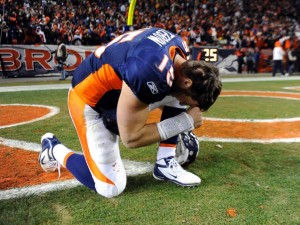
Tim Tebow prayingIf Tim Tebow wants to play in the NFL as a quarterback, here is my recommendation to him: โ€œTim, stop praying after you score a touchdown. Stop putting โ€œJohn 3:16โ€ in your eye black. Stop giving thanks to Jesus whenever you win a game.โ€

I agree with Jake Plummer, who, in 2011, gave Tebow the best advice, but which Tebow never heeded. Jake Plummer said this:

โ€œI wish heโ€™d just shut up after a game and go hug his teammates,โ€ Plummer said, via SportsRadioInterviews.com. โ€œI think that when he accepts the fact that we know that he loves Jesus Christ then I think Iโ€™ll like him a little better. I donโ€™t hate him because of that, I just would rather not have to hear that every time he takes a good snap or makes a good handoff.โ€

I can hear the Christian outrage already.

What? You want Tim Tebow to stop witnessing? You want him to stop thanking God for his successes? Weโ€™re not supposed to be ashamed of the Gospel! With all the murders and wife-beaters in the NFL, itโ€™s nice to have a good Christian role model for a change, and you want him to just shut up about his faith in Jesus?! What kind of heathen heretic are you, anyway?

Yes, well, hear me out.

I am thrilled that Tim Tebow is outspoken about his faith. Notice that I never said anything about him hiding the fact that heโ€™s an evangelical Christian.

But Tim Tebow is making a basic mistake about witnessing, which is the same mistake a lot of Christians make.

Lots of Christians think that if they gain some sort of prominence in the public sphere, this means that they are responsible for using their position or their prominence as a platform to witness to other people.

Nothing could be further from the truth.

If a Christian becomes the CEO of a large corporation, God has not put him or her in that position so that they can witness to all the employees of the corporation, shout โ€œPraise Jesus!โ€ whenever they land a big account, or open up all their board meetings with prayer. God does not raise up Christians to places of prominence so they can cram Christianity down other people’s throats.

No, the person in a position of power or prominence is there so they can be the best CEO possible. They may include (but is not limited to) providing good wages and fair treatment to employees, and operating the business with honesty, transparency, and generosity. It means running the business in an ethical way, with creativity and imagination.

I hate it when well-meaning Christians tell powerful, prominent, rich Christians that โ€œGod raised you up for such a time as this.โ€ Then they are told that God raised them up so they can hand out gospel tracts to their employees, or take a stand for โ€œbiblical marriage,โ€ or some such nonsense.

I hear such things, I just want to barf.

If God raised someone up to be a CEO (which is debatable), then it was not to hand out gospel tracts or take a stand for โ€œbiblical marriage,โ€ but is for the purpose of being the best CEO they can possibly be. If God really raised a person up to be a CEO of a company, it would be for the purpose of showing the world how a business can successfully be run according to the principles and values of the Kingdom of God rather than the principles of the rulers of this world. Same goes for politics, music, art, and sports.

This brings us back to Tim Tebow.

Tim Tebow John 3:16If God truly raised up Tim Tebow to be an NFL quarterback (which is debatable), then it was not so that Tim could announce his Christian faith by praying in the End Zone and praising Jesus at press conferences. No, God raised up Tim Tebow to be a quarterback so that he can be the best quarterback Tim Tebow can be. Period.
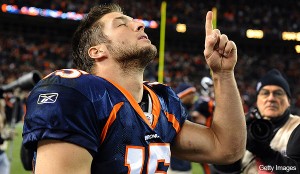
If Tim Tebow wants to be a quarterback in the NFL, he needs to be an NFL quarterback; not a missionary quarterback. Not a prophet quarterback. Not a โ€œGodโ€™s spokesmanโ€ quarterback. Just a quarterback. He needs to work hard, throw the ball, and run the ball. And he must do it all with honesty, integrity, and a good work ethic both on and off the field.

Someone needs to tell Tim Tebow that the NFL stage is not for proclaiming the Gospel but for playing football.

If you still disagree with me, let me make one more point.

When Tim Tebow played for the Denver Broncos and knelt to give thanks to God every time he scored, what exactly was the message he was proclaiming to all who watched him? I think Tim Tebow thought he was showing everybody that he was thankful to God.

But thankful for what?

For letting Tim play football in the NFL?

If that is the case, what about all the other Christian quarterbacks who also wanted to play in the NFL but never had the chance? Does God love Tim Tebow more? Does God hear his prayers more? Is Tim Tebow more faithful than those other quarterbacks?

Or maybe the prayers of Tim Tebow were his way of giving thanks to God for scoring a touchdown?

But again, if this is the case, what does this tell the Christian players on the opposing teamโ€™s defense? Does Tim think that God heard his own prayers and ignored those of the Christians on the defense? If Tim threw an interception, would he like it if the opposing team knelt down to thank God for Timโ€™s bad pass?

Tim Tebow and GodHereโ€™s the point: Whatever Tim Tebowโ€™s motives might be (and I think they are pure), his prayers on the field tell the world that God hears and answers the prayers of some people more than those of others. This further implies that everybody who doesnโ€™t seem to have the success, money, or fame that Tim Tebow has, must have less faith than Tim, or maybe God just doesnโ€™t love them as much as He apparently loves Tim.

I really, really doubt that this is the message Tim wants to send when he kneels to pray in the end zone.

Which is why I encourage Tim to stop praying on the football field.

And the โ€œJohn 3:16โ€ on his eye lids needs to go as well, for the same reasons. If he wants to invite people to believe in Jesus for eternal life, let him do it in one of his numerous speaking engagements, or in personal conversations with friends off the field. But when heโ€™s on the field, this is not the time to share the gospel, but to live the gospel by being the most hard-working, honest, ethical, cheerful, and dependable quarterback he can possibly be.

And this will be a good example to the rest of us about how to be a Christian in this world. I am not a good Christian if I refuse to do my work because I have to pray for 15 minutes out of every hour โ€œin order to show my coworkers how good of a Christian I am.โ€ I am not a good Christian if I refuse to work with certain coworkers because they have a lifestyle I disapprove of. I am not a good Christian if I show up late for work because โ€œmy morning devotions went too long.โ€

Look, we Christians are not good Christian witnesses when we stop doing the things we should be doing because we want to โ€œbe a witness.โ€ No, we are good Christian witnesses when we work hard at being the best we can be in whatever job or position we find ourselves.

Christian witnessing is not accomplished by trying to be a witness.

Christian witnessing is accomplished by living life the best we can and loving others in the process as much as we are able. When we do this, we naturally become a witness to how a life looks that is transformed by God.

So if Tim Tebow truly want to follow his lifelong dream of being an NFL quarterback, I suggest he lose the Christian circus. This begins with letting his passing, not his praying, do the talking.

Affiliate Disclosure: As an Amazon Associate I earn from qualifying purchases. Thank you for supporting my work in this way!

God is Redeeming Life Bible & Theology Topics: Discipleship, evangelism, prayer, witnessing

Advertisement

Which Religion Cares Most about the Homeless?

By Jeremy Myers
19 Comments

Which Religion Cares Most about the Homeless?

This guy is a genius…

religion homeless

Affiliate Disclosure: As an Amazon Associate I earn from qualifying purchases. Thank you for supporting my work in this way!

God is Redeeming Life Bible & Theology Topics: homeless, humor, laugh a little, religion

Advertisement

Two Men in one Bed (Luke 17:34)

By Jeremy Myers
154 Comments

Two Men in one Bed (Luke 17:34)
Note: This post is part of the July 2015 Synchroblog.

In the past, I have taught that Jesus never mentioned homosexuality.

But a few weeks ago, after the Supreme Court of the United Stated ruled that gay couples could get legally married, a guy came up to me and said, “This ruling is a sign of the end of the world! Jesus prophesied in Luke 17:34 that when the rapture happens, there will be two men in a bed!”

I went on to show him that in the Greek, the word “men” is not actually there, so all it really says is “There will be two in one bed …”

And besides, there is some question about whether Luke 17 is even referring to the rapture.

Jesus teaching Luke 17:34But even if the text is referring to a gay couple in bed, and even if the text does teach about the rapture, I pointed out to him that one of the men was taken in the rapture, which means that apparently, God accepted him.

He apparently hadn’t though about this … and so started back-peddling a bit from this text.

But I decided to look into Luke 17:34 a bit more deeply.

Is it just two people in a bed?

As I pointed out to the end-of-the-world alarmist, the word “men” is not in Luke 17:34. The text literally reads:

In that night there will be two in one bed; one will be taken and the other left.

But then I noticed that in the context, our English translations go on in Luke 17:35 to record Jesus talking about two women grinding at the mill. I looked briefly at the Greek here as well, and noticed that the word “women” was not in Luke 17:35, just as the word “men” was not in Luke 17:34. Note that the word “mill” is not in the text either. Luke 17:35 literally says this:

Two will be grinding together; one will be taken and the other left.

So I asked myself, “What am I missing? Why do many English translators supply the word “men” in Luke 17:34 and “women” in Luke 17:35 when neither word is there? So I looked at the verses a little more carefully, and noticed that other words in Luke 17:34-35 revealed the gender of the people in question.

When Luke 17:34 says, “one will be taken and the other left,” the words “one” and “other” are both masculine. By itself, this might not mean that the two people were men, for Greek (as in most languages) can use male words and pronouns to refer generically to “people” whether they are male or female.

But Luke 17:35 is much more clear. When this verse says, “one will be taken and the other left,” the words “one” and “other” are both feminine. A feminine pronouns are only used of women.

So when you compare Luke 17:34 and Luke 17:35, and Luke 17:35 is clearly referring to two women, then it seems pretty clear that Luke 17:34 is referring to two women. The burden of proof lies on those who want to say that Luke 17:35 refers to women while Luke 17:34 refers generically to “people.”

But so what?

Just because two men are in one bed, this doesn’t mean they’re gay.

This is very true.

While rare, it is not completely unheard of for two straight men to share one bed today. They might share a bed for warmth, or for protection, or simply because there is a lack of bed space.

This is especially true of men in ancient Middle-Eastern cultures. Unlike most modern Western males, I read in various sources that men of the Ancient Near East didn’t feel “weirded out” by sharing a bed with another man.

But then I started studying the context further.

One source that really provided some background details for my study was a series of blog posts by Ron Goetz on gays and lesbians in Luke. What follows below is a brief summary of his arguments.

NOTE: I am not saying I agree with Ron Goetz. All I am doing is summarizing his research. I would like your opinion on what he argues, and would like your thoughts about whether or not Jesus does, in fact, mention homosexual couples in Luke 17:34-35, and what this means (if anything) for the debate today about Same-Sex Marriage.

Gay Sex in Luke 17:34-35

Below is a small sampling of what Ron Goetz argues regarding two same-sex couples in Luke 17. Before you criticize what he says, I strongly urge you to go read through his entire series of posts, as it is likely that he has already responded to your question or criticism.

The summary/extended quote from Ron Goetz begins below…

I tell you, in that night,
there shall be two men in one bed;
the one shall be taken, and the other shall be left.
Two women shall be grinding together;
the one shall be taken, and the other left.
(Luke 17:34-35, KJV)

The Context of Sodom

Sodom and GomorrahImmediately before the mention of two men in one bed is a lengthy discussion of the destruction of Sodom. Now I donโ€™t believe the sin of Sodom was homosexuality. But there are many today who believe that it was, and I think most of the Jewish believers in Lukeโ€™s audience may have believed it as well.

Jesus knew that by recounting key details of Sodomโ€™s destruction, his audience would have man-on-man sex on its mind. Jesus intended for us to understand that the โ€œtwo men in one bedโ€ were gay.

One key practice for interpreting a passage in the Greek scriptures is to look for its antecedents in the Old Testament.

Iโ€™ve only found two Old Testament references to two men laying together.

“Thou shalt not lie with a man, as with a woman: it is abomination” (Leviticus 18:22).

“If a man lie with a man, as he lieth with a woman, both of them have committed an abomination: they shall surely be put to death; their blood shall be upon them” (Leviticus 20:13).

By clearly alluding to the Levitical prohibitions against male homosexuality, followed immediately with his declaration that โ€œone shall be taken, and the other left,โ€ Jesus declared his own acceptance of gays and lesbians, and that gays and lesbians are not automatically rejected by God.

Whether or not you believe in this final separation, or whether or not you believe the Bible, doesnโ€™t matter with regard to the significance of the passage. What is important is that Luke 17:34-35 teaches that sexually active gays and lesbians are not automatically consigned to perdition.

Two Women Grinding Together

In the Hebrew Bible, โ€œgrindโ€ is used as an acceptable euphemism for sexual intercourse in at least four places: Job 31:10, Judges 16:21, Isaiah 47:2-3, and Lamentations 5:13.

[Yet] It seems shocking that Jesus would use what sounds to us today like gutter language when referring to lesbian love-making. The idea of Jesus uttering the words โ€œwomen grinding togetherโ€ can be very uncomfortable. It certainly was for me. Even though the Old Testament evidence confirmed my hypothesis, it was difficult for me to hear that language coming from the mouth of Christ.

But when you remember that there is earthy language throughout the Bible, in both testaments, we get an understanding that the churchโ€™s demand for regal, solemn, respectable language is not a Biblical demand. Our personal and cultural expectations are not necessarily in sync with the scriptures. What sounds like earthy language today were, generally speaking, acceptable Biblical euphemisms.

Solomonโ€™s love poem, the Song of Songs, is well known for its graphic descriptions of romantic love. First century Israel did not have the clinical, scientific nomenclature for sexual matters that we have today, but they did have acceptable ways to discuss these things among adults.

No, Jesus Christ was not using gutter language when he mentions โ€œtwo women grinding together.โ€ The Old Testament books of Job, Judges, and Lamentations contain the Biblical use of the metaphorical grind. Jesus used the ordinary, acceptable language of his day to refer to lesbian love-making.

[But it is not just a couple of Old Testament texts that use “grind” in this way.]

In Latin, the word โ€œgrind,โ€ and the related word โ€œmill,โ€ are both euphemisms for things sexual. The Roman poet Horace (65 to 8 BCE) used โ€œgrindโ€ in his endorsement of brothels. Writing in Latin just decades before the birth of Christ, [one author] says that

Once, when a noble left a brothel, โ€œBlessed be thou for thy virtue!โ€ quoth the wisdom of Cato: โ€œfor when their veins are swelling with gross lust, young men should drop in there, rather than grind some husbandโ€™s private mill.โ€

His use of both โ€œgrindโ€ and โ€œmillโ€ shows that even the presence of the word โ€œmillโ€ does not eliminate the possibility of sexual meanings in the word โ€œgrind.โ€ Horaceโ€™s usage is very significant because it is proof of the use of โ€œgrindโ€ as a euphemism for sexual intercourse in the Roman empire just a few decades before the birth of Christ.

[Such euphemisms are also found in Greek.]

Sapphos from LesbosPlutarch (ca A.D. 45 to 120) was born in Greece near Delphi, and was a contemporary of Luke. One of Plutarchโ€™s s, โ€œThe Banquet of Seven Wise Men,โ€ is a fictional conversation among some famous men who lived around 650 BCE. After a brief lull in the conversation, Thales of Miletus speaks:
This remark arrested the attention of the whole company, and Thales said jestinglyโ€ฆ. โ€œwhen I was at Lesbos, I heard my landlady, as she was very busy at her handmill, singing as she used to go at her work:

Grind, mill, grind;
For even Pittacus grinds,
King of great Mytilene.

Plutarch records โ€œgrindโ€ used as a sexual metaphor in the last quarter of the first century A.D., overlapping the probable years when Luke was composed.

The sexual meanings of โ€œgrindโ€ and โ€œmillโ€ were common in Greek society when Luke being composed, and could have been in common usage for as long as 700 years prior to that. There is no room for quibbling over whether or not โ€œgrindโ€ and โ€œmillโ€ were used sexually in the Greek language of the first century, and that this layer of meaning was familiar to literate Greeks.

The Lightning and the Eagle

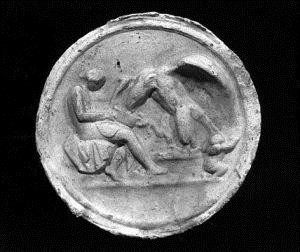
Zeus and GanymedeA major piece of evidence supporting the thesis of a deliberate gay theme in Lukeโ€™s Small Apocalypse (which I call โ€œLukeโ€™s Gay Apocalypseโ€) is found in the two primary symbols of Zeus, the supreme god in Roman religion. The symbols of Zeus are the lightning bolt and the eagle, and they appear in Luke 17:24, 37.

I subsequently investigated the Luke 17 passage specifically as the โ€œQ Apocalypse,โ€ and was blessed to find a terrific resource, โ€œWhere the Eagles are Gatheredโ€: The Deliverance of the Elect in Lukan Eschatology, by Steven L. Bridge (2003), who connects the lightning and the eagles with Zeus and Ganymede.

The lightning bolt was Zeusโ€™ powerful weapon, and the eagle was sent to retrieve the bolts after Zeus had thrown them. One of the most popular and enduring stories involving the eagle describes the Abduction of Ganymede. According to the story, the King of Troy had a beautiful son named Ganymede, and Zeus found Ganymede irresistibly attractive.

Zeus and GanymedeAccording to the story, the attractive young Ganymede is abducted by an eagle, who in one version is Zeus himself, having transformed himself into an eagle. While the story had several uses (as a paradigm for imperialism and an allegory for Truth), in the Roman era the sexual nature of Ganymedeโ€™s relationship with Zeus was widely recognized.

Zeus had numerous liaisons with mortal women, but only one same-sex relationship, and the eagle is vividly associated with his romantic relationship with Ganymede. Just as the donkey reminds Christians of the Nativity and the Triumphal Entry, so also the eagle reminded Romans and Roman subjects of Zeusโ€™ sexual relationship with his cup bearer and servant, Ganymede. The story of Zeus and Ganymede adds a layer of sexual meaning and interest to the eagleโ€™s image which is missing from its common use as a symbol of power.

Zeus and Ganymede What we have here are the two chief symbols of Zeus, lightning and eagles, one of which is vividly associated with Zeusโ€™ same-sex relationship with Ganymede, located at the beginning and end of a discrete unit of the third gospel, Lukeโ€™s Small Apocalypse. That distance between the verses may seem great, and this distance has obscured their historical and cultural connection. But these were the symbols of Zeus. If we were to read a paragraph that opened with a mention of a โ€œcrown of thornsโ€ and ended with a โ€œcross,โ€ no one would doubt that the crucifixion was a central element in that paragraph.

Anywhere in the Roman Empire, someone reading Luke 17:20-37 would immediately recognize Zeus and Ganymede in Luke 17:24, 37.

So are Gay People Accepted by God or not?

The upshot of all this? Once we recognize the common thread running through the major elements of the passageโ€“Zeus and Ganymede, Sodom, and the gay and lesbian couplesโ€“the entire passage coheres as a unified whole. Not only do the major elements of the passage become related in a single theme, but several unresolved interpretive questions fall into place as well.

The general topic or theme of the passage is indeed judgment, but the examples Jesus uses to illustrate the enactment of judgment donโ€™t tell us what is worthy of judgment, but what is not worthy of judgment.

And this is one very accurate way of describing the purpose of the passage. Weโ€™ve never quite known what the basis of acceptability was for the favored members of these pairs. We have surmised that they have an unspoken relationship with God, that they have faith, that they have remained awake and watchful and kept their lamps trimmed, but the passage has forced us to guess what the difference is between those who are taken and those who are left.

That puzzled guessing is understandable, because the point of the passage never has been to tell us the difference between who is acceptable to God and who is unacceptable. The point has been to tell us that homosexuality is not a factor in a personโ€™s acceptability to God.

Peopleโ€™s sexual orientation is not among the criteria for whether theyโ€™re in or whether theyโ€™re out.

Lukeโ€™s Gay Apocalypse, with the romantically involved gays and lesbians and the gathering of the Eagles around the Body of Christ, tells both Jews and Roman gentiles the โ€œmoral of the story.โ€ It is this:

  • Non-Celibate Gays and Lesbians are not Rejected by God.
  • Homosexuality is Not a Criterion of Acceptability for God.
  • Lesbians and Gays are Present in the Final Eschatological Gathering of Godโ€™s Elect.

Just because the word โ€œhomosexualโ€ doesnโ€™t appear in the gospels doesnโ€™t mean Jesus didnโ€™t talk about it. He did talk about homosexuality, using concrete terms similar to those in the Hebrew scriptures.

I tell you, in that night,
there shall be two men in one bed;
the one shall be taken, and the other shall be left.
Two women shall be grinding together;
the one shall be taken, and the other left.
(Luke 17:34-35, KJV)

Jesus discussed homosexuals in precisely the way we would expect him to, not in abstract terms, but using concrete examples.

The post above was part of the 2015 Sychroblog on Gay Marriage. Below are posts from other bloggers who also contributed. Go read them all to see what they have to say!

  • Justin Steckbauer โ€“ Gay Marriage, LGBTQ Issues, and the Christian Worldview
  • Leah Sophia โ€“ Marriage Equality Again
  • Tony Ijeh โ€“ Thoughts on Gay Marriage
  • Tim Nichols โ€“ Imago Dei: Loving the Different
  • Carlos Shelton โ€“ About Gay Marriage
  • Wesley Rostoll โ€“ Some Things to Consider Regarding Gay Marriage
  • K. W. Leslie โ€“ Same-sex Marriage
  • Paul W. Meier โ€“ Gay Marriage: Love is the Narrow Gate
  • Tara โ€“ Justice for All
  • Michelle Torigian โ€“ Marriage Equality: The Constantly Expanding Love of God
  • Lifewalk Blog โ€“ Here I am
  • Mary โ€“ A Recovering Evangelical Writes about Homosexuality
  • Liz โ€“ Same Sex Marriage Stuff: Part 1
  • Loveday โ€“ Gay Marriage in Africa, USA, and the World
  • Jea7587 โ€“ Loving Your Gay Neighbor, Part 2
  • D. L. Webster โ€“ Questions of Interacting with Differing Beliefs

Affiliate Disclosure: As an Amazon Associate I earn from qualifying purchases. Thank you for supporting my work in this way!

God is Redeeming Life, Redeeming Scripture Bible & Theology Topics: Bible Study, gay marriage, homosexual, homosexuality, Jesus, lgbt, Luke 17:34-35

Advertisement

Do you have Paper theology or People theology?

By Jeremy Myers
11 Comments

Do you have Paper theology or People theology?

Do you have a paper theology or a people theology?

I used to have a paper theology.

In many ways, I suppose I still do.

study theology

A paper theology is when we have the “right” answers to tough theological questions and issues, but we don’t really know any people that are affected by our “right” answer.

In other words, paper theology is when we approach Scripture and theology from an “ivory tower” perspective. We study for the sake of studying and finding answers, but none of our answers have any real connection to life.

Paper theology is a theology that comes from studying books.

There is nothing exactly wrong with a paper theology. It is just that since paper theology never takes people into consideration, paper theology is often wrong when applied to real life. Paper theology may be right on paper, but wrong in life.

That’s because life requires people theology.

I am working on my people theology

If paper theology comes from studying books, people theology comes from being with people.

It requires coming down out of the ivory tower, leaving the quiet study, closing the dusty books, and entering into the real lives of real people who have real problems. When you do this, you quickly discover that the neat and tidy answers from your paper theology rarely applies or helps anyone in real life.

More often than not, when you get involved in the lives of people, you will find that your paper theology begins to get a bit muddled. Lines start getting erased. Clear-cut answers start to get smudged a bit.

Being with people changes your paper theology.

If you try to hold on to your paper theology when hanging around with people, it will not be long before people stop hanging around you.

The theology that looks good on paper rarely looks good when applied to people.

Jesus had People Theology

One of the biggest battles Jesus faced during His earthly minister was with the religious people of His day. While those who were labeled as “sinners” by the religious people loved to hang out with Jesus, those who were religious often found themselves at odds with Jesus.

Why?

Because the people theology of Jesus clashed with the paper theology of the religious.

Almost every single encounter Jesus had with the religious people was because they had theologically “correct” answers to pressing cultural and religious issues, but which Jesus soundly rejected in favor of loving and helping people.

The religious people had laws (easily defended from Scripture) about not working on the Sabbath. Jesus let his disciples break these laws because they were hungry (Luke 6:1-5).

The religious people had laws (easily defended from Scripture) about who could and could not be helped on the Sabbath. It was even a nice three-point answer! But Jesus ignored their neat and tidy theological answer so He could help a person get his hand back (Luke 6:6-11).

The religious people had laws (easily defended from Scripture) about stoning those caught in adultery. But when they brought an adulterous woman to Jesus, He forgave her and let her go.

We could give example after example after example.

But here’s the point: Jesus knew that the point of theology was to help us love people better.

If our theology causes us to bind heavy burdens on people’s backs, while creating rules, restrictions, and regulations for how to live life with God and others, and we stifle people’s joy, censor their love, and chide them for their grace, it is no wonder that people reject us and our theology, and maybe the God we claim to follow as well.

people theology

But let us follow the example of Jesus in developing our theology surrounded by people.

If our theology is really “true” it will lead us to look like Jesus and love like Jesus. True theology will be a theology built not on a love for paper, but on a love for people.

What does this mean for our theology?

It means that while we can develop and build our theology by reading and studying, nothing should be really set in stone until we put this theology into practice in the lives of people around us.

Do you believe God is angry about sin? Take a look at what this sort of idea does psychologically, emotionally, and spiritually to those in your life who know they are sinners. Does it lead them toward God, or away from Him? Does it lead toward honesty and openness about our failures, or does it cause us to hide and lie about our mistakes?

Do you believe that LGBTQ people are sex-crazed perverts being used by the devil to lead our country to hell? Well, first, good luck trying to prove this from Scripture, but second, how about you go out and become friends with someone who is gay? Of course, you better not tell them your theology, or you will never become friends. But if you truly become friends, you might discover that your “theology” about LGBTQ people changes. Here are some accounts of people who had this very thing happen to them:

  • A pastor who changed his thinking about homosexuality
  • 3 Mistakes about the Homosexual conversations and how we can correct these

Do you believe that Muslims are all violent extremists who want to chop your head off? Again, good luck trying to prove this from Scripture, but before you go spouting off about this idea to others, maybe you should go out and become good friends with some Muslims. Not to convert them or “win them to Christ,” but just to be friends with them. I think that if you do, your paper theology about Muslims might change.

We could on and on about various other theological and practical issues, but the end of the matter is this: If you get to know people as part of developing your theology, these people will change your theology more than your theology will change people. And that’s a good thing.

Affiliate Disclosure: As an Amazon Associate I earn from qualifying purchases. Thank you for supporting my work in this way!

God is Redeeming Life, Redeeming Theology Bible & Theology Topics: life, love others, people, relationships, theology

Advertisement

  • « Previous Page
  • 1
  • …
  • 13
  • 14
  • 15
  • 16
  • 17
  • …
  • 35
  • Next Page »

My New Book is Out!

Get your copy on Amazon today!
Learn about the gospel and how to share it

Take my new course:

The Gospel According to Scripture
Best Books Every Christian Should Read
Study Scripture with me
Subscribe to my Podcast on iTunes
Subscribe to my Podcast on Amazon

Do you like my blog?
Try one of my books:

Click the image below to see what books are available.

Books by Jeremy Myers

My New Book is Out!

Get your copy on Amazon today!

Theological Study Archives

  • Theology – General
  • Theology Introduction
  • Theology of the Bible
  • Theology of God
  • Theology of Man
  • Theology of Sin
  • Theology of Jesus
  • Theology of Salvation
  • Theology of the Holy Spirit
  • Theology of the Church
  • Theology of Angels
  • Theology of the End Times
  • Theology Q&A

Bible Study Archives

  • Bible Studies on Genesis
  • Bible Studies on Esther
  • Bible Studies on Psalms
  • Bible Studies on Jonah
  • Bible Studies on Matthew
  • Bible Studies on Luke
  • Bible Studies on Romans
  • Bible Studies on Ephesians
  • Miscellaneous Bible Studies

Advertise or Donate

  • Advertise on RedeemingGod.com
  • Donate to Jeremy Myers

Search (and you Shall Find)

Get Books by Jeremy Myers

Books by Jeremy Myers

Schedule Jeremy for an interview

Click here to Contact Me!

Follow me on X

© 2026 Redeeming God · All Rights Reserved · Powered by Knownhost and the Genesis Framework