Redeeming God

Liberating you from bad ideas about God

Join the discipleship group
  • Join Us!
  • Scripture
  • Theology
  • My Books
  • About
  • Discipleship
  • Courses
    • What is Hell?
    • Skeleton Church
    • The Gospel According to Scripture
    • The Gospel Dictionary
    • The Re-Justification of God
    • What is Prayer?
    • Adventures in Fishing for Men
    • What are the Spiritual Gifts?
    • How to Study the Bible
    • Courses FAQ
  • Forum
    • Introduce Yourself
    • Old Testament
    • New Testament
    • Theology Questions
    • Life & Ministry

No, the blood of Jesus did not buy forgiveness of sins from God (Matthew 26:28)

By Jeremy Myers
37 Comments

No, the blood of Jesus did not buy forgiveness of sins from God (Matthew 26:28)
http://media.blubrry.com/one_verse/feeds.soundcloud.com/stream/421529790-redeeminggod-112-did-jesus-shed-his-blood-to-purchase-forgiveness-of-sins-from-god-matthew-2628.mp3

In Matthew 26:28, Jesus says, โ€œFor this is My blood of the new covenant, which is shed for many for the remission of sins.โ€ Does this mean that the blood of Jesus had to be shed so that He could buy forgiveness of sins for us from God?

Let’s see … what is the best way to answer this question? … Let me try this:

NO!

Ha!

blood of Jesus ChristBut I bet you want a better explanation …

I know that there are several verses in the Bible that some use to argue for the idea that Jesus had to shed His blood to purchase forgiveness of sins from God, but when carefully studied in their contexts, none of these Bible passages are teaching this idea.

God has always forgiven all people of all their sins simply because this is who God is. He did not need to be paid off or bought before He could forgive us. (That wouldn’t be forgiveness anyway…. you can either forgive a debt or be repaid, but not both.)

Matthew 26:28 is one of the passages that sometimes is quoted in defense of this idea that Jesus paid for our sins with His blood.

During the Last Supper on the night before His arrest, trial, and crucifixion, Jesus shared the Passover Meal with His disciples and imbued new symbolism into the bread and wine.

He said that the bread represented His body broken for them and the wine represented His blood shed for them. He then said that these things point to the new covenant in His blood, which is for the forgiveness of sins.

Some seem to assume through this description of events that Jesus was teaching His disciples that His blood would purchase the New Covenant and the forgiveness of sins from God.

But there are two keys which provide a better understanding of this text. A careful look at the context and what the rest of the New Testament teaches about the New Covenant and forgiveness reveals something different.

Let us briefly consider both concepts and how they relate to Matthew 26:28.

Matthew 26:28 and the New Covenant

Jesus was not teaching that His blood was the purchase price for forgiveness and the New Covenant, but that His blood was the sign of such things.
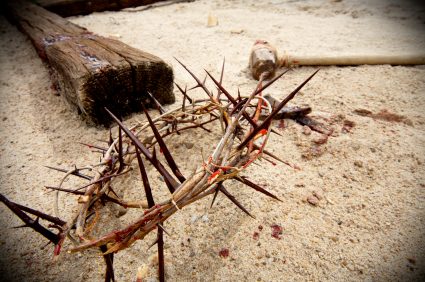
crucifixion of JesusIn reference the New Covenant, the blood of Jesus signaled that this New Covenant was now in effect. In essence, Jesus died to inaugurate or enact the New Covenant.

It is important to think of the New Covenant, not as a new system of laws and regulations to keep, but instead as a Last Will & Testament. And indeed, the term Jesus uses here does have this idea in view. Jesus is not sharing a new legal Contract, but new legal Will.

When we think of the Covenant as a โ€œLast Will & Testamentโ€ rather than as a legal contract (as the Greek words used seem to indicate), it becomes clear that a Last Will & Testament is not put into effect as long as the one who made it still lives (cf. Hebrews 9:15-17).

For a Last Will & Testament to be enacted, the one who made it must die. Yet since this is Godโ€™s Last Will & Testament, and since God cannot die, it was impossible for the Will to come into effect unless God became human and died as a human, which is what He did in Jesus Christ.

So when Jesus speaks of His blood representing the New Covenant, He is pointing out the fact that the New Covenant which had been promised through the Old Testament prophets (cf. Jeremiah 31:31-34) would now be put into effect because the one who made this Last Will & Testament was now here and was about to die.

All of this is explained in more detail in Hebrews 9โ€“10.

So when we understand that Jesus is talking a Last Will instead of a legal contract in Matthew 26:28, we then understand that the blood of Jesus was for the purpose of enacting the legal terms of this new Last Will & Testament. The death of Jesus was not needed to buy forgiveness, but to enact a new Will.

But what about the statement in Matthew 26:28 about the forgiveness of sins? Doesn’t that prove that Jesus did, in fact, die to purchase forgiveness of sins from God?

Matthew 26:28 and the Forgiveness of Sins

When it comes to the forgiveness that Jesus mentions in Matthew 26:28, it is critical to recognize that there are two types of forgiveness in the Bible.
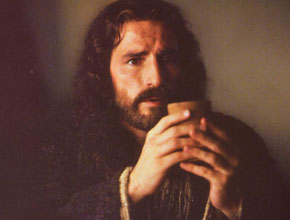
cup of new covenantThere isย charizomai forgivenessย andย aphฤ“sis forgiveness. Charizomai forgiveness is based on the free grace (charis) of God and is freely extended to all people throughout all time for all sins, with no strings or conditions attached.

Aphฤ“sis forgiveness, however, does have conditions, such as repentance and turning from sin. But aphฤ“sis forgiveness has nothing to with our standing with God or what He thinks about us. Aphฤ“sis forgiveness is not about our relationship with God.

Instead, aphฤ“sis forgiveness is about our relationship with sin. Aphฤ“sis forgiveness is only about one thing, and that is whether or not we are addicted to sin or break free from sin. This is why a better English translation for aphฤ“sis is “release” or “remission.”

Aphฤ“sis forgiveness is not about getting forgiveness from God, but is instead about breaking free from the addictive and destructive power of sin in our lives.

If you are addicted to a certain type or pattern of sin in your life, God has 100% forgiven you for this sin. This is charizomai forgiveness. But God’s charizomai forgiveness doesn’t help you much in breaking free from sin. For this, you need to repent, confess, and take steps to turn away from this sin, and start following God instead. When you do this, you will gain aphฤ“sis, release, from the power of sin in your life.

So what kind of forgiveness is Jesus talking about in Matthew 26:28? It is aphฤ“sis, release. This is why many Bible translations use the word “remission” here instead of “forgiveness.”

Jesus is not talking about how He is going to get God to forgive our sins. No, Jesus is talking about how His life and death, about how His shed blood, is going to help us break free from the power of sin in our lives.

Jesus is telling His disciples that through His blood, that is, through His violent death as a sacrificial scapegoat, they will gain deliverance and release from the sin that has enslaved humanity since the foundation of the world.

And this is exactly what happened. The violent death of Jesus on the cross exposed the lie of scapegoating and sacrificial violence for what it was. Those who see this lie are then able to live their lives in freedom from it.

How to Understand Matthew 26:28

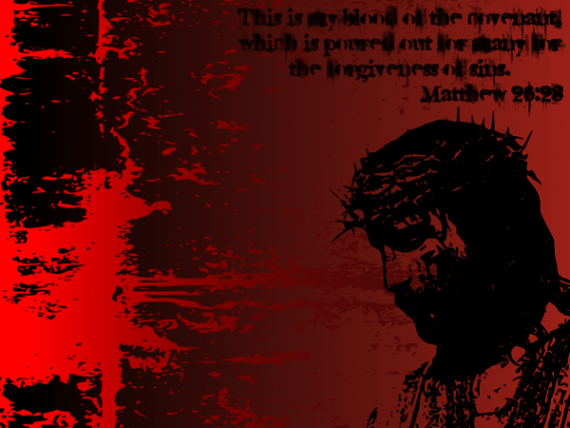
So Jesusโ€™ words at the Last Supper closely mirror what we have seen about blood in Genesis 4:10ย and Hebrews 12:24ย above. The murder of Abel by Cain represents the fratricidal, murderous violence upon which all human civilization is built. In unveiling this sin, the author of Hebrews compared the word spoken by the blood of Abel with the Old Covenant, and then contrasts this with the word spoken by the blood of Jesus and the New Covenant.
Matthew 26:28 blood of new covenant

Whereas the Old Covenant and the blood of Abel was concerned with sacrifice, vengeance, and retaliation, the New Covenant based upon the blood of Jesus speaks of grace, mercy, and forgiveness.

And this is what Jesus says to His disciples during their Last Supper.

He brings them to the table and says, “I’m going to inaugurate a New Covenant, a new way of doing things, a new Last Will & Testament. And it’s going to be put into effect through my death. And when you see what I am revealing through my death, you will gain release from the addictive and destructive power of sin that has enslaved humanity since the foundation of the world.”

Do you see? There is no mention in here of buying forgiveness from God. Quite the opposite in fact. Jesus is not saying, “I am going to die so God can forgive you.”

No, Jesus is saying, “I’m going to die so that you can learn that God has ALWAYS forgiven you, and my death will show you how to live in a similar way toward others. My death is going to show you how to extend unconditional love and free forgiveness toward others, as God has always extended toward you. And when you live this way, you will break free from the sin of violent, bloody, sacrificial scapegoating that has plagued humanity since the very beginning.”

So do you see?

The Old Covenant, the Mosaic Covenant, enslaved us to sin, and thus, to sacrificial and scapegoating violence.

But the New Covenant in Jesus, introduced to us and inaugurated for us through His own violent death on the cross, shows that we are completely forgiven and have always been forgiven, and that there is nothing for which God will not forgive us.

The New Covenant enacted through the death of Jesus which brings release from our bondage to sin.

Therefore, we too can forgive. Rather than lash out in violence against those who wrong us, we can, like God, simply extend love and forgiveness.

By seeing Godโ€™s loving, forgiving, non-retaliatory character through the death of Jesus, we are shown the way to live in loving, forgiving, non-retaliatory community with other people. Observing the Lordโ€™s Supper serves as a reminder of the way we are to live with one another.

In the Last Supper, Jesus used the cup of wine to symbolize how He was making a new Last Will & Testament with humanity. This time, the Testament will be put into effect by His own blood.

When we see Him do this, it is then that our eyes are opened to the truth about sin. What we see in the death of Jesus helps us finally break free from the destructive power of sin that has plagued humanity since the foundation of the world.

This is how the death of Jesus reveals our sin to us, and releases us from the bondage of sin in our lives.

Jesus did not buy forgiveness of sins for us from God, but instead revealed that God has always loved and only forgiven, and we can live this way as well.

The Gospel DictionaryUnderstanding the Gospel requires us to properly understand the key words and terms of the Gospel. Take my course, "The Gospel Dictionary" to learn about the 52 key words of the Gospel, and hundreds of Bible passages that use these words.

This course costs $297, but when you join the Discipleship group, you can to take the entire course for free.


Affiliate Disclosure: As an Amazon Associate I earn from qualifying purchases. Thank you for supporting my work in this way!

God is Redeeming God, Redeeming Theology, z Bible & Theology Topics: blood of Jesus, crucifixion of Jesus, death of Jesus, Easter, forgiveness, forgiveness of sins, Matthew 26:28, New Covenant

Advertisement

Why is the Bible so Bloody? Jesus tells us why in Matthew 23:29-35

By Jeremy Myers
7 Comments

Why is the Bible so Bloody? Jesus tells us why in Matthew 23:29-35
http://media.blubrry.com/one_verse/feeds.soundcloud.com/stream/417229323-redeeminggod-111-why-is-the-bible-so-bloody-and-violent-matthew-2329-35.mp3

Lots of people wonder why the Bible is so bloody … that is, why there is so much violence and bloodshed in the Bible. (I am going to provide a brief explanation below, but if you want a more detailed explanation, you can read my book, (#AmazonAdLink) Nothing but the Blood of Jesus.)

Many Christians often condemn the Muslim Qu’ran for being a violent book, but did you know that the Bible is far more violent than the Qu’ran? And this is not just descriptions of violence. There are more endorsements and commands to violence by God in the Bible than in the Qu’ran.

Of course, many Christians rightly point out that Jesus came and changed all that. That Jesus revealed a new a different way, a way of love and forgiveness.

I agree.

blood to horses bridles Revelation armageddonBut then many Christians turn right around and say, “But in the future, Jesus is going to return to this earth, and slaughter millions of people. There will be the greatest, bloodiest war the world has ever seen. When Jesus returns at the battle of Armageddon, the Valley will be filled with blood up to the horse’s bridle.”

So … wait. Is Jesus violent and bloody or not?

Are we saying that God in the Old Testament was violent and bloody, and then Jesus showed up to try love and forgiveness, but at the end of the world, even Jesus realizes that violence and bloodshed is the only solution after all? That love and forgiveness doesn’t actually work?

I think something is terribly wrong with this way of reading the Bible.

And by the way, this way of reading the Bible causes people to become violent themselves. I have heard Greg Boyd say that we become like the God we worship. If we worship a God who is violent at heart, and even though He tries love and forgiveness for a bit, He ultimately resorts to violence and bloodshed … then this is how we will act toward others.

This is why we hear Christians say, “Well, we tried to love and forgive those people over there …we really did, but they didn’t change, so now we are forced to drop bombs on them.”

Maybe we don’t drop bombs on them … but we do feel justified to hate other people when they don’t respond to our attempts to love and forgive them.

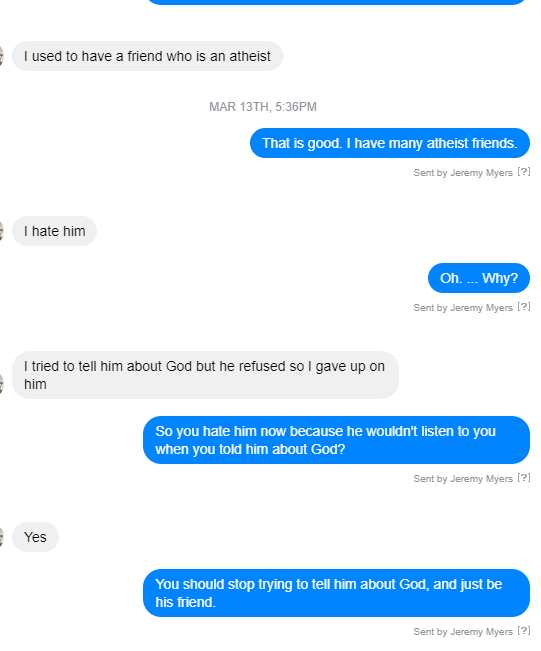
I had a conversation on Facebook Messenger the other day which reveals this attitude pretty well. Here is a screenshot:

(By the way, if you want to Message me on Facebook, you can do so here.)

Do you see? When we believe that God loves for a while, but then turns to hate when people don’t respond to Him, this causes us to hate those who don’t respond quickly enough to our evangelism efforts.

Now, if this is truly the way God is, then I agree that this is how we can behave as well.

But I do not believe that God is hateful, angry, violent, or bloody. I believe that Jesus reveals that God is quite the opposite. I believe that Jesus shows us what God is like, and that God has always been and always will be just like Jesus in the Gospels.

Jesus says “If you’ve seen me, you’ve seen the Father.” Paul says in Colossians 1:15 that Jesus “is the image of the invisible God.” The author of Hebrews says that Jesus is the exact representation of God, the express image of His person (Hebrews 1:3).

Now when Jesus, Paul, and the author of Hebrews were teaching these things, they were talking about how Jesus lived during this life on earth as recorded in the Gospels.

During His life and ministry, Jesus did not engage in bloody violence or acts of vengeance upon anyone. Instead, He always loved and only forgave.

If we believe that Jesus, Paul, and the author of Hebrews knew what they were talking about, then we are forced with a decision: We must either decide that Jesus was hiding the dark, bloody, and violent side of God so that He did not actually reveal to us the full and perfect image of God (and therefore, Jesus, Paul, and the author of Hebrews are not telling the truth), or we must decide that Jesus did, in fact, fully reveal God to us (as He claims to have done), and so God has never been violent and bloody, and never will be.

does God hate us while Jesus loves us

For myself, I believe that Jesus is telling the truth, and so is Paul and the author of Hebrews.

Which means we need to figure out why the Bible is so violent and bloody. We need to figure out why the Bible contains so much bloodshed. We need to figure out why God apparently commands so much violence and bloodshed in the Old Testament. We need to figure out why John writes in the book of Revelation about the return of Jesus in such violent and bloody ways.

Thankfully, this is not something we have to figure out on our own. Jesus Himself told us why the Bible is so violent. He did this in numerous ways and at various times during His life and ministry.

The greatest explanation was provided through His crucifixion, of course, but many of the parables and teachings of Jesus were also directed at revealing the truth to us about why the Bible is so bloody and violent.

Jesus tells us why the Bible is Bloody (Matthew 23:29-35)

One of the key texts where Jesus reveals this is Matthew 23:29-35 (cf. Luke 11:49-51):

[You] say, “If we had lived in the days of our fathers, we would not have been partakers with them in the blood of the prophets.” โ€ฆ Therefore, indeed, I send you prophets, wise men, and scribes; some of them you will kill and crucify, and some of them you will scourge in your synagogues and persecute from city to city, that on you may come all the righteous blood shed on the earth, from the blood of righteous Abel to the blood of Zechariah, son of Berechiah, whom you murdered between the temple and the altar.

why is the Bible so bloody and violentIn this text, Jesus provides a summary of how He reads and understands the Old Testament. This is “The Old Testament according to Jesus.” And according to Jesus, the Bible is filled with violent bloodshed.
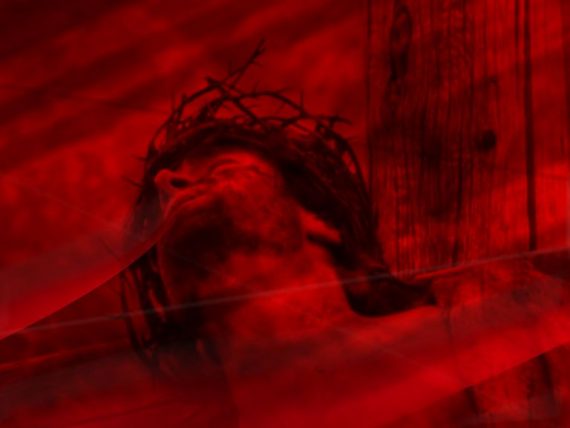

From Abel to Zechariah, from A-to-Z, the Bible reveals the violence of the human heart as we kill others in the name of God. According to Jesus, the Hebrew Scriptures are primarily about a revelation of bloodshed.

They reveal what the origins of bloodshed, and how sacrificial religion is often at the root of bloodshed, as human beings kills others in the name of God.

And it is not just evil sinners who are killed in the name of God, but righteous, innocent victims, such as Abel, Zechariah, and the prophets.

Jesus also says that the people in His day are doing the same thing.

This violent murdering of others in Godโ€™s name is the constant human sin of every culture and every generation. Yet no generation thinks that they themselves are guilty of it. The people in Jesusโ€™ day say that if they had lived in the days of the prophets, they would not have participated in killing the prophets. Yet the people in Jesusโ€™ day killed Jesus.

Today, we say that if we had lived in the day of Jesus, we would not have participated in killing Jesus. But is this true?

If you had lived in the days of Jesus, do you think you would be among those who cried out for His arrest and crucifixion? Or would you instead be among those who stood faithfully at His side and wept for Him as He bled and died?

Do not be too hasty to answer.

In Matthew 23:29-35, Jesus explains that the religious people who claim they would not have participated in murdering the prophets are the very same people who are planning to kill the prophets of their own day.

In this context, Jesus clearly equates blood with murder and violence, and especially the bloodshed that is religiously motivated. When the Bible speaks of blood, it primarily has in mind the sacrificial and religious bloodshed which takes place when we kill and murder in Godโ€™s name.

Of more importance, however, is the shocking truth that this text contains for us modern Christians. We Christians like to say that if we had lived in the days of Jesus, we would not have been among those calling for His crucifixion, but would have sided with Him instead, defending His innocence and calling for His release.

Sadly, Jesus disagrees with our assessment. The human condition and tendency is to side with the mob in calling for the death of the innocent scapegoat victim. The religious people in Jesusโ€™ day claimed that they would not have participated in killing the prophets of old, yet it is they who led the charge in accusing, condemning, and killing Jesus.

Just as with every other violent text in Scripture, Matthew 23:29-35 is a serious call to take a careful look at the condition of our own hearts toward others.

This text, like so many others, was not primarily written so that we can condemn the ignorance of those in the past, but so that we can allow this text to expose the darkness in our own hearts. Just as the people in Jesusโ€™ day were guilty of the same sins they condemned in their ancestors, so also, we are guilty of the same sins we condemn in them.

We say we would not have condemned Jesus, yet it may very well be that the people we think God should kill today are the very prophets whom God has sent to us to reveal our sin. Who is it that you want to see dead?

Who is it that you believe God could (and should) โ€œrighteouslyโ€ kill? Could it be that you only think this about them because they are exposing your sin to you, just like the prophets of old?

This reveals why the Bible, and especially the Old Testament, is so violent.

Jesus died to reveal the source of violence

Why is the Old Testament so Violent?

Much of the Old Testament is filled with blood, whether it is the blood spilled in the sacrificial rituals of the Mosaic Law or the blood spilled during Canaanite Conquest and subsequent wars of Israel.

It is not without reason that some have called the Bible the bloodiest religious book in human history. Such a charge is not unfounded, for when the actual calls for violence and bloodshed are tallied, the Bible has more bloody texts than the Muslim Qurโ€™an or any other religious holy book.

The proper response to all this bloodshed in the Bible, however, is not to try to explain it away and justify God as the bloodiest deity in the history of religion, but instead to embrace the revulsion that we feel and recognize that the reason the Bible is so bloody is not so that we emulate the behavior we read about in its pages, but instead to see these events as though they were a mirror being held up to our own faces (James 1:23-24).

In Matthew 23:29-35, Jesus says that the Bible is so violent and bloody, because it reveals what we ourselves are doing in our own day. Jesus says that the Bible is so violent and bloody, not so that we can condemn the people of the past, but so that we can see how we ourselves participate in the same exact bloodshed and violence.

Jesus says that the Bible is so violent and bloody, not because it reveals what God is like (for only Jesus does that), but because it reveals what mankind is like. And therefore, what we are like.

The Old Testament does not reveal God to us as much as it reveals mankind to us.

The bloody passages of the Old Testament provide a better glimpse into the heart of man than they do the heart of God.

This is how to read the violent portions of the Bible, so that when we turn away from them in revulsion, we are trained to turn away from similar violent tendencies in our own heart as well.

Until we read the Bible this way, we will forever be confused about why there is so much blood and violence in the Old Testament. But once we read the Bible through this lens, we see that the Bible reveals man to us so that in Jesus Christ we receive both a perfect revelation of what God is like and a perfect revelation of what mankind is supposed to be like.

Through His death on the cross, Jesus willingly submitted Himself to the violent death of ritualistic sacrifice as a way of exposing to humanity the sin to which humanity is enslaved.

Jesus died, not to affirm and reinforce the idea that God wants blood sacrifice, but to unveil and expose the truth about sacrifice, the truth that it is we who want sacrifice; not God.

It is we who shed blood; not God.

By letting us kill Him in such a violent and bloody way, Jesus unveiled the truth about humanity and the truth about sin, and in so doing, called us to abandon these scapegoating, sacrificial rituals in our own lives.

By letting us shed His blood, Jesus revealed that all such scapegoating sacrificial rituals have nothing whatsoever to do with God and originate instead within the hearts of mankind.

Jesus fully exposed and unveiled the mystery of the scapegoat sacrifice by fully submitting Himself to it.

Through His life and death, Jesus revealed how to live:

We are not to make sacrificial scapegoat victims of others, while at the same time we are to willingly lay down our lives for others.

The blood of Jesus reveals that true life does not come through the death of others, but through the death of self for the sake of others. While seeking life through the death of others leads only to more death, seeking life through the death of self leads to life for all.

The blood of Jesus teaches that while humans seek death, God seeks life, and so when the life of God is in us, we will stop seeking the death of others.

To learn more about this, get my book, (#AmazonAdLink) Nothing but the Blood of Jesus, or take my online course, The Gospel Dictionary, which you can take for free by joining my online discipleship group:

The Gospel DictionaryUnderstanding the Gospel requires us to properly understand the key words and terms of the Gospel. Take my course, "The Gospel Dictionary" to learn about the 52 key words of the Gospel, and hundreds of Bible passages that use these words.

This course costs $297, but when you join the Discipleship group, you can to take the entire course for free.

Affiliate Disclosure: As an Amazon Associate I earn from qualifying purchases. Thank you for supporting my work in this way!

God is Redeeming God, Redeeming Scripture, Redeeming Theology, z Bible & Theology Topics: blood, blood of Jesus, crucifixion of Jesus, death of Jesus, Matthew 23:29-35, violence, violence of God, violence of Scripture

Advertisement

Once upon a time, I was interviewed by Jason Wiedel

By Jeremy Myers
1 Comment

Once upon a time, I was interviewed by Jason Wiedel
http://media.blubrry.com/one_verse/feeds.soundcloud.com/stream/406648668-redeeminggod-jason-wiedel-interviews-jeremy-myers.mp3

Several years ago, I was interviewed by Jason Wiedel for his podcast.

For some reason, he never aired this interview.

I don’t know why.

Maybe he forgot about it. Maybe he didn’t like what I said.

Maybe it was because my facial hair wasn’t as good as his.

Whatever the reason, I am putting this out now as a bonus episode for my podcast.

Enjoy!

Affiliate Disclosure: As an Amazon Associate I earn from qualifying purchases. Thank you for supporting my work in this way!

God is Redeeming God, Redeeming Theology Bible & Theology Topics: church, inerrancy, Jason Wiedel

Advertisement

How the concept of adoption helps us understand Romans 8:17 and Romans 9:4

By Jeremy Myers
6 Comments

How the concept of adoption helps us understand Romans 8:17 and Romans 9:4
http://media.blubrry.com/one_verse/feeds.soundcloud.com/stream/402688467-redeeminggod-107-romans-817-adoption-in-biblical-times.mp3

The podcast episode above looks at Romans 8:17, and the video below looks at Romans 9:4. Both texts are greatly aided by a proper understanding of how adoption worked in biblical times.

Below is a recording of my first attempt at a Facebook Live video. In it, I discuss the concept of adoption from Scripture and how it helps us understand Romans 9:4.

I am definitely not an expert videographer by any means … Oh well. As mentioned in the video, the information is drawn from my Gospel Dictionary online course, specifically from the lesson on “Adoption.” Members of RedeemingGod.com can take this course for free. You can join here.

Here is a text version of what I was teaching:

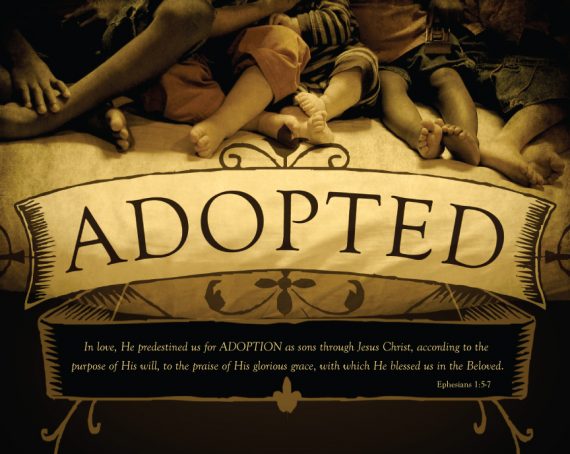
Romans 9:4 adoption

Biblical Adoption

While modern adoption is when we take an orphan and adopt them into our family, this is not how adoption worked in Paul’s day.

Back then, the children who were adopted already had parents. Adoption was a way of uniting two rich and powerful families together so that one powerful family adopted the child of another powerful family. Or sometimes, a father who had multiple children would adopt one of his younger children as his heir, thereby displacing the oldest son as the heir.

So adoption was not about giving parents to those who had none, but was about naming a child (of other parents, or even one of your own children) as an heir. Adoption was about glory, honor, and privilege; not about joining a family.

Romans 9:4 and Adoption

Romans 9 is a confusing chapter. Since it is about the election and rejection of Israel for Godโ€™s purposes, many believe that Romans 9 teaches that even after we receive eternal life, if we fail to live according to Godโ€™s purposes, we either lose our eternal life or we prove we never had it in the first place.

This is, after all, what happened to Israel, is it not? No, it is not.

Election is not about how God, from eternity past, chose who would receive eternal life and who would be condemned to hell forever. Instead, election is about purpose and privilege within the plan of God (see my book, The Re-Justification of God).

It is no surprise, then, that at the beginning of this discussion of Israelโ€™s purpose and privilege within the plan of God, Paul mentions the fact of Israel adoption by God (Rom 9:4).ย Paul also refers to glory, covenants, the law, service, and promises.

Right at the introduction to Romans 9, Paul shows that he is not writing about how the people of Israel were part of Godโ€™s family and then were rejected as members of His family, but is instead writing about the favored members of Godโ€™s family who have position, power, and privilege within the family because of how they live.

Though Israel began with the position of being the adopted son, they lost it through disobedience and rebellion. This is why Paul warns us, who are now in the position of adoption, that we must take heed to how we live, or else we too might be cut off (Romans 11:19-23).

This is not about losing eternal life or proving that we were never children of God, but is instead about losing out on the privileged position within the plan and purpose of God for this world.

The Gospel DictionaryUnderstanding the Gospel requires us to properly understand the key words and terms of the Gospel. Take my course, "The Gospel Dictionary" to learn about the 52 key words of the Gospel, and hundreds of Bible passages that use these words.

This course costs $297, but when you join the Discipleship group, you can to take the entire course for free.

Affiliate Disclosure: As an Amazon Associate I earn from qualifying purchases. Thank you for supporting my work in this way!

God is Redeeming God, Redeeming Scripture, Redeeming Theology Bible & Theology Topics: adoption, election, Romans 9-11, Romans 9:4

Advertisement

Does Galatians 1:8-9 give you permission to curse others? Did Paul curse others?

By Jeremy Myers
5 Comments

Does Galatians 1:8-9 give you permission to curse others? Did Paul curse others?
http://media.blubrry.com/one_verse/feeds.soundcloud.com/stream/401261907-redeeminggod-106-did-paul-curse-others-to-hell-galatians-18-9.mp3

The following study of Galatians 1:8-9 is drawn from my Gospel Dictionary Online Course, which defines 52 key words of the Gospel, and considers hundreds of texts from the Bible related to these key terms. See details at the bottom of this article for how you can take the entire course. Here is a video that provides the basic answer to what Paul is saying in Galatians 1:8-9.

In Galatians 1:8-9 Paul calls down anathema on any person or teacher who presents a different gospel than the one he himself taught when he was among the believers in Galatia.ย Paul is so emphatic he says this not once, but twice in these two verses.

The Galatian believers have abandoning the gospel of grace which Paul taught to them, and have instead turned to a gospel of works, which is no gospel at all (cf. Galatians 1:7). So as Paul sits down to write this letter of correction to the Galatians, he begins in Galatians 1:8 by saying that anyone who preaches something different than what he preached, let them be accursed; let them be anathema.

Galatians 1:8-9Among those who knew Paul, such a statement would have been shocking. Paul does not go around cursing people. So Paul, knowing that his statement would have caused the readers in Galatian to scratch their head and wonder if they were hearing him correctly, repeats himself in Galatians 1:9.

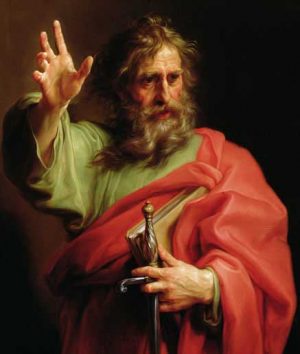
Christians have used Galatians 1:8-9 to justify cursing others to hell

These two verses by Paul have caused so much bad behavior by Christians over the years.

Back during the Reformation, the Reformers pronounced anathemas on the Catholics, and the Catholics pronounced anathemas on the Reformers.

In more recent years, it is not at all uncommon to hear some Christian go around pronouncing curses and condemnation on people, and when you challenge them about their unloving behavior, they quote Galatians 1:8-9 and say, โ€œPaul cursed people for the sake of the gospel; so can we.โ€

What did Paul mean in Galatians 1:8-9 when he announced an anathema on others?

You are about to learn that this way of reading Paulโ€™s message in Galatians is completely wrong. I will show you a key to understanding Galatians that will allow you to read the Galatians in a whole new light.

You will not only understand the book more than ever before, but will also smile a little bit when you read his anathemas here in Galatians 1:8-9. You will understand why Paul states this anathema twice in these verses, and why we can never, ever, ever curse or condemn people who disagree with us, because, as we will see, that is not what Paul is doing either.

While it is tempting once again to see in these statements a vindictive Paul calling down a death curse upon his theological opponents, we must understand that such behavior does not fit the wider thought and theology of Paul.

What Paul writes in Galatians 1:8-9 must be understood in light of the wider context of this letter as a whole.

Galatians 1:8-9 in the context of Galatians

Let me give you a little hint right now about how to read this letter. If you want to read Galatians properly, you need to read it with a little smirk on your lips. You need to read it with a twinkle in your eye. You need to read it with a half-smile and a wink.

Why?

Because that is what Paul was doing when he wrote this letter. If you can read Galatians with the idea that Paul was writing with a somewhat sarcastic, or ironic, tone of voice, the letter will make a whole lot more sense to you.

Oh, and by way of fair warning, the explanation of Galatians 1:8-9 below is rated PG-13.

circumcision

Let us begin by looking at a later โ€œcurseโ€ that Paul pronounces on the teachers in Galatia with whom he disagrees.

In Galatians 5:12, Paul states his wish that those teachers who make circumcision a requirement for new believers would just go ahead and emasculate themselves entirely. Paulโ€™s theological satire is quite evident. The teachers in Galatia were arguing that if believers in Jesus really wanted to please and obey God, faith in Jesus was not enough; men needed to also get circumcised.

So in Galatians 5:12, Paul, with a little smirk on his lips, argues that if God is pleased with us when men cut off part of their penis, maybe God will be even more pleased if men cut off the whole thing!

You have to love Paul, for only Paul can use a penis to make a theological point.

But what exactly is that point?

Well, the issue of circumcision is not just about pleasing God. The issue is much larger.

paul and circumcisionUnder the Mosaic Law, circumcision was a sign of separation. It was a sign that only the circumcised were part of the people of God. Only the circumcised were the โ€œinsidersโ€ with God. Everybody else was an โ€œoutsider.โ€ Circumcision then, was a way of dividing humanity. It was โ€œus vs. them.โ€

Yet one central themes of Paulโ€™s letters is that in Jesus Christ, all such divisions have been dissolved. There is no more wall separating insiders from outsiders (Ephesians 2:11-22).ย In Jesus Christ, all are insiders.

So when certain Christians in Galatia began to make circumcision a requirement for fellowship once again, Paul saw it as a return to divisions and a rebuilding of walls. This was to live not according to the Spirit but according to the flesh (Gal 5:16-26), especially since, in more ways than one, circumcision was of the โ€œflesh.โ€

The factions, divisions, and lusts that were present in the community were further signs that some in Galatia were living according to the flesh rather than according to the Spirit. The pressure to get circumcised was creating an atmosphere of some men comparing his โ€œfleshโ€ to that of others to see who was more spiritual.

But such comparisons are not spiritual, but fleshly. To put it bluntly, Christians were comparing dicks to see who was more spiritual. Paulโ€™s criticism is that the entire argument is โ€œfleshlyโ€ and he wants it to stop. For Paul, this whole argument is ridiculous.

N. T. Wright explains it a little more circumspectly:

The opponents, after all, whoever they were, were seeking to establish a way of being, a grand story, a form of knowing, a type of identity, upon the converts. The pressure to get circumcised was precisely an insistence on establishing one kind of ethnic or para-ethnic identity over against others. Paul deconstructs these claims, showing that they themselves are dehumanizing, based on โ€œthe flesh.โ€

It really is quite a humorous argument when understood.

Paulโ€™s letter to the Galatians has a whole different feel if you understand that Paul wrote it with a smirk instead of a scowl.

Paul had a sense of humor after all!

Paul is writing about “the flesh” in Galatians

This imagery of “the flesh” is found throughout this letter. The image of the sowing with the flesh in Galatians 6:8ย and making a good showing in the flesh in Galatians 6:12ย as two further examples.

The โ€œfleshโ€ (Gk. sarx) is the word used to translate the Hebrew word for โ€œfleshโ€ (basar) which is often used in the Hebrew Scriptures as a euphemism for the male sexual organ.

This understanding gives us a completely different reading of Galatians 1:8-9, especially when we remember that the word anathema is exactly equivalent to the Hebrew concept of cherem. In Israel, only outsiders were under cherem, and circumcision was one of the defining characteristics used to separate the insiders from the outsiders. This is why it was so important for all male Israelites to get circumcised before they entered into Canaan (Joshua 5:3-7).

Yet in Jesus Christ, all of these divisions and separations had been done away with and set aside.

golgothaPaulโ€™s message in Galatians is that Golgotha has done away with Gibeath-haaraloth, the hill of foreskins (Josh 5:7).

There is no longer any โ€œus vs. themโ€ or โ€œinsiders vs. outsiders.โ€ Paul is now saying if we demand circumcision, we are only going back to that old way of dividing the world between insiders and outsiders.

But the reality is that, through Jesus, we are all insiders. The only real outsiders are those who claim that they are insiders and everyone else is an outsider. If you do that, then you are an outsider, and this places you under cherem, under anathema.

When Paul introduces his letter to the Galatians, he is not calling down judgment and condemnation upon his theological opponents. Instead, he is saying that if they are right in what they teach, then we must go back to the old way of dividing the world, and if we do that, then they will be cherem, anathema. Nobody wants that, including Paul, so he calls them to return once again to the gospel he preached to them, which is the gospel of inclusion and embrace.

Paul closes out his letter with a call for peace and mercy (Galatians 6:16) and that we โ€œdo good to all, especially to those who are of the household of faithโ€ (Galatians 6:10).

We must not think that Galatians begins with a curse ends with a blessing.

Paul has been blessing his readers all the way throughout, while using irony, sarcasm, humor, and even sexual innuendos to point out the error of their ways.

The Gospel DictionaryUnderstanding the Gospel requires us to properly understand the key words and terms of the Gospel. Take my course, "The Gospel Dictionary" to learn about the 52 key words of the Gospel, and hundreds of Bible passages that use these words.

This course costs $297, but when you join the Discipleship group, you can to take the entire course for free.

Affiliate Disclosure: As an Amazon Associate I earn from qualifying purchases. Thank you for supporting my work in this way!

God is Redeeming God, Redeeming Scripture, Redeeming Theology Bible & Theology Topics: accursed, anathema, circumcision, curse, Galatians 1:8-9, gospel, Paul

Advertisement

  • « Previous Page
  • 1
  • …
  • 22
  • 23
  • 24
  • 25
  • 26
  • …
  • 82
  • Next Page »

My New Book is Out!

Get your copy on Amazon today!
Learn about the gospel and how to share it

Take my new course:

The Gospel According to Scripture
Best Books Every Christian Should Read
Study Scripture with me
Subscribe to my Podcast on iTunes
Subscribe to my Podcast on Amazon

Do you like my blog?
Try one of my books:

Click the image below to see what books are available.

Books by Jeremy Myers

My New Book is Out!

Get your copy on Amazon today!

Theological Study Archives

  • Theology – General
  • Theology Introduction
  • Theology of the Bible
  • Theology of God
  • Theology of Man
  • Theology of Sin
  • Theology of Jesus
  • Theology of Salvation
  • Theology of the Holy Spirit
  • Theology of the Church
  • Theology of Angels
  • Theology of the End Times
  • Theology Q&A

Bible Study Archives

  • Bible Studies on Genesis
  • Bible Studies on Esther
  • Bible Studies on Psalms
  • Bible Studies on Jonah
  • Bible Studies on Matthew
  • Bible Studies on Luke
  • Bible Studies on Romans
  • Bible Studies on Ephesians
  • Miscellaneous Bible Studies

Advertise or Donate

  • Advertise on RedeemingGod.com
  • Donate to Jeremy Myers

Search (and you Shall Find)

Get Books by Jeremy Myers

Books by Jeremy Myers

Schedule Jeremy for an interview

Click here to Contact Me!

Follow me on X

© 2026 Redeeming God · All Rights Reserved · Powered by Knownhost and the Genesis Framework