
Redeeming God

Liberating you from bad ideas about God

Join the discipleship group
  • Join Us!
  • Scripture
  • Theology
  • My Books
  • About
  • Discipleship
  • Courses
    • What is Hell?
    • Skeleton Church
    • The Gospel According to Scripture
    • The Gospel Dictionary
    • The Re-Justification of God
    • What is Prayer?
    • Adventures in Fishing for Men
    • What are the Spiritual Gifts?
    • How to Study the Bible
    • Courses FAQ
  • Forum
    • Introduce Yourself
    • Old Testament
    • New Testament
    • Theology Questions
    • Life & Ministry

What is Prayer?

By Jeremy Myers
30 Comments

What is Prayer?

what is prayerA reader recently sent in this question:

What is a prayer?

Now that is a concise question! Ha! Of course, it cannot be answered so concisely…but I will try.

What is prayer?

what is prayer
Why do we think this is what prayer looks like?

We can always begin by defining prayer according to the standard English, Greek, and Hebrew dictionaries, but I think that the person who asks “What is prayer?” is not so much looking for the dictionary definition of prayer, but rather, how to pray, and how to see answers to prayer.

So in trying to answer the question, “What is prayer?” I think the simplest and most practical answer is best.

You see, most people learn about prayer by listening to others pray, and this often leads to some very bad prayer habits and practices. Most people, when they pray, seem to think that prayer requires a spiritual tone of voice, a new set of words, a sing-songy cadence and rhythm, and maybe even the repetition of certain words or phrases.

So it is not uncommon to hear people pray this way::

Father God in heaven, holy art thou above all things, and thy name, Father God, is worthy to be praised, Father God. ย Hallelujah! Praise Jeeeezus! Can I hear an Amen?

Oh, Father God, Lord God, Holy Jesus, we come before you today, as your children, Father God, to beseech you with our many needs, Father God. But before we do so, oh Holy Father in Heaven, we ask thee to forgive us for our many sins. We have failed thee in so many ways, Father God, so that as the prophet Isaiah says, all our righteous works are as filthy rags before thee, Father God! And so we thank thee for sending thy holy Son, Jesus Christ, the Lord of the universe and the master of all, the Lamb who was slain before the foundation of the world, to die for our sins on that wretched cross, oh holy Father God, – Hallalejujah! – praise Jesus – so that we might be forgiven of our many trespasses against you, Father God…

And the prayer goes on this way for many minutes. What is prayer? Not this. The person doing the praying will often work himself up into a bit of a frenzy, until he is shouting and shaking, and people who are listening are nodding their heads, shouting “AMEN!” “HALLELUJAH!” “PRAISE JESUS!” and so on.

This may not be your practice in praying, but it is a common practice and illustrates that when it comes to the question of “What is prayer?” we often learn what prayer is not by thinking about prayer or learning from Scripture what prayer is, but rather learning by watching and listening to others pray, and frankly, we learn some very bad practices this way.
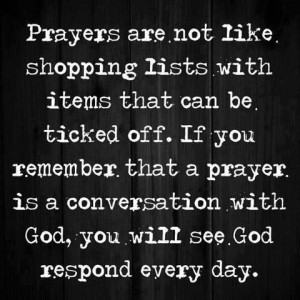
What is prayer?Even if you do not pray the way I have written above, listen to yourself prayย sometime, and ask yourself, “Where did I learn how to pray this way?” Why am I saying these certain words? Why am I changing my voice? Why am I bowing my head and folding my hands? Why am I closing my eyes? Why do I pray to Jesus, or to the Holy Spirit? Why do I repeat this certain phrase over and over, or use those certain words?

So when it comes to asking, “What is prayer?” I like to tell people that prayer is nothing more than talking to God as you would talk to a spouse or a friend. Of course, although I have said it is “nothing more” than that, prayer is certainly nothing less! Think about it! The fact that we can talk to God as a man would talk to a friend! There is no idea more shocking, more amazing!

People are often jealous that Moses spoke to God as a man speaks to a friend, but the fact of the matter is that Jesus has enabled all people to speak to God in this way! We do not need a priestly mediator, or special words, or a holy language, or a spiritual frenzy in order for God to pay attention to us. All of that is religious prayer, which is not the kind of prayer God wants.

I think sometimes God sighs at our religious prayers. He rolls his eyes as we go on and on and on.

He is always paying attention to us, and is with us throughout the day, going where we go, doing what we do, and hanging out with us as we eat, as we work, as we drive. This means that we can talk to him as a man speaks to a friend.

What is prayer? It is simply telling God what is going on and keeping him the in the loop on your life. Are you angry? Tell God. Are you sad? Let him know! Did you just sin? Yeah, he saw it, and he is not mad about it, but he does want to talk to you about it. Did you see something beautiful or experience something joyful? Thanks him! Are there needs and concerns? Ask him for advice or help.

What is prayer? It is simply talking to God in a normal way, just as we talk to anybody else.

What this means it that if you are asking “What is prayer?” you don’t really need to read books on prayer. You don’t need to be taught how to pray. You don’t need to attend prayer training seminars. You don’t need to learn a prayer language. You don’t need to memorize lots of Scripture in order to pray. If you know how to talk, you can pray! Just imagine God sitting next to you, and talk to him as you would talk to anyone else!

Do you want to pray like never before?

Do you what to talk to God like you talk to a friend? Do you want to see more answers to prayer?

If you have these (and other) questions about prayer, let me send you some teaching and instruction about prayer to your email inbox. You will receive one or two per week, absolutely free. Fill out the form below to get started.

Membership-become-a-member

Thanks for visiting this page ... but this page is for Discipleship Group members.

If you are already part of a Faith, Hope, or Love Discipleship Group,
Login here.

If you are part of the free "Grace" Discipleship group, you will need to
Upgrade your Membership to one of the paid groups.

If you are not part of any group, you may learn about the various groups and their benefits here:
Join Us Today.


Membership-become-a-member

Affiliate Disclosure: As an Amazon Associate I earn from qualifying purchases. Thank you for supporting my work in this way!

God is Redeeming Life, Redeeming Theology Bible & Theology Topics: Books by Jeremy Myers, Books I'm Writing, Discipleship, how to pray, prayer, What is prayer

Advertisement

Tell God Your Blasphemous Thoughts

By Jeremy Myers
122 Comments

Tell God Your Blasphemous Thoughts

A reader recently sent in the following question about blasphemous thoughts and the unforgivable sin.

I got your book on the unforgivable sin. What advice can you give for those who suffer with blasphemous thoughts? I have not said anything but they are still upsetting. I am going through a lot of stress right now. I have been having this issue about 2 years now. Any advice is appreciated. I was told just not to accept them (or cry-which I have done). God bless you.

I am glad you got the book. There is so much more I could have said about the unforgivable sin in that little book. This is one of the questions I should have dealt with in more detail.

What is a Blasphemous Thought?

First off, I am not sure what you might consider a “blasphemous thought.” As I have had hundreds of personal and online conversations about the unforgivable sin over the years, I find that lots of people have some sort of idea about what constitutes blasphemous thoughts or actions, but which are not really blasphemous at all. The reason most people have these ideas is because they heard a sermon, read a book, or had a pastor tell them that certain actions or thoughts were blasphemous. But when we really look at the what blasphemy is, ย we find that most of these sermons, books, and pastors were simply misinformed or were trying to control other people to act or behave a certain way.

So, to take an extreme case as an example… I have sometimes talked with people who say that they were told that it was blasphemy to question something their pastor taught. They were told that the pastor is “the Lord’s anointed.” Often the pastor will quote Psalm 105:15 as a way of showing that to touch, harm, or question “the Lord’s anointed” is some sort of affront to God. Therefore, to question or challenge the pastor is considered to be some sort of blasphemous challenge to God Himself.

This is an extreme example, to be sure, but it does happen (more than we realize!). But a moment’s reflection reveals that in these cases, the pastor is usually just trying to control people to conform to his own desires, wishes, and commands.

However, I would say that easily 95% of the teaching out there about the “sin of blasphemy” falls into this same category. Usually, what is being taught as blasphemous is not blasphemous at all! Sure, those certain behaviors or actions might be sinful, but there is a vast ocean of difference between sinful thoughts or actions and blasphemous thoughts or actions.

But here’s the thing… I am just going to go out on a limb and guess at what blasphemous thoughts you might be having. Though there is a whole variety of things that people think qualify as blasphemous thoughts or actions, in my experience, there is one main thing that people think is a blasphemous thought.

And it is this… when most people think they have thought or said something blasphemous, it is because they thought or said these words:

F*** you, God! I hate you!

Probably there is not much worse that could be said toward God, and I hesitate even putting such a thing on this blog. If anything qualifies as a blasphemous thought, this is probably it. (Though even here, nowhere does the Bible say that such a statement is blasphemous. In Matthew 12:31-32, when Jesus accuses the Pharisees of being close to committing the unforgivable sin, this is not what the Pharisees were saying, and is not even close to anything they ever would have said…)

So the statement above is not a blasphemous thought, but is still pretty bad, but I wrote it out for a purpose.

If you are saying or thinking these sorts of things toward God, there are two things God wants to say to you in return.

God Wants You to Know He Loves You

The first thing God wants to say to you is this:

Oh yeah? So you hate me, huh? Well guess what?

I love you.

Yeah, that’s right.

I. Love. You.

No matter what, I love you.

No matter what you say or do, no matter what you think, no matter how hurtful your words or thoughts, I will love you forever. My love for you will never change, will never diminish, will never fade away.

Say what you will. Do what you will. I forgive you for all of it, because I love you.

love of GodHow do we know God says this to us, no matter what we say to Him?

Because the Bible tells us over and over that He loves us no matter what. While we were yet sinners, God sent His Son Jesus to die for us (John 3:16; Rom 5:8). Love is the essence of who God is (1 John 4:8). Before you were ever born, God knew every sin you would ever commit, every word you would ever say, and all “blasphemous thoughts” you would ever say or think. And He sent Jesus to die for you anyway! Why? Because He loves you!

More than anything else, God wants to let you know that He loves you and will always love you.

The God you Hate… God Hates Too

But the second thing God would want to say to you in response for any angry or hateful thought you might have about Him is this:

Hey, I understand. In fact, the god you claim to hate is the god I hate too.

The only reason you are having those thoughts or thinking those words is because you thought I was a certain type of god, and I have not turned out to be that way. Your life is going in directions you didn’t think it would go, horrible things have happened to you in life, and you think I did these things to you. Someone told you some wrong things about me. Someone told you that I caused those bad things to happen to you. This is not true.

If I had done those horrible things to you, you would have every right to resent and hate me.

But I didn’t send this pain, tragedy, hardship, or evil into your life. I would never do that.

Remember what I told you before? I love you!

I might discipline you out of love, but when I do, I will make it clear to you what I am doing, and why.

All those evil things that happen to you are only because the world is full of sin, and the enemy is out to steal, kill, and destroy. I never steal, kill, or destroy.

Bad things happen in this world, and I am so sorry you have to experience them.

When these bad things happen, my role, my job, my task, is to do what I can to love you through them, to be with you in the pain, to suffer alongside you. This is one reason I sent Jesus. It is also why I sent the Holy Spirit.

I am not a god who sends suffering into your life; I am the God who suffers with you in life.

I am not a god who sends pain so you cry; I am a God who cries with you in your pain.

And regarding what you thought before… you know, those words you said in your head. Thank you for saying them.

Really.

Many people either try to deny the painful experiences they are facing, or they clam up about their pain and refuse to talk to me about it. But not you. You are honest about your pain and are willing to talk to me about it.

Even though your words are hurtful, they show that you continue to want to talk to me and have a relationship with me. Most people just give me the silent treatment. But you haven’t done that. You continue to want to talk. I want that too.

Telling me you hate me isn’t blasphemy; it’s honesty. It is how you feel. And I am glad you came to me in your pain.

So let me begin by showing you who I really am…

I am not sure if this exactly answers the question that was sent in to me, but in my years of experience as a pastor, author, and blogger, I have found that most people who have fears about blasphemous thoughts and blasphemous words, usually have one of two things going on in their life (and often both). People who think they have committed the unforgivable sin usually have a religious leader who is trying to control them, or warped and dangerous ideas about who God is and what God is like.

Once we can see that God is not like the angry, fire-hurling deity that is often taught in some churches and by some pastors, but instead looks remarkably like Jesus who loved, accepted, and forgave everybody, it is then that we begin to see how much God loves us, and that no matter what we say or do, His love for us will never change, never waver, never diminish.

It is not a blasphemous thought to think that you hate God.

If you think you hate God, go talk to Him about what you are feeling, and why you feel that way.

He loves to have these open and honest conversations with us about who He truly is and how much He truly loves us… no matter what.

Only once we see the love of God, will the thoughts of anger and resentment toward God begin to disappear. So if you are having blasphemous thoughts or ideas toward God, don’t feel bad about them or fear that such thoughts will make God stop loving you. Instead, take those thoughts to God, and say, “God? Do you see what think about you?” Then sit and listen to see what God says in return.

The last thing God wants is for us to shut ourselves off from Him. So if we are having blasphemous thoughts toward God, the best thing we can do is talk to God about them, so that He can show us how much He loves us, and how the God we think we hate is not actually the God He truly is.

Affiliate Disclosure: As an Amazon Associate I earn from qualifying purchases. Thank you for supporting my work in this way!

God is Redeeming Books, Redeeming Theology Bible & Theology Topics: blasphemy, forgiveness, grace, hate, Jesus, love of God, Matthew 12:31-32, Theology of God, Theology of Sin, Unforgivable Sin, unpardonable sin

Advertisement

The Date Jesus Will Return is Finally Revealed!

By Jeremy Myers
356 Comments

The Date Jesus Will Return is Finally Revealed!

I know the date that Jesus will return!

I figured it out! The math was always there for people to see, but in these last days, God has seen fit to reveal the truth to me, His chosen prophet, of the exact day that Jesus will return! It is privilege to be the first person on earth who knows when Jesus will return.

Jesus will return

Here is how the Holy Spirit helped me figure it out:

When Jesus will Return According to Daniel 12

First, I was reading the book of Daniel, and noticed that in Daniel 12, Daniel mentions a few different spans of time. In Daniel 12:7 he mentions “time, times, and half a time” which is a prophetic way of saying 3 1/2 years. This is proven by other passages that use similar terminology to refer to 42 months or 1260 daysย (cf. Rev 11:2-3; 12:6; 13:5 14, Dan 7:25; 12:7).

Later in Daniel 12, he writes about a similar period of time, but this one is 1290 days. Many people have speculated about why this period of time is 30 days longer than the 3 1/2 years mentioned earlier in the chapter, but the reason will be obvious in a moment. But for now, we should also recognize this second period of 1290 days as another 3 1/2 years, though this time is is 43 months.

So you take the 1260 days and the 1290 days and add them together, and you get 2550 days. As all prophecy experts know, this is not referring to days only, which would be about 7 years, but also to a period of time in years. So Daniel is making a prophecy of something that will happen 2550 years in the future. But when did the countdown begin?

Well, thankfully, Daniel tells us. In Daniel 9:25, we are told to begin counting the years until the Messiah comes when the decree goes forth to rebuild Jerusalem. So if we want to know when Jesus will return, we begin counting when the Jewish people were told they could begin rebuilding Jerusalem. When did this happen? This decree first went out under Cyrus in 536 BC.

[Read more…]

Affiliate Disclosure: As an Amazon Associate I earn from qualifying purchases. Thank you for supporting my work in this way!

God is Redeeming Theology Bible & Theology Topics: Blogging, Daniel 12, date setting, end times, humor, laugh, prophecy, return of Christ, synchroblog, Theology of the End Times

Advertisement

What are the Signs of Demonic Possession?

By Jeremy Myers
182 Comments

What are the Signs of Demonic Possession?

signs of demonic possessionIn a previous post we considered the question, “Can a Christian be demon-possessed?” we said no. But if a non-Christian is demon possessed, what the the signs of demonic possession, and is a Christian able to make the determination that someone is possessed by a demon?

Let us consider first the signs of demonic possession.

What are the signs of demonic possession?

We must be extremely careful on this question, because many people have been falsely labeled as being a possessed by a demon, and such an accusation can be terribly frightening and disturbing.

Furthermore, I do not think that the signs of demonic possession are as obvious as many seem to think. Satan, after all, masquerades as an angel of light (2 Cor 11:14). We can assume that Satanic minions also use similar tactics to deceive and trick people into thinking something is good and holy, when in fact, it is of the devil.

When we read of the ministry of Jesus in the Gospels, we find many circumstances where Jesus encountered people who were possessed by demons. For example, there is the man possessed by a legion of demons (Mark 5:6-13). Here is a video adaptation of this event:

http://www.youtube.com/watch?v=lz_s-cCpqGY

But there are also times when Jesus accuses the religious leaders of His day of acting according to their father, the devil (John 8:44). They, of course, showed no signs of demonic possession. Instead, they were the religious elites of the day. Of course, some could argue that they were not possessed, but were only being influenced by Satanic forces. This might be true.

But then there is the example of Judas. Scripture says that Satan entered Judas (Luke 22:3; John 13:27). This did not cause Judas to start spewing vile profanities, or have his heard start spinning in circles. No, he acted pretty normal, and did what most religious people of his day wanted him to do… to accuse Jesus of being a false Messiah and give Him over to the Roman officials for crucifixion.

I guess all I am saying is that when it comes to signs of demonic possession, we shouldn’t rely on Hollywood to tell us what these signs of demonic possession are. Scripture is our best guide on this, and it seems to indicate that while demonic possession sometimes results in strange, erratic, vile, and violent behavior, demonic possession can also result in what appears to be good religious behavior as well.

So what are the signs of demonic possession? I don’t think there is a list by which to determine whether or not someone is possessed by a demon. At least, there is no such list in Scripture, and even if we could compile such a list, it would have to include many of the things that the religious leaders of Jesus’ day were involved in.

Furthermore, such a list would also be misleading because what we often think of as signs of demonic possession might actually be signs of some sort of mental illness or other mental incapacity.

I know a family who had an eleven-year old daughter who behaved in terrible ways. They eventually became convinced that she was possessed by a demon and took her to a pastor to see if he could exorcise the demon. I personally think she had some serious mental issues, but do not think she was possessed. But I don’t think her exorcism session with the pastor helped her very much. What does it do to the mind of an eleven-year old girl to know that her parents think she is possessed by a demon? There is nothing good that comes from that.

So this brings us to the related question:

Can a Christian determine if someone is Demon-Possessed?

If there is no good list of indications or signs of demonic possession, then there is not sure and certain way to determine whether or not a person is possessed by a demon.

I know that some people point to passages like 1 John 4:1 which says that Christians are to discern the spirits to see whether or not they are from God, and the text goes on to say that “any spirit that confesses that Jesus Christ has come in the flesh is of God, and every spirit which does not confess that Jesus Christ has come in the flesh is not of God” (1 John 4:2-3).

By these passages, some believe that one sure sign of demonic possession is whether or not a person can say that Jesus Christ has come in the flesh.

I once tried this “test” on a man who I thought might be possessed by a demon. He was homeless, and my wife and I were talking to him outside of an Arby’s. We had just bought him some food and were talking to him while he ate. We found out he had no clothes other than the tattered clothes he had on, and so my wife got in the car to go the nearest department store to buy him a pair of pants, a sweatshirt, and a coat.

While she was gone, the man launched into a filth-laden tirade against Christians, God, and Billy Graham. His behavior was so erratic, that I decided to run this little test from 1 John 4 on him. I asked him if he could say that Jesus Christ had come in the flesh. The man got extremely upset when I asked him this question, and refused to even say the name of Jesus. He kept referring to Him as “that man.”

My wife came back with the clothes right about then, and he thanked us and went on his way.

Was he possessed by a demon? Did he exhibit any signs of demonic possession? Based on my experience with this man, some would say yes. I might be wrong, but I came away believing that I had misunderstood 1 John 4. I think it is another one of those texts we rip out of context so that we can label and condemn certain people with mental problems.

Take, for example, the incident in Matthew 8 where two demon-possessed men loudly proclaim that Jesus is the Son of God and ask why He has come (Matt 8:28-29). They clearly knew Who Jesus was and had no problems admitting that He was there in the flesh, and that He was the Son of God. Furthermore, why would a demon-possessed person be unable to admit that Jesus came in the flesh? It makes no sense for a demon to deny this.

No, what John is talking about in 1 John 4 is the specific false teaching he is writing against in his first letter. These false teachers were saying that Jesus was not fully human, that He did not come in the flesh. John says that anyone who says this is not speaking the truth of God.ย In 1 John 4, John isย not saying that anyone and everyone who is possessed by a demon cannot confess that Jesus Christ has come in the flesh.

I wrote elsewhere about the similar statements in 1 Corinthians 12:3.

So what are the signs of demonic possession, and can a Christian determine if someone is demonically possessed? The truth is that there is no sure and certain list ย by which to determine if someone is possessed by a demon, nor is there a step-by-step guide to follow if we think someone is possessed.

Don’t Focus on Signs of Demonic Possession

One thing I do know for sure: Some Christians give way too much credit to Satan, and spend way too much time thinking about demonic powers. Satan and his forces are a defeated foe. They’re in retreat. The more we talk about them, and the more we think about them, and the more we are scared by them, the happier they are and the more power they get in our lives.

christ and him crucifiedInstead of worrying about a demon behind every corner and whether or not our neighbor exhibits sings of demonic possession, we should be filling our minds with Jesus, focusing our minds on Christ and Him crucified, and praising Him for the victory He has won on the cross over all the principalities and powers. One book that has really helped me see that it is unhealthy (and dangerous) to focus on satanic influences is Overrun by Demons by Ice and Dean.ย 

When I was a pastor, a woman in my church once asked me to cast the demons out of her car. She said that her car usually ran fine, but that her car would often not start very well, especially on Sunday mornings when she was trying to get to church. As a result, she felt her car had a demon, and she wanted me to exorcise it. I refused, and told her that a mechanic would do just fine.

It is a true story, but this is the way some people think about demons and the spiritual realm. They see a demon under every rock and Satan behind every bad thing that happens in our life. But this is given the demonic realm too much credit.

Don’t spend your life running around scared by the devil. He wants you to be scared of him, but as a believer in Jesus and with the Holy Spirit indwelling your life, he has no more power over you than he has over God Himself. Is God scared of the devil? Of course not! So you don’t need to be either.

Also, if you are looking for signs of demonic possession in the lives of others, please stop. Those who fill their lives looking for these kinds of things are sure to find them, and when you do, it will either fill you with a smug satisfaction about how that coworker you dislike is so evil because she is possessed by a demon, OR it will fill you with terror, dread, and a sense of hopelessness because you fear that someone you love is possessed by a demon and there is not much you can do about it. Either way, you are not viewing that other person the way God views them through the lens of Jesus Christ.

So don’t look for signs of demonic possession. Instead, look for signs of God at work in the lives of others. Look for glimpses of glory shining through. Look for evidence of grace, mercy, and hope. Look for healing, redemption, and forgiveness. As we look for these signs in the lives of others, we will inspire them to live in these ways, and in so doing, expand the rule and reign of God on earth.

What do you think? Are there clear signs of demonic possession? If so, what are they? Should these be things we focus on in life, or, as I suggest above, should we instead focus on Christ and Him crucified?

Affiliate Disclosure: As an Amazon Associate I earn from qualifying purchases. Thank you for supporting my work in this way!

God is Redeeming Theology Bible & Theology Topics: 1 John 4:1-3, Christian, demon possession, demons, Holy Spirit, satan, Theology of Angels

Advertisement

Is Theological Certainty Possible?

By Jeremy Myers
19 Comments

Is Theological Certainty Possible?

A reader recently sent in the following question:

I’m currently involved in a discussion and was asked this specific question:”Do you have an absolute certainty that when you die you will go to heaven?” What is your take, if you have the time?

Here is my attempt at a response, but I would love for you to weigh in on this subject in the comment section below…

certainty

Whew! What a question. In years past I would say โ€œYes.โ€ But in recent years, I am not sure what “absolute certainty” even means.

To have absolute certainty about anything, you must also have absolute certainty about a whole series of other ideas that lead up to and support the one idea you are trying to have certainty about.

I suppose, if I were pressed, I would say that faith is like an โ€œon-offโ€ switch. It is not a dimmer switch. So you either believe something or you donโ€™t. But in any single belief, there are often a multitude of other beliefs which lead up to it. Maybe you believe all the links in that chain up to the belief in question, or maybe you donโ€™t. So if all the links in that chain are switched โ€œonโ€ then you can be said to have absolute certainty in that belief. But if all the links are not switched on, then you probably do not have absolute certainty.

[Read more…]

Affiliate Disclosure: As an Amazon Associate I earn from qualifying purchases. Thank you for supporting my work in this way!

God is Redeeming Theology Bible & Theology Topics: belief, Bible and Theology Questions, certainty, doctrines, Theology - General

Advertisement

  • « Previous Page
  • 1
  • …
  • 55
  • 56
  • 57
  • 58
  • 59
  • …
  • 82
  • Next Page »

My New Book is Out!

Get your copy on Amazon today!
Learn about the gospel and how to share it

Take my new course:

The Gospel According to Scripture
Best Books Every Christian Should Read
Study Scripture with me
Subscribe to my Podcast on iTunes
Subscribe to my Podcast on Amazon

Do you like my blog?
Try one of my books:

Click the image below to see what books are available.

Books by Jeremy Myers

My New Book is Out!

Get your copy on Amazon today!

Theological Study Archives

  • Theology – General
  • Theology Introduction
  • Theology of the Bible
  • Theology of God
  • Theology of Man
  • Theology of Sin
  • Theology of Jesus
  • Theology of Salvation
  • Theology of the Holy Spirit
  • Theology of the Church
  • Theology of Angels
  • Theology of the End Times
  • Theology Q&A

Bible Study Archives

  • Bible Studies on Genesis
  • Bible Studies on Esther
  • Bible Studies on Psalms
  • Bible Studies on Jonah
  • Bible Studies on Matthew
  • Bible Studies on Luke
  • Bible Studies on Romans
  • Bible Studies on Ephesians
  • Miscellaneous Bible Studies

Advertise or Donate

  • Advertise on RedeemingGod.com
  • Donate to Jeremy Myers

Search (and you Shall Find)

Get Books by Jeremy Myers

Books by Jeremy Myers

Schedule Jeremy for an interview

Click here to Contact Me!

Follow me on X

© 2026 Redeeming God · All Rights Reserved · Powered by Knownhost and the Genesis Framework