Redeeming God

Liberating you from bad ideas about God

Join the discipleship group
  • Join Us!
  • Scripture
  • Theology
  • My Books
  • About
  • Discipleship
  • Courses
    • What is Hell?
    • Skeleton Church
    • The Gospel According to Scripture
    • The Gospel Dictionary
    • The Re-Justification of God
    • What is Prayer?
    • Adventures in Fishing for Men
    • What are the Spiritual Gifts?
    • How to Study the Bible
    • Courses FAQ
  • Forum
    • Introduce Yourself
    • Old Testament
    • New Testament
    • Theology Questions
    • Life & Ministry

Dead in Sin – A Favorite Calvinistic Analogy

By Jeremy Myers
11 Comments

Dead in Sin – A Favorite Calvinistic Analogy

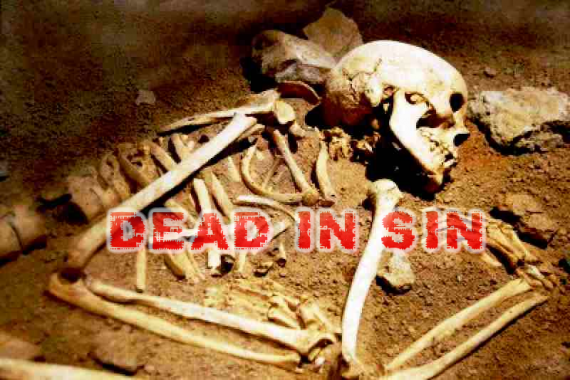
When talking about Total Depravity, total inability, and the bondage of the will, it is quite popular among Calvinists to talk about mankind being โ€œdead in sin.โ€

dead in sin Calvinism

The Bible frequently makes mention of people being dead in sin, or being spiritually dead, and this terminology is often used to defend the Calvinistic concepts of total inability and the bondage of the will to sin.

Humans are “Dead in Sin”

Here are some quotes from Calvinists showing how they understand and explain the โ€œdead in sinโ€ imagery in Scripture.

A dead man cannot exercise faith in Jesus Christ (Gordon H. Clark, The Biblical Doctrine of Man, 102)

A dead man is utterly incapable of willing anything (Pink, Sovereignty of God, 141).

A dead man cannot cooperate with an offer of healing (John H. Gerstner, A Predestination Primer, 18).

The corpse does not restore life to itself, after life is restored it becomes a living agent (Robert Dabney, The Five Points of Calvinism, 35).

The Calvinist holds to the plain teaching of Scripture and says: โ€œNo; he is dead. He cannot even open his mouth. Nor does he have any desire to call a doctor to help him. He is deadโ€ โ€ฆ The Calvinist โ€ฆ would compare man to one who jumps off the top of the Empire State Building and is spattered over the sidewalk. Even if there were anything left of him when he landed, he could not know that he needed help, let alone cry out for it. That man is deadโ€”lifelessโ€”and cannot even desire to be made whole โ€ฆ And that is the picture of the sinner. He is dead in his sins and trespasses (Eph. 2:1, 5). He does not want to be made whole, let alone even know that he should be made whole. He is dead. When Christ called to Lazarus to come out of the grave, Lazarus had no life in him so that he could hear, sit up, and emerge. There was not a flicker of life in him. If he was to be able to hear Jesus calling him and to go to Him, then Jesus would have to make him alive. Jesus did resurrect him and then Lazarus could respond (Palmer, The Five Points of Calvinism, 17-18).

Could the Word of God show more plainly than it does that the depravity is total? And that our inability to desire or procure salvation is also total? The picture is one of deathโ€”spiritual death. We are like Lazarus in his tomb; we are bound hand and foot; corruption has taken hold upon us. Just as there was no glimmer of life in the dead body of Lazarus, so there is no โ€œinner receptive sparkโ€ in our hearts. But the Lord performs the miracleโ€”both with the physically dead, and the spiritually dead; for โ€œyou hath he quickenedโ€”made aliveโ€”who were dead in trespasses and sins.โ€ Salvation, by its very nature, must be โ€œof the Lord” (WJ Seaton, Five Points of Calvinism).

[A sinner] has all the passive properties belonging to a corpseโ€ฆ (Boice & Ryken, Doctrines of Grace, 74).

The natural man is enslaved to sin; he is a child of Satan, rebellious toward God, blind to truth, corrupt, unable to save himself or to prepare himself for salvation. In short, the unregenerate man is dead in sin, and his will is enslaved to his evil nature (Steele & Thomas, Five Points of Calvinism, 19).
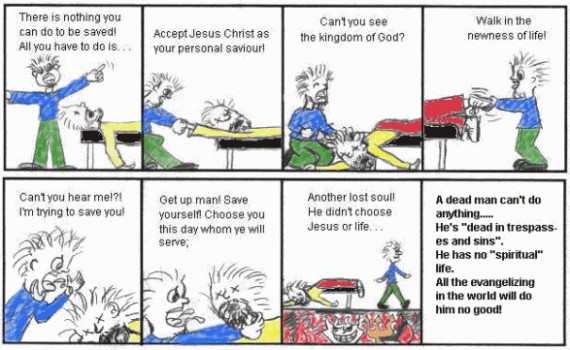
dead in sin calvinism evangelism

In later posts we will look at some of the biblical texts used to support and defend this Calvinistic interpretation of people being dead in sin. For now, have you encountered this before? Do you think that when the Bible talks about being dead in sin, it refers to the total inability of humankind?

If you want to read more about Calvinism, check out other posts in this blog series: Words of Calvinism and the Word of God.



Affiliate Disclosure: As an Amazon Associate I earn from qualifying purchases. Thank you for supporting my work in this way!

God is Redeeming Theology Bible & Theology Topics: Books by Jeremy Myers, Calvinism, dead in sin, Theology of Man, Theology of Salvation, Theology of Sin, Total Depravity

Advertisement

Do humans have a free will? Calvinism says “No!”

By Jeremy Myers
63 Comments

Do humans have a free will? Calvinism says “No!”

Often wrapped up in a discussion of Total Depravity and Total Inability is a discussion of free will.

free will and calvinism

Though it is variously stated, most Calvinists believe that humans do not have a free will.

Some argue that humanity did have a free will before Adam and Eve rebelled against God and fell into sin by eating fruit from the Tree of the Knowledge of Good and Evil. Others argue that a form of free will is awakened in the minds of the Christian. What almost all agree on, however, is that no unregenerate person has free will. Of course, even here, you will occasionally run across a Calvinist who claims to believe that unregenerate people have a free will, but that the free will of unregenerate people is only a free will to do evil. That is, though they can choose of their own free will to do what they want, their choices are only between various forms of evil, and they cannot choose to do any good.

Calvinism and Free Will

free will Here are some Calvinist quotes about Free will:

Free will is nonsense (Spurgeon, Free Will a Slave, 3).

Free will is the invention of man, instigated by the devil (David Wilmoth, The Baptist Examiner, September 16, 1989, 5).

Free will makes man his own savior and his own god (Tom Ross, Abandoned Truth, 56).

The heresy of free will dethrones God and enthrones man. โ€ฆ The ideas of free grace and free will are diametrically opposed. All who are strict advocates of free will are strangers to the grace of the sovereign God (W. E. Best, Free Grace Versus Free Will, 35, 43).

To affirm that [man] is a free moral agent is to deny that he is totally depraved (Pink, Sovereignty of God, 138).

In matters pertaining to his salvation, the unregenerate man is not at liberty to choose between good and evil, but only to choose between greater and lesser evil, which is not properly free will… As the bird with a broken wing is โ€˜freeโ€™ to fly but not able, so the natural man is free to come to God but not able (Boettner, Reformed Doctrine of Predestination, 62).

Inasmuch as Adamโ€™s offspring are born with sinful natures, they do not have the ability to choose spiritual good over evil. Consequently, manโ€™s will is no longer free (i.e., free from the dominion of sin) as Adamโ€™s will was free before the Fall. Instead, manโ€™s will, as the result of inherited depravity, is in bondage to his sinful nature (Steele & Thomas, Five Points of Calvinism, 19).

What are your thoughts on free will? Does it exist? Does it not? If it does, how can we have free will and God remain sovereign? If free will does not exist, how can we avoid the charge of fatalism or determinism?

If you want to read more about Calvinism, check out other posts in this blog series: Words of Calvinism and the Word of God.

Affiliate Disclosure: As an Amazon Associate I earn from qualifying purchases. Thank you for supporting my work in this way!

God is Redeeming Theology Bible & Theology Topics: Books by Jeremy Myers, Calvinism, free will, sin, Theology of Man, Theology of Salvation, Theology of Sin

Advertisement

Total Depravity as Total Inability

By Jeremy Myers
19 Comments

Total Depravity as Total Inability

total inability total depravityYesterday we introduced the Calvinist concept of Total Depravity. We saw that in general, the basic understanding of this idea is pretty sound.

However, when most Calvinists speak of โ€œTotal Depravityโ€ what they really have in mind is something they call โ€œTotal Inability.โ€

This is where the trouble with Total Depravity gets introduced.

Total Inability

Here is what Calvinists have to say about Total Depravity as Total Inability:

As a creature the natural man is responsible to love, obey, and serve God; as a sinner he is responsible to repent and believe the Gospel. But at the outset we are confronted with the fact that the natural man is unable to love and serve God, and that the sinner, of himself, cannot repent and believe (Pink, Sovereignty of God, 187).

Therefore, all people are conceived in sin and are born children of wrath, unfit for any saving good, inclined to evil, dead in their sins, and slaves to sin. Without the grace of the regenerating Holy Spirit they are neither willing nor able to return to God, to reform their distorted nature, or even to dispose themselves to such reform (Canons of Dort, III/IV.3)

Inasmuch as Adamโ€™s offspring are born with sinful natures, they do not have the ability to choose spiritual good over evil. Consequently, manโ€™s will is no longer free (i.e., free from the dominion of sin) as Adamโ€™s will was free before the fall. Instead, manโ€™s will, as the result of inherited depravity, is in bondage to his sinful nature (Steele & Thomas, Five Points of Calvinism, 19).

Natural (soulish) unregenerate men cannot comprehend the things of God. They are the unborn dead (spiritually) who know only darkness. They are totally depraved, wholly incapable of thinking, perceiving, or doing anything pleasing to God (Spencer, TULIP, 35).

In and of himself the natural man has power to reject Christ; but in and of himself he has not the power to receive Christ (Pink, Sovereignty of God, 128).

In summary, total depravity means that our rebellion against God is total, everything we do in this rebellion is sinful, our inability to submit to God or reform ourselves is total, and we are therefore totally deserving of eternal punishment (Piper, Five Points, 22).

There is a fundamental incapacity in the natural man. He does not accept the things of the Spirit of God (willful rejection), for they are foolishness to him. Why are they foolishness? Because he is not a spiritual man. He cannot (not โ€œdoes notโ€ or โ€œnormally chooses not toโ€) understand them. This is another phrase of inabilityโ€ฆ (Hunt & White, Debating Calvinism, 69).

In future posts I will discuss why I am uncomfortable with the way Calvinists talk about Total Inability, but for now, what are your thoughts on this idea from Calvinistic teaching? Do you think we have total inability as the Calvinists describe it in the quotes above? Why or why not?

If you want to read more about Calvinism, check out other posts in this blog series: Words of Calvinism and the Word of God.

Affiliate Disclosure: As an Amazon Associate I earn from qualifying purchases. Thank you for supporting my work in this way!

God is Redeeming Theology Bible & Theology Topics: Books by Jeremy Myers, Calvinism, sin, Theology of Salvation, Theology of Sin, Total Depravity, total inability

Advertisement

Total Depravity According to Calvinists

By Jeremy Myers
20 Comments

Total Depravity According to Calvinists

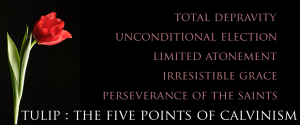
Calvinism 5 point TULIPThe first point of Calvinismโ€™s TULIP is Total Depravity.

Total Depravity forms the logical and theological foundation for the rest of the Calvinistic system, and as such, we will spend additional space laying out what Calvinism teaches about Total Depravity, and how it forms the foundation for everything that follows. If we can grasp all the intricacies and implications of Total Depravity, and see how it does not fit with Scripture, the rest of the Calvinistic system will fall like a set of dominoes.

It is not an overstatement to say, as does R. C. Sproul, that all five points of Calvinism stand or fall on the basis of Total Depravity.

If one embraces this aspect [inability] of the T in TULIP the rest of the acrostic follows by a resistless logic. Once cannot embrace the T and reject any of the other four letters with any degree of consistency (Sproul, Grace Unknown, 128)

Though my journey away from Calvinism ended by dropping Total Depravity, Sproul is correct: Total Depravity is foundational to TULIP Calvinism. As a result, I will be spending many posts discussing Total Depravity and related concepts.

what is total depravity

What is Total Depravity?

On the surface, the doctrine of Total Depravity seems acceptable. In fact, it is because of the surface level explanation of Total Depravity that I believed it for so long.

Just as many evangelists today begin their gospel presentation with the โ€œbad newsโ€ about our sinfulness before God, so the five points of Calvinism also begin with the sinful condition that mankind finds itself in. The term โ€œTotal Depravityโ€ refers to the sinfulness of humanity in relation to Godโ€™s righteous standards, and especially to our inability to do anything that helps us earn or merit eternal life from God.

I agree with this.

The reason I finally rejected Total Depravity, however, is not because I believe that people can โ€œsave themselvesโ€ or earn their way into heaven, or do anything good to merit eternal life. I believe nothing of the sort. Instead, I eventually rejected Total Depravity because I understood what most Calvinists meant when they talked about Total Depravity.

For Calvinists, Total Depravity means way more than just sinfulness.

But let us allow Calvinists to define and explain Total Depravity in their own words.

Total Depravity According to Calvinists

total depravity sinMany people, including many Calvinists, object to the term โ€œTotal Depravityโ€ because it gives the impression that human beings are totally and completely sinful. When some people hear about โ€œTotal Depravityโ€ they think of someone who always and only does the most evil thing possible.

This clearly does not happen. No person in history always does the most evil thing they can do in every situation.

Thankfully, Calvinists recognize this as well and so are careful to clarify that the teaching on Total Depravity is not the same thing as โ€œabsolute depravity,โ€ and that in general, humanity is not without some good. They say instead that Total Depravity means that mankind is as bad off as man can be (Spencer, TULIP, 32).

Here are some other quotes on Total Depravity from Calvinists:

Total depravity does not mean that each man is the epitome of the devil. For, as a matter of fact, man does not commit all the sins possible; and those he does commit are not always as bad as possible. Furthermore, we see that he can even perform a certain amount of relative good. โ€ฆ Total depravity means that natural man is never able to do any good that is fundamentally pleasing to God, and, in fact, does evil all the time (Palmer, The Five Points of Calvinism, 12-13).

Human nature has been and is utterly corrupted by sin so that man is totally incapable of doing anything to accomplish his salvation (Rose, TULIP, 2).

When Calvinists speak of man as begin totally depraved, they mean that manโ€™s nature is corrupt, perverse, and sinful throughout (Steele & Thomas, Five Points of Calvinism, 18).

Total Depravity means that unregenerate man is hopelessly enmeshed in sin, bound by Satan with the chords of spiritual death, and wholly disinterested in the things of the Creator (Spencer, TULIP, 36).

To be totally depraved, however, does not mean that a person is as intensively evil as possible, but as extensively evil as possible. It is not that he cannot commit a worse crime; rather, it is that nothing that he does is good. Evil pervades every faculty of his soul and every sphere of his life. He is unable to do a single thing that is good (Palmer, The Five Points of Calvinism, 9).

What total depravity is meant to convey is the idea that sin has affected the whole person down to the very core or root of his or her being (Boice & Ryken, Doctrines of Grace, 71).

By nature we are slaves to sin. This does not mean that the fall has destroyed or eradicated the human will. Fallen man still has all the faculties to make choices. WE still have a mind and a will. The problem is not that we cannot make choices. Natural men make choices all the time. The problem is that, in our fallen condition, we make sinful choices. We make these choices freely. We sin precisely because we want to sin, and we are capable of choosing exactly what we want to choose (Sproul, Grace Unknown, 130).

For the most part, though I would not state it in exactly the same way, I am not that opposed toward the teaching on Total Depravity as expressed in the quotes above.

I firmly believe that in and of ourselves, there is nothing we can do to earn or merit eternal life before God, or even to place ourselves in good standing with God. We cannot become righteous on our own. Even all of our righteous works are like filthy rags (Isaiah 64:6). On this, I am in agreement with Calvinism.

Future posts will show, however, that Calvinists have numerous teachings that come from Total Depravity which I am not too excited about. We will look at the first of these tomorrow. Until then, what do you think about the doctrine of Total Depravity as expressed above? Is it biblical or not? Is it wise to base our theology on a foundational idea of sin?

If you want to read more about Calvinism, check out other posts in this blog series: Words of Calvinism and the Word of God.

Affiliate Disclosure: As an Amazon Associate I earn from qualifying purchases. Thank you for supporting my work in this way!

God is Redeeming Theology Bible & Theology Topics: Books by Jeremy Myers, Calvinism, sin, Theology of Salvation, Theology of Sin, Total Depravity

Advertisement

Two Kinds of Forgiveness – One is free, one is conditional

By Jeremy Myers
48 Comments

Two Kinds of Forgiveness – One is free, one is conditional

forgiven forgivenessWhen seeking to understand the biblical definition of forgiveness, it must first be understood that there are two main Greek words for forgiveness, both of which refer to a different kind of forgiveness.

Charizomai Forgiveness

The first type of forgiveness is charizomai forgiveness, by which God has graciously forgiven us of all our sinsโ€”past, present, and future โ€” whether we confess and repent of these sins or not.

All people have this gracious forgiveness (charizomai) from God, whether they are a Christian or not.

As far as God is concerned, your guilt has been removed from you. Your sin is no longer an issue with God.

Aphฤ“sis Forgiveness

However, we all still struggle with the consequences of sin in our lives and in our relationships. The biblical answer to this problem is to first of all recognize that we have the gracious and loving forgiveness of God, but then to admit to God that we have actually messed up our lives by failing to live according to His instructions, and then seeking to take steps and make changes which allow us to live according to Godโ€™s will.

The biblical words for what I have just described are confession (admit, agree) and repent (turn from sin and turn toward obedience). When we do this, we receive release (aphฤ“sis) from the captivating power of sin in our lives.

When understood this way, we see that aphฤ“sis forgiveness has absolutely nothing to do with whether or not a person goes to heaven when they die. Aphฤ“sis forgiveness is about whether or not we live in bondage and enslavement to sin here and now in this life.

forgiveness aphesis release

This sort of forgiveness is not about whether or not God โ€œforgivesโ€ us. He does and He has! No, seeking to gain release (aphesis) from our sins through confession and repentance is about whether or not we gain freedom from the destructive power of sin in our lives which seeks to wreak havoc in our lives, our health, our marriages, our family, our finances, our jobs, and pretty much everything else.

God has forgiven so that we might gain forgiveness

So when we read the Bible and encounter the words โ€œforgiveโ€ or โ€œforgiveness,โ€ how should we understand these words? One thing to do would be to get an interlinear Bible so that you can see when the text is talking about aphฤ“sis forgiveness and when it has charizomai in view.

But if you donโ€™t have an interlinear Bible, you can simply look in the context of the verse which talks about forgiveness, and if there are conditions involved to receive this forgiveness (such as repenting, confessing, or forgiving others), you can be almost certain that the forgiveness in question is aphฤ“sis. If, however, the forgiveness is being offered freely by God to all without condition, then you can be confident that the forgiveness in question is charizomai.

Faith Alone in Christ Alone and Forgiveness

Faith alone in Jesus Christ grants us eternal life. But all Christians still struggle with sin. Many still sin just as much as they did before they were Christians. Though they have believed in Jesus for eternal life, there is still a pattern of sin in their lives from which they just cannot break free.

As a result of this ongoing power of sin in their lives, some of them begin to wonder if they are truly Christians. Sadly, many books, pastors, and Christian leaders only reinforce this idea. They teach that if you have patterns of habitual sin in your life, you have good reason to question whether or not you actually have eternal life.

But instead of this damaging line of thought, it is much better to realize that the way to gain release from the power of sin in our lives is not by wondering whether or not God has truly forgiven us and accepted us into His family (He has!), but by accepting by faith that God loves us completely, and wants us to break free from sin even more than we do.

This process of release (aphฤ“sis forgiveness) begins by agreeing with Him that we have sinned (confession), and then making the changes necessary in our lives (repentance) to get back onto the path of righteousness.

So do not let anyone ever tell you that you have committed a sin which God cannot forgive. No matter what sin you have committed, God has already forgiven you for it in Jesus Christ. This forgiveness is free and unconditional, and has already been extended to you whether you know it or not.

But God does want you to confess and repent of your sin, not in order to gain forgiveness, but because you have been forgiven. This confession and repentance is for your own good, so that you can gain freedom and deliverance from the enslaving power of sin in your life.

If this idea is helpful or challenging to you, share it with others using the buttons below to get their input as well!

Affiliate Disclosure: As an Amazon Associate I earn from qualifying purchases. Thank you for supporting my work in this way!

God is Redeeming Books, Redeeming Theology Bible & Theology Topics: aphesis, Books by Jeremy Myers, Calvinism, confession, eternal life, forgiveness, repentance, Theology of Salvation

Advertisement

  • « Previous Page
  • 1
  • …
  • 49
  • 50
  • 51
  • 52
  • 53
  • …
  • 82
  • Next Page »

My New Book is Out!

Get your copy on Amazon today!
Learn about the gospel and how to share it

Take my new course:

The Gospel According to Scripture
Best Books Every Christian Should Read
Study Scripture with me
Subscribe to my Podcast on iTunes
Subscribe to my Podcast on Amazon

Do you like my blog?
Try one of my books:

Click the image below to see what books are available.

Books by Jeremy Myers

My New Book is Out!

Get your copy on Amazon today!

Theological Study Archives

  • Theology – General
  • Theology Introduction
  • Theology of the Bible
  • Theology of God
  • Theology of Man
  • Theology of Sin
  • Theology of Jesus
  • Theology of Salvation
  • Theology of the Holy Spirit
  • Theology of the Church
  • Theology of Angels
  • Theology of the End Times
  • Theology Q&A

Bible Study Archives

  • Bible Studies on Genesis
  • Bible Studies on Esther
  • Bible Studies on Psalms
  • Bible Studies on Jonah
  • Bible Studies on Matthew
  • Bible Studies on Luke
  • Bible Studies on Romans
  • Bible Studies on Ephesians
  • Miscellaneous Bible Studies

Advertise or Donate

  • Advertise on RedeemingGod.com
  • Donate to Jeremy Myers

Search (and you Shall Find)

Get Books by Jeremy Myers

Books by Jeremy Myers

Schedule Jeremy for an interview

Click here to Contact Me!

Follow me on X

© 2026 Redeeming God · All Rights Reserved · Powered by Knownhost and the Genesis Framework