

Redeeming God

Liberating you from bad ideas about God

Join the discipleship group
  • Join Us!
  • Scripture
  • Theology
  • My Books
  • About
  • Discipleship
  • Courses
    • What is Hell?
    • Skeleton Church
    • The Gospel According to Scripture
    • The Gospel Dictionary
    • The Re-Justification of God
    • What is Prayer?
    • Adventures in Fishing for Men
    • What are the Spiritual Gifts?
    • How to Study the Bible
    • Courses FAQ
  • Forum
    • Introduce Yourself
    • Old Testament
    • New Testament
    • Theology Questions
    • Life & Ministry

God is Not Angry With You

By Jeremy Myers
10 Comments

God is Not Angry With You

God is not angryOne of the reasons Jesus came was to reveal God to us.

Among all the truths that Jesus revealed to us about God, one of the most critical truths in connection to the violence of God in the Old Testament is that God is not angry.

The violence of God in the Bible makes it appear that God is angry with us, and one way He deals with His anger is by slaughtering people through flood, earthquakes, pestilences, diseases, and enemy armies.

God is Not Angry with the World

When people believe that God is angry with the world, and is actively punishing us for the sins we have committed by sending us diseases, famines, earthquakes, storms, terror, and death, we malign the character of God. God does not torture, rape, kill, and murder in order to teach us to love and obey Him. While there is indeed blood on Godโ€™s hands, this blood is His own. God does not force us to bleed for Him so that we might learn some sort of lesson about obedience.

[God does not bring] about suffering in order to discipline a person. โ€ฆThis presumption morphs to cruel absurdity when we are speaking of horrors like a man mourning his murdered wife or a mother grieving over her stillborn child.

This way of thinking takes the cruel arbitrariness of life and deifies it by projecting it onto God. When this is done, the beautiful clarity of Godโ€™s loving will revealed in Christ and centered on the cross is obscured by a nonbiblical picture of a God of power. And Jesusโ€™ simple words โ€œIf you see me, you see the Fatherโ€ are qualified by every terror-stricken scream of torture throughout history (Greg Boyd, Is God to Blame? 82).

But God is not angry.

God is not out for bloody revenge.

God does not punish, kill, torture, or maim so that by some inscrutable aspect of His mysterious will, He might teach us a lesson.

Quite to the contrary, as I reveal in my book, (#AmazonAdLink) The Atonement of God, Godโ€™s nature and character is revealed in Jesus Christ.

God is not Angry

How Jesus Reveals God is Not Angry

When Jesus began to minister in Galilee, one of the common threads of His miracles and message was that God is not angry at us. Instead, God loves us, and wants to redeem, deliver, and rescue us from the clutches of Satan, the bondage of sin, and the sting of death.

I wish we had space and time to go miracle by miracle and parable by parable through the Gospel accounts to see how Jesus reveals the love and forgiveness of God through everything He says and does.

Such a study would reveal that the consistent message of Jesus is not that God is angry with us and has departed from us, but that we have misunderstood God and have departed from Him, and now, finally, God is bridging that divide by drawing near to us and reconciling us to Himself once and for all in the person and work of Jesus Christ.

God is not angry

The Parable of the Prodigal Son Reveals that God is Not Angry

Take one of the more popular parables as an example: the parable of the Prodigal Son. We all know the story. A man has two sons. The younger asks for his portion of the inheritance, and when he has received it, travels to a far country where he squanders his inheritance on parties. He eventually finds himself living and eating with the swine, and so decided to return home to his father, in the hopes that he might be taken on as a servant. But when he is a long way off, the father sees him coming and runs to him. Then the father throws a party for his long-lost son, which leads to a teachable moment for the older son.

There are multiple levels of interpretation to this parable, but one is sufficient for our purposes here.

The prodigal son is not just a story about a wayward Christian, but is a story of cosmic proportions. It is about a father who loved his son so much, he let the son think the worst of him, insult him, slap in the face, treat him as if he were dead, and then on top of it all, depart into a foreign land. Note that the father goes nowhere. The son has done all the leaving while the father stays right where he was.
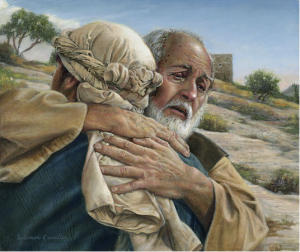
prodigal sonWhen the son returns, the father has clearly been watching for his return, for when the son is still a long way off, the father sees him coming, and runs to meet him on the road. For a wealthy middle-eastern man, any sort of running was considered shameful, but to run to meet a son who had betrayed you was extremely shameful. Nevertheless, due to the fatherโ€™s great love for his son, he runs to meet him, and not only that, but gives him a warm welcome and throws a party for him.

The only thing that is really different about this parable and how God behaves toward prodigal humanity is that God came Himself into the far country to seek and save the lost. Then, when God found His lost child, the child killed Him.

But other parables represent this aspect of what God has done for humanity in Jesus Christ. The point of this parable, as well as many of the other parables by Jesus, is to show humanity how badly we have misunderstood God and what God is doing in this world, and that God is not out to destroy us, slaughter us, or punish us, but is seeking to bring us back into His family, to rescue us from the pigsty we find ourselves living in, and to throw us a party when we are reconciled to Him.

This sort of message is found, not just in the parables of Jesus, but in all the other teachings and miracles of Jesus as well. By the love of God, those who were once far off have been brought near and have been accepted once again into Godโ€™s family.

God is Not Angry; God is Love

God is not angry with us; He loves us! And since the first sin of Adam, God has been doing everything He can to rescue and deliver us from sin, death, and devil.

The violent portrayals of God in the Bible are actually part of this rescue operation of God. He is not the one commanding or performing these violent actions, but is instead, taking the blame for them. Just like the father of the prodigal son, out of His great love for us, God is shaming Himself for our sake.

God of the Old Testament and JesusHow can a God who says "Love your enemies" (Matthew 5:44) be the same God who instructs His people in the Old Testament to kill their enemies?

These are the sorts of questions we discuss and (try to) answer in my online discipleship group. Members of the group can also take ALL of my online courses (Valued at over $1000) at no charge. Learn more here: Join the RedeemingGod.com Discipleship Group I can't wait to hear what you have to say, and how we can help you better understand God and learn to live like Him in this world!


Affiliate Disclosure: As an Amazon Associate I earn from qualifying purchases. Thank you for supporting my work in this way!

God is Redeeming Theology Bible & Theology Topics: anger, prodigal son, Theology of God, Theology of Jesus, violence of God, When God Pled Guilty

Advertisement

Dancing With Jesus

By Jeremy Myers
9 Comments

Dancing With Jesus

dancing with JesusMy friend, Sam Riviera, wrote this about how he spent Easter:

Amazing grace,
How sweet the sound.
That saved a wretch like me
I once was lost,
But now am found.
Was blind,
But now I see.

We spent Easter morning with the outcast — the lame, the halt, the thieves, the alcoholics, the drug-addicts, the murderers. We climbed out of our warm beds and headed out into the streets laden with bags of clothes, food and water. We shared what we had with those who had slept under bushes, on the ground and any other place they could find.

Happy Easter! Happy Easter! Almost every person greeted us with โ€œHappy Easter!โ€

These are supposed to be the people who donโ€™t know Jesus. Yet they know Jesus. They have seen Jesus walking among them. He has danced with them. He loves them. They like Jesus.

Jesus was with them in prison. He visited them there. He was with them in Southeastern Asia when they spent the years rotting away in bamboo cages lowered into holes. He was with them as they walked the streets of America, looking for a place to lay their head. They told us Jesus was with them.

โ€œGrace. Itโ€™s all about grace. No matter had bad we screw up, Godโ€™s grace is still good. He never forgets us. Heโ€™s always there. Heโ€™s always been there for me. Heโ€™s been there the last eighteen years while Iโ€™ve traveled around the country. I donโ€™t have a dime to my name, but Iโ€™ve got Godโ€™s grace. Itโ€™s all about grace. Donโ€™t ever forget that.โ€

So said the man sitting on the sidewalk on Easter morning. The man with no home. The man with nothing. But he knows that Jesus lives!

โ€œSee this mark behind my ear,โ€ said another. Thatโ€™s where the VC shot me. The bullet came out through my nose. See this big white patch on my thighโ€ he said, pulling up his pant leg. โ€œThatโ€™s where they got the skin to graft onto the left side of my face. Another bullet ripped a big hole there and they had to patch it. God got me through it and Heโ€™ll get you through whatever comes your way too.โ€

We went to give a cup of water, a warm coat. We found Easter. The risen Jesus had been there. The risen Jesus was there, walking among those outcast and despised by the world. He too had been outcast and despised. He knows what itโ€™s like. He walks among those He loves. They see Him. They see the One who was despised, rejected and afflicted. He is one of them.

He is risen!

He is risen indeed!

He walks among His people.

He loves us. Whether weโ€™re thieves, adulterers, liars, cheats, gluttons, alcoholics or murderers, He loves us.

Whether we see Him in a fancy building with stained glass windows or dancing with us in the streets, Heโ€™s there. Heโ€™s alive.

If you havenโ€™t seen Him, walk with those who do see Him. Perhaps youโ€™ll catch a glimpse. Perhaps Heโ€™ll come and sit with you. Perhaps Heโ€™ll dance with you.

There is so much need in the world!

And YOU can help.

Fill out the form below to receive several emails about how to love and serve the poor and homeless.

(Note: If you are a member of RedeemingGod.com, login and then revisit this page to update your membership.)

Affiliate Disclosure: As an Amazon Associate I earn from qualifying purchases. Thank you for supporting my work in this way!

God is Redeeming Theology Bible & Theology Topics: Discipleship, Easter, following Jesus, He is risen, mission, Sam Riviera, Theology of the Church

Advertisement

Why God Appears Violent in Scripture

By Jeremy Myers
22 Comments

Why God Appears Violent in Scripture

The reason that God appears so violent in Scripture (and in nature) is not because He is violent, but because He allows human and natural violence to be attributed to His name for our own sake. There are numerous reasons God allows violence to be attributed to His name, but we must begin by understanding the origin of violence itself.

The Origin of Violence

violent GodThroughout history and around the world, people have noticed that violence permeates everything. From birth to death, from galaxies down to sub-atomic particles, violence is omnipresent. Whenever people recognize this, they are left with only two basic options for the existence and origin of violence.


First, as I discuss in my book, (#AmazonAdLink) The Atonement of God, some people decided that violence and evil were eternal and that God was constantly at war against this violence and evil, but would never overcome it. This view has come to be known as dualism, and while dualism is prevalent in many Eastern religions and has attached itself in various ways to most Western religions (including Christianity), most Christians would not say that evil is eternally co-existent with God.

The second option for the origin of violence is that somehow or another, violence and evil originated with God (or the gods). Though many in the ancient world had no problems with such an idea (just look at how the gods of Egyptian, Persian, Greek, Roman, and Egyptian mythology behave) such a suggestion is not acceptable to most people today. Ever since the time of Plato (and as a result of his ideas), the gods are supposed to behave in morally superior manner, and not simply be extreme manifestations of humanityโ€™s deepest emotions and desires.

God and the Origin of Violence

Since neither option for the origin of evil and violence appeals to most Christians, numerous theories have been proposed for how violence and evil can exist in Godโ€™s good creation while not being eternally existent with God nor having its origin in God.

Some say the violence came directly from God, while others said its origin was in evil spiritual beings who rebelled against God, or even in mankind ourselves, but such options beg the question about why God would create beings who were capable of such evil.

Others argue that violence and evil are not always identical, so that what is violent may not always be evil. Though this is true, the origin of violence and evil must still be considered.

Regardless of which view people today hold regarding the origin of evil and violence, it cannot be denied that civilizations of earlier eras believed that since all creation was violent, and since all creation came from God, that therefore, God also was violent. How else, they thought, could violence exist? If God did not will it, want it, or command it, violence would have no place in the world.

Such a view is not surprising, for many people today believe the exact same thing.

The Origin of our OWN Violence

But more than the origin of violence, people needed an object on which to blame their own violence. For while everybody hates violence in others, we always seek to justify the violence that we ourselves exhibit.

Whenever we ourselves commit violence, we almost always find some way to blame it as a necessary response to the actions of others against us. Sometimes, when our violence has no one else to blame, we place blame upon God.

God is not violent

If we deny that God is the source of our violence, then we are left with only two options: either we must call our violence โ€œgoodโ€ or we must accept that we ourselves are terribly and inherently violent.

Though some theologians take the first option and some warriors take the second, the vast majority of mankind prefers to blame their violence on God. The violent God of a violent creation is the perfect target for our own violence. The word โ€œtargetโ€ is used intentionally. When we blame God for the violence we ourselves commit, God becomes both the justification for our violence, and the victim of it.

So why does God appear violent in Scripture? Because we have blamed God for our own violence. (See my book, (#AmazonAdLink) The Atonement of God, for a longer explanation.)

God appears violent in the Bible because humans would rather blame God for our violence than admit that we ourselves are violent. And as we have seen in previous posts, and will see in future posts, God willingly accepts the blame (or responsibility) for our violence because He is seeking to rescue and deliver us from it.

God of the Old Testament and JesusHow can a God who says "Love your enemies" (Matthew 5:44) be the same God who instructs His people in the Old Testament to kill their enemies?

These are the sorts of questions we discuss and (try to) answer in my online discipleship group. Members of the group can also take ALL of my online courses (Valued at over $1000) at no charge. Learn more here: Join the RedeemingGod.com Discipleship Group I can't wait to hear what you have to say, and how we can help you better understand God and learn to live like Him in this world!

Affiliate Disclosure: As an Amazon Associate I earn from qualifying purchases. Thank you for supporting my work in this way!

God is Redeeming Theology Bible & Theology Topics: Books by Jeremy Myers, evil, Theology of God, Theology of Sin, violence of God, When God Pled Guilty

Advertisement

I get Depressed on Facebook

By Jeremy Myers
22 Comments

I get Depressed on Facebook

I used to think it was just me. Then my wife got a Facebook account, and she complained of it too. Then I saw the little comic below, and realized that maybe it is a common occurrence.

facebook life

When I get onto Facebook, it seems that everybody else’s life is full of vacations, parties, promotions, happy children, perfect marriages, and people who are “happy happy happy all the time.”

Since my life isn’t like that at all, I stopped getting on Facebook. It was too depressing.

So if you want to “Like” me on Facebook, I promise not to tell you how grand my life is. You will mostly just get updates about my blog. If you haven’t already, please “Like” me below!


This post is part of the March Synchroblog. It is on the subject of “New Life” and while I thought about writing something serious and theological, I decided to do this more “lighthearted” post. Why? Laughter and humor should central aspects of our new life in Christ. I am generally pretty serious, but am learning to loosen up and laugh more in life.

Here are the other contributors to this month’s synchroblog:

  • Michael Donahoe โ€“ New Life
  • K.W. Leslie โ€“ Sin Kills; God Brings New Life
  • Carol Kuniholm โ€“ New Life. Mystery Fruit.
  • Glenn Hager โ€“ A Personal Resurrection Story
  • Loveday Anyim โ€“ Spring Forth โ€“ Ideas That Speak New Life
  • Loveday Anyim โ€“ Inspired By Spring To Create A New Life
  • Sarah Quezada โ€“ Post Winter Delight
  • Edwin Aldrich โ€“ Finding New Life In Our New Home
  • Doreen A. Mannion โ€“ Each Day A New Decision: Choose Life
  • kathy escobar โ€“ new life through nonviolent communication
  • Anita Coleman New Life, The Immortal Life of Henrietta Lacks, and Eternal Living
  • Sonja Andrews Persephone
  • Mallory Pickering New Life Masterpiece Theater Style

Affiliate Disclosure: As an Amazon Associate I earn from qualifying purchases. Thank you for supporting my work in this way!

God is Redeeming Theology Bible & Theology Topics: Blogging, Discipleship, facebook, life, synchroblog

Advertisement

How do I stop sinning?

By Jeremy Myers
64 Comments

How do I stop sinning?

Below is another question that was sent in by a reader. He wants to know how to stop sinning.

Don’t we all!

Below his question I have included the answer I sent to him, but I am sure he would like for you to weigh in as well. As always, be gracious in your replies. cant stop sinning

I need your advice. I was saved in 2005 and really pursued God and got close to Him. I have a reputation in my town and with my family as a big Christian. God used my to witness and that made people form the opinion of me. I have been living for him off and on. Finally the other night I drank some alcohol and slept with a girl. Now sometimes I feel awful. I feel like the biggest hypocrite alive. And I’m afraid if people found out it would discredit God. I used to live a life of integrity and had boldness. Now I am often reminded of what I have done and feel less than bold.

Thank you for any advice.

P.S. I know that you are very big on believing God always finishes His work in us. So my question is what do I do when I sin? I know it can’t be OK and fine to live in sin and claim to be a Christian. How do I get my confidence before God back by not sinning for a long time? That doesn’t seem right. And lastly if I try and witness I am reminded of my own sin so I lose confidence.

This is a very difficult question, as I know almost nothing about your situation, your beliefs, or your background.

But let me suggest this: It sounds to me like you are trapped in religion. It may be the Christian religion, but it is still religion.

One prominent sign of religion is the desire to live a certain way to give an impression to others that we are godly and spiritual.

We hide from others who we really are, and we never let them see our mistakes, our failures, or our weaknesses.

There are other indicators of religion as well, such as the desire to keep God happy with us through our obedience and the pressure to live by a set of rules and standards that keep us in good standing with others in our religious group.

I could go on and on about religion, but that is not going to helpful for you right now. You want to learn how to stop sinning.

Here are my recommendations:

Learning to live the victorious Christian life is based on three things:

1. Honesty with God about who you are

Most sin comes from a failure to be honest with ourselves and with God about our own weaknesses and mistakes. We often try to put on a good show for God and others, hiding from them the real struggles that we face.

But if we are not honest with God about our struggles, then we will never be able to receive help from Him.

Though it may sound trite, confessing your sin to God is the beginning point of gaining freedom from that sin (and the guilt that comes with it). See 1 John 1:9-10.

Then every time you struggle with sin, with temptation, or even find yourself in the midst of sin, be honest with God about it.

There have been times when I have been in the midst of some sin, and I look at what I am doing and in the midst of that sin, pray, saying, “God … what am I doing?” Almost always, it seems to me that God says back, “Yeah … I was wondering the same thing.”

And then we are able to have a conversation about that sin, why I fell into the trap, and what I got out of it. Usually, such open and honest conversations with God help me resist the temptation when it comes at a later time.

Remember, God is not shocked, surprised, or ashamed of your sin. He walks with us through our sin because He wants to help rescue us from our sin.

As we are open and honest with God about our sin — even in the midst of the sin — we begin to understand that God is not scared off by our sin, nor is He shocked, surprised, or ashamed when we sin. God wants us to invite Him into our sin, not so that He can participate with us, but so that He can rescue us from it.

Living this way will help with my second recommendation.

2. Knowledge that God loves and forgives you NO MATTER WHAT

As we are honest with God about our sin, we will come to see that God loves us and forgives us no matter what.

Religion often teaches us that God’s forgiveness has a limit. But if Jesus tells us to forgive those who sin against us 490 times (which means … don’t even count, just always forgive), don’t you think that God Himself does the same thing toward us?

Infinite grace, love, and forgiveness is not a license to sin as many Christians assume, but is the starting place of learning to live without sin. Sin loses all its power when we realize that sin will not cause God to love us any less.

Learning to live in God’s love is essential to learning to beat sin and temptation.

While we cannot become sinless, by focusing on the love of God, we can learn to sin less.

3. Believe that as you are honest with God and rest in His love, He will conform you to Jesus Christ

When we are honest with God and learn to rest in God’s love, these two things allow God to begin to work in us in ways that we were trying to do in our own strength previously. When we are focused on a list of do’s and don’ts, and behaviors and actions that we must practice for God to love us and forgive us, we are trying to live life on our own strength. If we are successful, we become self-righteous and proud. If we fail, we become depressed and desperate.

But when we are honest with God, and know that He is with us, loves us, and forgives us, it is from this place of resting in God’s love that He begins to perform His work within us. It takes time, to be sure, but God’s will can only be done in God’s time.

So those are my three recommendations.

Notice that I am not telling you to broadcast to your town and your family about what you have done. Some Christians would tell you do this, but I won’t. It might be important for you to make a public confession, but it might not. That is something between you and God. I think that as you incorporate the three recommendations above, God will make it clear to you how He wants you to proceed regarding your sin.

Let me say one thing though about your lack of boldness and confidence. I might be wrong, but it appears that your boldness came from your ability to be a good Christian. Now that you have failed, you no longer have the self-righteous pride you did before, and so lack the boldness. This is actually a very good thing. In that sense, praise God for the good work He is already accomplishing in your life as a result of your failure. We must not ever be confident in ourselves, but confident in God and His grace. How do you gain this confidence in Him? Through the three recommendations above.

Oh, and one last thing. As I was searching for images for this post, I found the two images below:

stop sinning

I laughed a bit because of the internet memes these images come from, but the images gets it right. One does not simply stop sinning. And we can wish to stop sinning and try to stop sinning all we want, but sin will be a constant reality this side of glory, and the sooner we learn that fact, the better. Again, this is not a license to sin, but an invitation to invite God into our sin, and let Him deal with it as only He can.

I hope this helps a little bit. Hopefully some of the comments below will be helpful as well.

Affiliate Disclosure: As an Amazon Associate I earn from qualifying purchases. Thank you for supporting my work in this way!

God is Redeeming Theology Bible & Theology Topics: Bible and Theology Questions, forgiveness, grace, love, religion, stop sinning, Theology of Sin

Advertisement

  • « Previous Page
  • 1
  • …
  • 51
  • 52
  • 53
  • 54
  • 55
  • …
  • 82
  • Next Page »

My New Book is Out!

Get your copy on Amazon today!
Learn about the gospel and how to share it

Take my new course:

The Gospel According to Scripture
Best Books Every Christian Should Read
Study Scripture with me
Subscribe to my Podcast on iTunes
Subscribe to my Podcast on Amazon

Do you like my blog?
Try one of my books:

Click the image below to see what books are available.

Books by Jeremy Myers

My New Book is Out!

Get your copy on Amazon today!

Theological Study Archives

  • Theology – General
  • Theology Introduction
  • Theology of the Bible
  • Theology of God
  • Theology of Man
  • Theology of Sin
  • Theology of Jesus
  • Theology of Salvation
  • Theology of the Holy Spirit
  • Theology of the Church
  • Theology of Angels
  • Theology of the End Times
  • Theology Q&A

Bible Study Archives

  • Bible Studies on Genesis
  • Bible Studies on Esther
  • Bible Studies on Psalms
  • Bible Studies on Jonah
  • Bible Studies on Matthew
  • Bible Studies on Luke
  • Bible Studies on Romans
  • Bible Studies on Ephesians
  • Miscellaneous Bible Studies

Advertise or Donate

  • Advertise on RedeemingGod.com
  • Donate to Jeremy Myers

Search (and you Shall Find)

Get Books by Jeremy Myers

Books by Jeremy Myers

Schedule Jeremy for an interview

Click here to Contact Me!

Follow me on X

© 2026 Redeeming God · All Rights Reserved · Powered by Knownhost and the Genesis Framework