Redeeming God

Liberating you from bad ideas about God

Join the discipleship group
  • Join Us!
  • Scripture
  • Theology
  • My Books
  • About
  • Discipleship
  • Courses
    • What is Hell?
    • Skeleton Church
    • The Gospel According to Scripture
    • The Gospel Dictionary
    • The Re-Justification of God
    • What is Prayer?
    • Adventures in Fishing for Men
    • What are the Spiritual Gifts?
    • How to Study the Bible
    • Courses FAQ
  • Forum
    • Introduce Yourself
    • Old Testament
    • New Testament
    • Theology Questions
    • Life & Ministry

Is faith like getting in a wheelbarrow to be pushed across Niagara Falls?

By Jeremy Myers
3 Comments

Is faith like getting in a wheelbarrow to be pushed across Niagara Falls?
http://media.blubrry.com/one_verse/feeds.soundcloud.com/stream/540400641-redeeminggod-137-is-faith-like-getting-in-a-wheelbarrow-to-be-pushed-across-niagara-falls.mp3

How do you define and explain faith? How do you know you have faith? What is faith?

(#AmazonAdLink) What is FaithI have a new book coming out on January 15 which answers all of these questions about faith. The book is titled, (#AmazonAdLink) What is Faith? and is available for preorder on Amazon.
But between now and then, I wanted to publish several Podcast episodes which talks about faith, and looks at several tricky and troublesome texts in the Bible about faith.

We will discuss the concepts of great faith and little faith. We will look at whether there is such a thing as head faith and heart faith. We will also discuss the faith of demons mentioned in James 2.

In today’s study, I just want to introduce some of the key concepts about faith that will help you understand what the Bible is talking about when it talks about faith.

Let me begin by telling you a story, which you have probably already heard.

The Niagara Falls Tightrope Illustration of Faith

There once was a man who walked across Niagara Falls on a tightrope. After the tightrope had been fixed in place, he started gathering a crowd to watch his daring and dangerous feat. โ€œCome one! Come all!โ€ he shouted into his bullhorn. โ€œWatch me walk above Niagara Falls, balancing on nothing more than this little rope!โ€

faith tightrope walk

As people started gathering, he passed around a sample of the rope so people could see how small it was. โ€œOne little slip, and I will tumble to my death in the waters below!โ€ he shouted. โ€œYou never know when I might fall. The rope is getting wet from the misting water. A wind is coming up the gorge. I donโ€™t want to die, but today could be the day!โ€

As the crowd swelled even more, he shouted to those who had gathered, โ€œWho believes I can walk across the falls and back without falling to my death below?โ€

Most of the crowd shouted that they believed he could do it. Many of them cheered him on to try it. So he climbed up onto the rope, and balanced his way across Niagara Falls. When he reached the far side, he turned around and came back. He didnโ€™t slip. He didnโ€™t fall. In fact, he barely wobbled or wavered. So when he returned to the safety of the shore, he motioned with his hands for the cheering crowd to quiet down.

โ€œThat was too easy!โ€ he yelled. โ€œThat wasnโ€™t a challenge for me at all! Letโ€™s make it more difficult! Who believes I can do again, but this time, while pushing a wheelbarrow? If my hands are on the wheelbarrow, I will not be able to use them to balance on the rope. Shall I give it a try? Do you believe I can do it?โ€ He motioned to a nearby wheelbarrow, which he had brought for this very purpose.

The crowd cheered their approval, which caused the number of gathering people to swell even further. So with the help of two nearby men, he lifted a wheelbarrow up onto the rope, and then started pushing it across the Falls. He went more slowly this time, and even had a few wobbles, which caused the crowd to gasp and cry out with fear, but he made it to the other side and back without any great problem.

The crowd went wild.

โ€œThat was too easy!โ€ he yelled. โ€œWho believes I can do it again, but this time, with another person inside the wheelbarrow?โ€ The crowd roared their approval. โ€œI would not only be risking my own life, but also the life of the person in the wheelbarrow,โ€ the man shouted to the crowd. โ€œWith a show of hands, let me see how many of you believe I can do this!โ€ Almost every person in the large crowd raised their hand. It was nearly unanimous.

โ€œWonderful! I am so glad to see that you have such faith in me! I think I will give it a shot!โ€ the man yelled. โ€œNow โ€ฆ among all of you who raised your hand, do I have a volunteer to get into the wheelbarrow?โ€ Every hand in the large crowd went down. โ€œWhat?โ€ said the man. โ€œYouโ€™ve seen me walk across Niagara Falls twice without any problems, once while pushing this wheelbarrow! And most of you believe I can do it with someone else in the wheelbarrow with me! But when I ask which of you wants to get into the wheelbarrow, none of you volunteer? Do you believe I can do it or not?โ€

But there were no takers, so the crowd did not see him push someone across Niagara Falls in a wheelbarrow that day.

This story is likely fictional, but it is often used by pastors and preachers as an example of faith. They say, โ€œYou see? Itโ€™s not true faith unless you get into the wheelbarrow. Those people didnโ€™t really believe. They just said they believed. They raised their hand claiming they had faith the man could do it. But it is not enough to say you believe. It is not enough to claim you have faith. If you really believe, you have to get into the wheelbarrow. Otherwise, you have false faith. Spurious faith.โ€

faith tightrope walk niagara falls wheelbarrowThen the pastor goes on to tell the audience how they can have true and effective faith. Usually the pastor says that they need to โ€œproveโ€ the reality of their faith by their good works.

If they donโ€™t have the good works which proves the existence of their faith, then they are just like the people who claimed to have faith, but didnโ€™t prove it by getting into the wheelbarrow.

Most people go away from such a sermon wondering if theyโ€™ve really believed, and therefore, whether they are really a Christian.

But you can know that you are really a Christian and that you have really believed.

You can know that you have eternal life.

You can know that you are already in the wheelbarrow, and that it is the safest place you can be.

This knowledge of your safety and security in Jesus Christ begins by properly defining the word โ€œfaith.โ€

The Definition of โ€œFaithโ€

When we begin to define the word โ€œfaith,โ€ it is important to recognize that modern, English usage of the word โ€œfaithโ€ does not match the ancient Hebrew or Greek usage. The way this word is used today bears little resemblance to the way the word was used in biblical times.

Today, when we use the word “faith” or “believe” we tend to use it as a synonym for “hope.” We say, I believe the Red Sox will win the Word Series. But really, we only hope they win. We do not know for sure that they will win.

But this is not how the word “faith” was used in biblical times.ย In the Greek New Testament, the word โ€œfaithโ€ is most commonly used in reference to something that a person knows to be true.

For New Testament era Christians, to believe something, or to have faith, meant that they were persuaded or convinced of the truth of it. They knew it to be true.

Good synonyms for โ€œfaith,โ€ therefore, are not โ€œhope or wishโ€ but rather โ€œpersuasion, conviction, or knowing.โ€

faith is certaintyNew Testament Greek Lexicons typically provides three basic definitions for pistis. When used with an article, as in โ€œthe faith,โ€ it typically refers to the body of Christian beliefs that separates Christianity from other religious faiths. It is used this way thirteen times in the New Testament (cf. Acts 6:7; Rom 4:11; Gal 1:23).

Second, the word can be translated as โ€œfaithfulnessโ€ or โ€œfidelity.โ€ But even most of theseย could arguably be translated as โ€œfaithโ€ (Matt 23:23; Rom 3:3; Gal 5:22; Titus 2:10). We will discuss this concept in a future podcast episode.

The third possible definition for pistis is also the most common. Over 180 times in the New Testament, pistis refers to โ€œbelieving.โ€ In context, this belief occurs when a person knows something to be true.

Therefore, the primary lexical definition for the verb is โ€œto consider something to be true, to believe.โ€[1] Faith (and the verb โ€œbelieveโ€) is a confidence, persuasion, or conviction that something is true.[2] We have faith when we are fully persuaded by the evidence presented to us. โ€œTo believe is to be persuaded that some declaration is true. โ€ฆ If you think something is true, you believe it.โ€[3]

Joseph Dillow says,

Faith is located in the mind and is persuasion or belief. It is something which โ€œhappensโ€ to us as a result of reflection upon sufficient evidence โ€ฆ Saving faith is reliance upon God for salvation. It does not include within its compass the determination of the will to obey, nor does it include a commitment to a life of works. To believe is to be persuaded and be reliant and includes nothing else.[4]

So what then is biblical faith (or belief)?

We can do no better at defining faith than does the author of Hebrews, who writes: โ€œFaith is the substance of things hoped for, the evidence of things not seenโ€ (Heb 11:1). The author of Hebrews is saying that faith substantiates, or sees as reality, that which we have previously only hoped to be true.

Faith is the evidence, conviction, or confidence in things we cannot see. Certainly, we also believe the things we have seen, but the faith described in the rest of Hebrews 11 is the faith that is confident in Godโ€™s promises based on what is known about Godโ€™s character and Godโ€™s Word.

A Second Look at the Tightrope Illustration

This brings us back to the illustration of the tightrope walker pushing a wheelbarrow across Niagara Falls. The people truly believed that the man could walk across the tightrope above Niagara Falls. They had seen him do it. They also believed that he could do it with a wheelbarrow. They had seen him do this as well.

In both cases, their faith was real and genuine. Based on what they had seen him do, they also stated their belief that he would be able to push someone across Niagara Falls in a wheelbarrow.

However, none of them were willing to get into the wheelbarrow themselves. Does this mean that they didnโ€™t actually believe?

No, it does not. They did believe and their faith was genuine.

So why didn’t they want to get into the wheelbarrow?

First, walking across Niagara Falls on a tightrope has inherent risks. This is why it is so thrilling to watch. And given all the various things that can go wrong in such a situationโ€”many of which are completely out of the control of the man on the tightropeโ€”there is no guarantee that he will make it across.

Even if he performed this feat a thousand times in a row and became so good at it that he could run across while blindfolded, there is still no guarantee that he would be able to do the one-thousand-and-first time. Maybe a stronger than normal gust of wind would knock him off balance. Maybe it would start to rain and he would slip. Maybe a reckless bird would hit him in the head. There are just too many variables.

No matter how many times the man completes this feat, it is a statistical certainty that eventually he will slip and fall to his death.

So while the crowd could state their genuine belief every time that the man will make it across the falls, they also believe that a time will come when the man will fall. None of the people on the shore wanted to be in the wheelbarrow when that happened.

So the people on the shore had two genuine, but conflicting, beliefs.

They believed that the man could walk across Niagara Falls, and would be able to do it many times, even with a person in a wheelbarrow. However, they also believed in statistics and science, both of which say that eventually, the tightrope walker will fall.

Related to this, while the people on the shore might have had full faith in the tightrope walkerโ€™s ability to maintain his balance, none of them had faith in their own ability. It is logical and reasonable to think that the man could take someone across the Falls in a wheelbarrow if the person stayed completely still and did not move.

After all, if the person in the wheelbarrow starts flailing about, screaming in terror, or even sneezes, such movement could throw off the balance, causing both people to plunge to their death below. And as all people know, we cannot always keep fear at bay, nor can we easily hold back a sneeze.

Therefore, here again, while a person might properly believe that a well-trained tightrope walker can push a person in a wheelbarrow across Niagara Falls, there are too many unknown and uncontrollable variables for any person to believe that they themselves could hold still enough to complete such a dangerous journey.

The bottom line truth is that that this fictional illustration about how nobody from a watching crowd would get into a wheelbarrow so that they might be pushed across Niagara Falls on a tightrope does not illustrate the lack of faith in the watching crowd.

To the contrary, it shows their true and genuine faith in a variety of truth claims. They believed the man could do it. But they did not believe in their own ability to sit still enough inside the wheelbarrow. They also knew (i.e., believed) that there were millions of random variables in nature that could create problems as well.

So did they believe the man could push a person across Niagara Falls in a wheelbarrow? Yes, they firmly believed that the man could do it.

But did each individual person believe the man would do this for themselves if they got into the wheelbarrow? No, they did not believe this, for the various reasons mentioned above.

They probably had somewhere over fifty percent certainty that he would, maybe even approaching ninety percent certainty in some cases. But this was not enough reasonable certainty for them to gamble their lives on it.

God is not a Tightrope Walker!

But notice how different it is when it comes to the promises of God made to us through Jesus Christ.

God is not a tightrope walker who will eventually make a mistake if we just give Him enough time. If He promises to take us across a spiritual tightrope, He will fulfill that promise every single time forever and ever without fail.

There are no spiritual or natural variables which can wreak havoc with the promises of God.

faith in God

The same goes for Jesus. When Jesus makes a promise, it is a promise with a 100% guarantee. Like God, Jesus is fully reliable.

Eternal Life is Not a Wheelbarrow

Furthermore, many of the promises of God are not at all dependent upon our own effort or involvement.

If we were to equate eternal life to getting into a wheelbarrow for a trip across Niagara Falls, then we would also have to say that on this trip, we could jump around and do flips inside the wheelbarrow and Jesus will still not lose His balance or let us fall into the waters below.

We could even try to jump out, but He will not let us fall. Eternal life is His gift to us, and this gift has an everlasting guarantee. We are safe and secure in His hands, and He will never let us go (John 10:27-29). This is His promise.

When we refuse to believe His promises, it is simply because we are refusing to believe that Jesus knows what He is talking about and can be trusted to do what He says.

Jesus is fully trustworthy and reliable. So you can believe in Him for what He says. And when He offers eternal life to anyone who believes in Him for it, you can know that if you have believed in Jesus, then you have eternal life.

When you believe in Jesus, you are already in the wheelbarrow and He is taking you across the falls, and there is nothing that you, or anyone (or anything) else can do to stop Him (Rom 8:38-39).

Nevertheless, I imagine that you still have some questions about the nature of faith and how faith works. You also might still have some lingering doubts about whether or not you really believe. Maybe you have also heard people talk about head faith, heart faith, true faith, false faith, small faith, and great faith, and you want to know how these sorts of descriptions fit with what we have learned in this chapter.

We will continue to look at these sorts of questions and issues in future podcast episodes.

The Gospel DictionaryUnderstanding the Gospel requires us to properly understand the key words and terms of the Gospel. Take my course, "The Gospel Dictionary" to learn about the 52 key words of the Gospel, and hundreds of Bible passages that use these words.

This course costs $297, but when you join the Discipleship group, you can to take the entire course for free.

Notes for this Podcast Study on Faith

[1] Walter Bauer et al., (#AmazonAdLink) BAGD,ย ย 816.

[2] Wilkin, (#AmazonAdLink) Confident in Christ, 5, 7.

[3] Shawn Lazar, (#AmazonAdLink) Beyond Doubt, 106.

[4] Dillow, (#AmazonAdLink) Final Destiny, 276.

Affiliate Disclosure: As an Amazon Associate I earn from qualifying purchases. Thank you for supporting my work in this way!

God is Redeeming God, Redeeming Theology, z Bible & Theology Topics: believe, believe in Jesus, certainty, faith, gospel dictionary, pistis, what is faith

Advertisement

Legalism: The Biggest Threat to Church Unity

By Jeremy Myers
55 Comments

Legalism: The Biggest Threat to Church Unity

There is no greater threat to the unity of the church than legalism.

These are strong words, but history, tradition, experience, and Scripture reveal that where legalism spreads, disunity prospers.

Thankfully, God has provided an antidote to legalism through the free gift of eternal life which is received by grace along through faith alone in Christ alone.

legalism threat to unityJust as legalism breeds disunity, love and unity flourish where grace and faith multiply. The more we emphasize grace and faith, the greater our unity will be. For this reasonโ€”and simply for the sake of the truthโ€”a strong stance on the simplicity and freeness of eternal life by grace alone through faith alone is essential.
To see this, it is important first of all to know what legalism is.

Legalism Defined

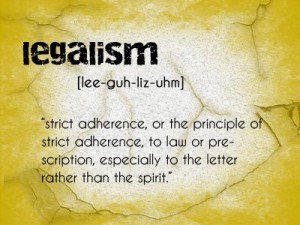
Lots of people have heard about legalism, but few know what it is. Here is a basic definition of legalism:

Legalism is when people use the law of God in an attempt to gain favor with God.

legalism definedAt it’s core, legalism believes that God is angry with humanity, and that the way to make God like us again is to obey His laws. And if everybody could just obey God’s laws all at the same time, then God might love us and be happy with us again, and blessings from heaven will flow down upon us once more.

So at it’s core, legalism has some seriously faulty views about God, about sin, about the law, and about how people can get into a good relationship with God. All of these faulty views are what makes legalism so dangerous and divisive.

Legalism is Dangerous

Legalism is dangerous because it begins with the premise that God is mad at us and He gave us His law so that we could get back into His good favor.

But if Jesus tells us anything about God, it is that He is NOT angry with us. To the contrary, He loves us deeply and longs for nothing more than to reconcile us to Himself (2 Cor 5:19). It is not He who needs to be reconciled to us, but we to Him. In other words, He is not the one who has abandoned us; we have abandoned Him. It is not He who left us, but we who left Him.

By sending Jesus to this earth, God bridged the divide that we placed between Him and us. Out of His great love for us, He has come to where we are, because He knew that we would never (and could never) come to Him.

But the basic premise of legalism contradicts all this. Legalism teaches that we have offended God so deeply that He is angry with us… He even hates us… and so we must try to please and appease God by doing things He likes so that maybe, somehow, hopefully, God will love us once more.

Not only is such legalistic theology terribly wrong, it becomes terribly divisive.

Legalism is Divisive

Legalism is divisive because as soon as one person thinks that they are starting to obey God’s law and make God happy with us again, that person begins to think that the reason God is still angry with the world is not because of his or her sin, but because of everyone else’s. So if everyone else would just clean up their life and start obeying God, then God will start to love us again. As soon as legalists begin to make some headway in their own life in the “Obedience to the Law” department, they set themselves up as a manager in the department, and try to get everybody else to follow the rules as well.

But this isn’t the most dangerous or divisive element to legalism. What makes legalism so divisive is that nobody actually thinks they are legalistic.

Though there are countless Christians who are legalistic, you will never meet anyone who claims to be a legalist. This is what makes legalism so sinister. It sucks the life out of Christians who believe they stand for the truth of Scripture and the Gospel. Legalism run madly toward death, all the while thinking they are pursuing life.

legalism and obedienceSince nobody believes that they are legalistic, everybody believes they have a healthy balance between law and grace, between faith and good works. A legalist then, is anyone who places a greater emphasis on law and good works than you do. On the opposite end of the spectrum, we criticize those who take grace too far. Those people are licentious, we think. They place too much emphasis on grace and in so doing, give people license to sin.

In this way, since only “other” people are legalists, and each of us is only trying to get people to obey God and live within the principles of the Kingdom of God, the hidden legalist in each of us (myself included!) becomes judgmental, critical, and divisive in our treatment of others. Legalism tears Christians apart because it sets up laws and rules as the means by which we maintain relationships between one another and between ourselves and God. And part of the divisive nature of legalism is that nobody can agree on the rules that must be observed. Everybody has different rules and regulations that must be maintained in order to fellowship with someone else.

Legalism’s Antidote

So what is the cure? What is the fix? What is the antidote to legalism?

Since legalism is so sinister, and since it is so hard to define, one might think that combating legalism is not worth the effort. Some might be tempted to think that it is not legalism that divides Christians, but the struggle against legalism that causes the problems. If some people are legalistic and others are licentious, wouldnโ€™t it be better, for the sake of unity, to just throw up our hands, shrug our shoulders, and say “Live and let live”?

No, I don’t think so. Why not? Because Scripture seems intent on combating legalism wherever it is found. If legalism is one of the greatest threats to Christian unity, and legalism is found in every one of us, and Christian unity is something we should strive for, then legalism is worth fighting against.

In fact, it could be argued that much of the New Testament was written to combat legalism. Jesus fought against the legalism of the Pharisees and Sadducees. The apostles fought against legalism in Acts (e.g., Acts 15), and the Apostle Paul fought against legalism in most of his letters. So if they fought against legalism, we should to.

breaking the bonds of legalismHow? Most people try to combat legalism with a different form of legalism. I have seen arguments break out between a behavioral legalist and a doctrinal legalist. The first person thinks we make God happy by what we do, while the second person argues that we make God happy by what we believe.


I think it is time to back away from all of these rules and regulations, and look at how the Bible seems to combat legalism. And how is that? By emphasizing grace as much as possible.

One reason legalism is so divisive is that Christians seem so intent on putting limits and restrictions on grace. The moment we set limits to Godโ€™s boundless grace is the moment we wrap ourselves in the dark bonds of legalism, but the moment grace is unleashed and unchained, legalism shrivels up and dies.

So what is the antidote to legalism? Grace. Radical grace.

Do your best to never limit or restrict grace in any way. Let grace be extended to point of shamefulness. Let us live indiscriminate, shocking, outrageous, scandalous, senseless, irrational, unfair, irreligious, ridiculous, absurd, offensive, infinite, free grace.

Let us live life as a contest to see who can be the most gracious, loving, kind, and forgiving, and teach others to do the same. If we are going to follow the example of Jesus (and of God), we must extend grace to the point that people accuse us being friends to tax-collectors and sinners, to the point that they complain of how we allow people to get away with anything, of how we liberally shower blessings upon friends and enemies alike, and how we even show love and mercy upon those who wish to do us harm.

Such outrageous grace is what God shows us, and how we can live toward others. This kind of grace is the antidote to the legalism in all of us.

This post was part of the November 2018 Synchroblog.

Here is the list of other writers and authors who contributed to this monthโ€™s Synchroblog. Go read them all to see what others think about church unity.

  • Heathens and Hereticsย โ€“ Glenn Hager
  • What have we Become?ย โ€“ Rocky Glenn
  • Unified Through Lifeย โ€“ Jordan Hathcock
  • How Can Churches Exemplify Unity in a Divided Country?ย โ€“ Mike Edwards
  • Practicing Unityย โ€“ Tim Nichols
  • Christian Unityย โ€“ Joseph A.

Affiliate Disclosure: As an Amazon Associate I earn from qualifying purchases. Thank you for supporting my work in this way!

God is Redeeming Theology, z Bible & Theology Topics: church unity, Discipleship, eternal life, free gift, free grace, grace, law, legalism, synchroblog, Theology of Salvation

Advertisement

Evangelism is Gospelism. But what is Gospelism?

By Jeremy Myers
8 Comments

Evangelism is Gospelism. But what is Gospelism?
http://media.blubrry.com/one_verse/feeds.soundcloud.com/stream/533614833-redeeminggod-136-evangelism-is-gospelism-matthew-115-romans-115.mp3

What is evangelism? What needs to be said in evangelism? Who do you say it to? How long does evangelism take? What Scriptures should you use? How do you know when someone has been “evangelized”? Ask these questions to 10 people, and you will get 11 answers (because there’s always that one guy who gives two answers).

There is a lot of confusion today about how to evangelize and what to say and do in evangelism.ย I believe the primary problem lies in the word itself. The word proves the truth of the saying, “The translation is the traitor!” Let me show you what I mean.

Evangelism from the Greek

You would never know it in English, but in Greek, the words “gospel” (Gk. euangelion) and “evangelism” (Gk. euangelizomai) have the same root. In fact, the word “evangelism” isn’t really a translation of the Greek word at all, but is instead a transliteration. The translators, rather than translateย euangelizomai, just changed the Greek letters intoย English, and left it:

euangelizomai
evangelism

evangelism is gospelismSometimes, the English translations use the phrase “preach the gospel” which is better than “evangelism” but tends to make us think that the gospel is spread only by preaching, which as we saw in a previous post, is simply not true.

Let me suggest a new term instead of evangelism.

How about “gospelism” (evangelizing = gospelizing)? This would help show a clearer connection between the gospel itself and the activity of spreading the gospel. This would really help clarify what gospelism is (i.e., what evangelism is) and how to carry it out.

What is Gospelism?

If (as we saw in a previous post) the gospel is more than a set of propositions which must be believed to receive eternal life, thenย gospelism is way more than just sharing a set of propositions to a person in the hopes that they will believe and receive eternal life.

Put another way, gospelism takes place whenever the gospel is revealed.ย 

And if the gospel contains all sorts of truths about the temporal and eternal benefits that are offered through the life, death, and resurrection of Jesus, then logically, any time we share (either by word or deed) any of the truths related to the gospel, we are gospelizing.

Since the gospel contains truths about how to live life in light of the incarnation and resurrection of Jesus, “gospelizing” is not only done with words, but with actions as well. Ideally, since the gospel is related to all aspects of life,ย our entire life – all we say and do – will be gospelizing.

Sermon Application

More concretely, since the gospel affects how we interact with others, how we spend our money, how we use our time, etc., we are gospelizing not only when we preach and teach about the gospel, but also when we treat others with kindness, fairness and honesty, when we show forgiveness and grace, when we stand up for the poor, the neglected, and the outcast, and any time we reveal the changes that the gospel has brought about in our own life.

When evangelism becomes gospelism, and we see that the gospel is for all of life, then gospelism is for all of life as well.

Gospelism is not just about eternal life, but about all of life … just like the gospel.ย 

Read these posts to learn more about gospelism:

Evangelism is Gospelism (Part 1)
Evangelism is Gospelism (Part 2)
Evangelism is Gospelism (Part 3)
Evangelism is Gospelism (Part 4)
Evangelism is Gospelism (Part 5)
Evangelism is Gospelism (Part 6)

The Gospel According to ScriptureWant to learn more about the gospel? Take my new course, "The Gospel According to Scripture."

The entire course is free for those who join my online Discipleship group here on RedeemingGod.com. I can't wait to see you inside the course!

Affiliate Disclosure: As an Amazon Associate I earn from qualifying purchases. Thank you for supporting my work in this way!

God is Redeeming God, Redeeming Theology, z Bible & Theology Topics: Discipleship, evangelism, good news, gospel, gospelism, One Verse Podcast

Advertisement

Does Jesus tell the Rich Young Ruler how to earn eternal life? (Matthew 19:16-21; Luke 18:18-23; Mark 10:17-22)

By Jeremy Myers
3 Comments

Does Jesus tell the Rich Young Ruler how to earn eternal life? (Matthew 19:16-21; Luke 18:18-23; Mark 10:17-22)
http://media.blubrry.com/one_verse/feeds.soundcloud.com/stream/530019786-redeeminggod-135-did-jesus-tell-the-rich-young-ruler-to-earn-eternal-life-matthew-1916-21.mp3

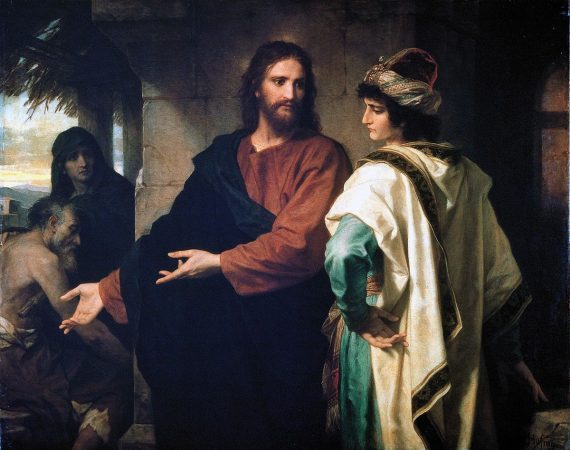
In the account of Matthew 19:16-21 (and the parallel passages of Luke 18:18-23; Mark 10:17-22), a rich, young ruler approaches Jesus and asks Him what he must do to have eternal life. (Luke also contains the account of a lawyer who asks a similar question Luke 10:25-28. I have written about the Rich Young ruler before here.)

Jesus points the young man to the law, and specifically to the Ten Commandments. The man responds that he has kept all of the commandments since he was a boy.

So Jesus says that the man still lacks one thing: he must go out and sell everything he owns, and then give the money to the poor.

At this, the rich young ruler becomes forlorn and goes away, because he was very rich.

What is the Story of the Rich Young Ruler about?

Many pastors and scholars point to this passage as primary evidence that good works and obedience to the commandments are required to receive eternal life.

believe in Jesus for eternal lifeBut there are numerous considerations from the text which reveal that this is not what Jesus is saying, and this is not how we should understand the passage.
1. We must first understand the meaning of “eternal life”

What is eternal life, and how is it gained?

To answer this, let me briefly summarize some of what I teach in my online course, The Gospel Dictionary.

There are three main truths to remember about eternal life.

First, eternal life begins the moment we believe in Jesus for it.

Since eternal life is the life of God given to those who believe in Jesus Christ, it begins the moment we receive Him (John 3:16; 5;24; 6:47; etc).

Eternal life is not some future possession, but is something we receive now, at the moment we are placed in Christ Jesus through faith.

Since eternal life is the life of God, and since this life is in Jesus, then anyone who shares this life with Jesus, also shares this life with God. To put it more succinctly, since Jesus is eternal life (cf. 1 John 1:2), we receive eternal life when we receive Jesus.

Second, eternal life is eternal.

In other words, everlasting life is everlasting.

This means that once you have eternal life in Jesus, you can never lose it.

Earl Radmacher used to say that โ€œIf you can lose your everlasting life, it has the wrong name.โ€ Just as you cannot be unborn after you are born, so also, when you are born again into the family of God, you cannot ever go back and become unborn.

Once a person believes in Jesus for eternal life, they receive it permanently, and no matter what they say, think, or do in the future, their new birth into Godโ€™s family is a historical fact and cannot be undone.

Every single passage in the Bible which appears to teach that eternal life can be lost is not in fact talking about eternal life, but is instead referring to something else, such as physical life here on earth, inheritance and reward in the future, or to some sort of deliverance (salvation) from temporal catastrophe or disaster.

There is no verse in the Bible which teaches that a person can lose their eternal life.

Finally, since eternal life begins the moment we believe, and since eternal life is forever, this means that we can begin experiencing eternal life now.

Some seem to believe that eternal life does not begin until we die, at which point we will float around on clouds and play harps. When people have such an idea, it is no wonder they are not all that excited or thrilled about experiencing eternal life.

But once we understand that eternal life begins in this life, when we receive the life of God through faith in Jesus, it becomes much more thrilling to think about it.

To experience eternal life with God means that we live up to our full creative, adventurous potential as human beings, so that we begin to experience true life now.

It refers to experiencing โ€œthe age to comeโ€ here and now in this age. Eternal life is not just a future experience to be longed for, but is a way of life that can be lived here and now.

It is helpful to think of eternal life as a whole new life in a whole new world.

We pass through the doorway into this new this world by faith in Jesus Christ. And the doorway is not a revolving door. It is a one-way door. Once you are through the door and in the new world, you can never go back.

But once we are through the door, there is a whole world to explore. Those who sit at the entrance, bemoaning what they have left behind, have not yet begun to experience all the lies ahead.

Newcomers are encouraged to do more than just sit at the doorway, content that they have entered into a new life with Jesus Christ. Instead, they are encouraged to follow Jesus into all the beauty and adventures that awaits them in this new world. Jesus calls people who have entered into new life with Him to follow Jesus wherever He leads, to go higher up and further in.

In this way, it is not wrong to recognize that while eternal life is a free gift and a present expression, it not only refers to the quantity of life (life that never ends) but also the quality of life (the experience of God’s life that only gets better over time).

This clarification is extremely helpful when trying to understand various tricky texts in the Bible about eternal life, and especially in those texts that seem to imply that eternal life can be earned or inherited. Such texts are not talking about how we can earn or work for the free gift of eternal life, but are instead referring to the ongoing experience of eternal life here and now.

Let me summarize these three truths about eternal life:

Eternal life is Godโ€™s life in us so that we can have life with Him that never ends, and it is freely given to all who believe in Jesus, and experienced in greater degrees as we follow Jesus.

While it is an eternal possession that is received by faith alone in Jesus, it can also be a present reality that is experienced when we follow Jesus in discipleship.

Eternal life refers to both an eternal possession we receive by faith alone in Jesus Christ alone and a present experience we can enjoy here in this life as we follow Jesus by faithful obedience to His leading.

This brief study of eternal life helps us understand the story of the Rich Young Ruler inย Matthew 19:16-21 (cf. Luke 18:18-23; Mark 10:17-22)

The Rich Young Ruler Matthew 19:16-21

2. Matthew 19:16-21 is about inheriting eternal life, not earning eternal life

First, the passage is clearly about inheriting eternal life, not receiving it (cf. Matt 19:29; Mark 10:17, 30; Luke 18:18, 30).

Support for this is found in the following context where Jesus says that it is difficult for the rich to enter the Kingdom of heaven (Matthew 19:23; Mark 10:23; Luke 18:24), and then equates the Kingdom of heaven with inheriting eternal life (cf. Matthew 19:29; Mark 10:30; Luke 18:30).

So the rich young ruler is not technically asking about how to receive eternal life, but how to inherit it, or experience it, in this life. Jesus answers accordingly.

The man felt that he should be experiencing eternal life because of his strict obedience to the law, but he also felt that something was lacking. So he asked Jesus about how to inherit, or experience, eternal life now. Jesus ran a quick diagnostic test on the man, and quickly determined two sources of the manโ€™s problem.

First, the man was proud.

He thought he had perfectly obeyed the law. He said he has obeyed it from his youth.

This, of course, is completely impossible, as Jesus knew. Yet rather than challenge the young man on his perceived moral perfection, Jesus โ€œupped the anteโ€ on the man as a way to show the man that he was not as righteous as he thought.

Jesus told the man to do something which the man could not do. He should sell all his riches and give the money to the poor. Yet even this was not the end, for after he did this, Jesus told the man to โ€œCome, follow Meโ€ (Matthew 19:21; Mark 10:21; Luke 18:22).

The point of Jesus was that the young man would never โ€œarrive.โ€ The main thing holding the young man back from experiencing the life of God was his self-righteous spiritual pride. The words of Jesus were intended to begin dismantling this pride.

Rich Young Ruler

Second, Jesus recognized that wealth was the source of the rich young rulerโ€™s problem.

This is why Jesus focused on the riches of this young man, instead of on some other area where the young man was blind to his own sin.

After all, even though Jesus asked about the commandments, there is no commandment or statement in the Mosaic Law to sell everything and give it away. So why does Jesus seem to shift from focusing on the commandments to giving up riches?

The answer is found within the law itself. The law promised wealth and riches to those who completely obeyed the law (cf. Deut 28:1-14). This young man was rich and wealthy at a very young age, which made him believe that he must have obeyed the entire law since his youth.

This is why Jesus told him to sell all his possessions and give away all his wealth. It wasnโ€™t exactly about the money. It was about the false sense of moral perfection that the money created in the manโ€™s heart. When Jesus told the man to give up his wealth, He was saying that the man could not look to his wealth as a sign of Godโ€™s blessing.

In fact, it is quite possible that this young man did not keep the law as well as he thought. In the Ancient Mediterranean world, it was thought that wealth was a โ€œzero sum game.โ€ They believed that there was a fixed amount of material wealth in the world, so that the only way people gained more money and riches was if others lost it.

Of course, from a theological perspective, the only way someone would lose their riches and wealth is if they were sinful, and God displayed His displeasure by taking away their wealth and giving it to someone else who pleased Him.

But is this how the world really works? Is it only the righteous who are rich and only the wicked who are poor? No. Quite the opposite, in fact.

The same was true in biblical times as well, which is why some of the prophets wonder why the wicked prosper and the faithless live in ease (cf. Jer 12:1).

The sad reality is that the rich often (but not always) become rich because they murder, steal, and bear false witness, which are exactly the sins Jesus questioned the rich young ruler about (Matt 19:18; Mark 10:19; Luke 19:20). It is entirely possible that the rich your ruler became rich at such a young age because he, or his family, engaged in various practices which made them rich at the expense of the poor.

But this young man was ignorant or blind to such things, and thought that because he was rich, he was blessed by God, and therefore, obedient to the law. By telling him to sell his riches and give his money to the poor (who, according to this line of thought, were poor because they were sinners), Jesus was challenging this entire way of thinking.

So although eternal life is mentioned in this passage, the rich young ruler is not asking, and Jesus is not explaining, how to gain eternal life.

The rich young ruler isnโ€™t asking about how to go to heaven when he dies. He is asking about the new world that God is going to usher in, the new era of justice, peace, and freedom God has promised his people. And he is asking, in particular, how he can be sure that when God does all this, he will be part of those who inherit the new world, who share in its life.

Jesus and the rich young ruler are talking about how to experience Godโ€™s life (eternal life) in this life.

While the commandments are mentioned, the instructions of Jesus are not even about keeping the commandments, but about spiritual pride and arrogance.

What is the Meaning of Matthew 19:16-21 and the Rich Young Ruler?

Therefore, when all the factors are considered, we see that the passage is primarily about how Jesus challenged the status quo theological belief that the rich are loved by God while the poor are under His judgment.

camel through eye of a needleJesus sought to reverse this entire line of thought, as the following contexts make quite clear (Matthew 19:23-30; Mark 10:23-30; Luke 18:24-30). It is difficult for the rich to enter the Kingdom of heaven because they rely on their riches as evidence that they are already living the life God wants for them.

Many of the rich people in the days of Jesus (and even many today) believe that their riches prove that they are under God’s blessing and are part of His family. Jesus is saying, “If you think your riches prove that you have eternal life, give up your riches. They don’t prove anything about eternal life one way or the other.”

Eternal life is received by believing in Jesus for it. And there is no amount of good works you can do to keep, earn, or prove that you have eternal life.

But once you have eternal life through faith in Jesus, you can gain a better experience of eternal life by following Jesus on the path of discipleship. This might require you to make some difficult decisions in life.

Bottom line: You DO NOT need to give away your wealth to receive eternal life … but you might need to be more generous with it if you want to experience the reality of God’s life in you.

Do you want to inherit, or experience, eternal life in this life? You first, of course, need to make sure you have received the free gift of eternal life through faith in Jesus.

But after that, to experience eternal life, you must not depend on your riches or worldly success, nor your self-deceived ability to obey all of Godโ€™s law (which doesnโ€™t lead into love anyway, see Law), as signs that you are fully experiencing all that God has for you.

Instead, to live within the Kingdom of God and experience the joys and blessings of eternal life, you must humbly follow Jesus wherever He leads, even if it is into poverty and obscurity.

The Gospel DictionaryUnderstanding the Gospel requires us to properly understand the key words and terms of the Gospel. Take my course, "The Gospel Dictionary" to learn about the 52 key words of the Gospel, and hundreds of Bible passages that use these words.

This course costs $297, but when you join the Discipleship group, you can to take the entire course for free.

Affiliate Disclosure: As an Amazon Associate I earn from qualifying purchases. Thank you for supporting my work in this way!

God is Redeeming God, Redeeming Scripture, Redeeming Theology, z Bible & Theology Topics: eternal life, everlasting life, gospel dictionary, Luke 18:18-23, Mark 10:17-22, Matthew 19:16-21, money, Rich Young ruler, riches

Advertisement

Jeremy Myers interviews Shawn Lazar about his book, Chosen to Serve

By Jeremy Myers
2 Comments

Jeremy Myers interviews Shawn Lazar about his book, Chosen to Serve
http://media.blubrry.com/one_verse/feeds.soundcloud.com/stream/522383439-redeeminggod-134-jeremy-myers-interviews-shawn-lazar-about-divine-election.mp3

Shawn Lazar

I have been teaching a series on the doctrine of divine election in Scripture, and so am pleased to welcome Shawn Lazar onto the show to discuss his book, (#AmazonAdLink) Chosen to Serve.

(#AmazonAdLink) Chosen to ServeIn his book, Shawn shows what the Bible teaches about election, and discusses several key passages which are used to defend various views of divine election. Shawn shows us how to understand these passages in light of the rest of biblical revelation about this tricky doctrine.

When you properly understand divine election, you will no longer find yourselves in angry and heated debates about who God chose for heaven from eternity past … nor will you be anxious about whether or not you yourself are chosen by God.

Instead, you will discover the beautiful biblical truth that election is to service, not to eternal life.

By listening to the podcast episode, you will also learn how to get 50% off Shawn’s book, Chosen to Serve. Or you can (#AmazonAdLink) pay full price on Amazon … if that is what you really want.

Here are other links we mentioned in the podcast interview:

  • Free Magazine signup at FaithAlone.org
  • Chosen to Serve at FaithAlone.org
  • Shawn Lazar on Facebook
  • The discussion on Cornelius by Ken Yates is a YouTube video found here:

Affiliate Disclosure: As an Amazon Associate I earn from qualifying purchases. Thank you for supporting my work in this way!

God is Redeeming God, Redeeming Scripture, Redeeming Theology, z Bible & Theology Topics: 1 Peter 1:2, 2 Peter 1:10-11, Acts 13:48, Chosen to Serve, divine election, election is to service, eternal life, gospel, salvation, Shawn Lazar, Unconditional Election

Advertisement

  • « Previous Page
  • 1
  • …
  • 16
  • 17
  • 18
  • 19
  • 20
  • …
  • 82
  • Next Page »

My New Book is Out!

Get your copy on Amazon today!
Learn about the gospel and how to share it

Take my new course:

The Gospel According to Scripture
Best Books Every Christian Should Read
Study Scripture with me
Subscribe to my Podcast on iTunes
Subscribe to my Podcast on Amazon

Do you like my blog?
Try one of my books:

Click the image below to see what books are available.

Books by Jeremy Myers

My New Book is Out!

Get your copy on Amazon today!

Theological Study Archives

  • Theology – General
  • Theology Introduction
  • Theology of the Bible
  • Theology of God
  • Theology of Man
  • Theology of Sin
  • Theology of Jesus
  • Theology of Salvation
  • Theology of the Holy Spirit
  • Theology of the Church
  • Theology of Angels
  • Theology of the End Times
  • Theology Q&A

Bible Study Archives

  • Bible Studies on Genesis
  • Bible Studies on Esther
  • Bible Studies on Psalms
  • Bible Studies on Jonah
  • Bible Studies on Matthew
  • Bible Studies on Luke
  • Bible Studies on Romans
  • Bible Studies on Ephesians
  • Miscellaneous Bible Studies

Advertise or Donate

  • Advertise on RedeemingGod.com
  • Donate to Jeremy Myers

Search (and you Shall Find)

Get Books by Jeremy Myers

Books by Jeremy Myers

Schedule Jeremy for an interview

Click here to Contact Me!

Follow me on X

© 2026 Redeeming God · All Rights Reserved · Powered by Knownhost and the Genesis Framework