Redeeming God

Liberating you from bad ideas about God

Join the discipleship group
  • Join Us!
  • Scripture
  • Theology
  • My Books
  • About
  • Discipleship
  • Courses
    • What is Hell?
    • Skeleton Church
    • The Gospel According to Scripture
    • The Gospel Dictionary
    • The Re-Justification of God
    • What is Prayer?
    • Adventures in Fishing for Men
    • What are the Spiritual Gifts?
    • How to Study the Bible
    • Courses FAQ
  • Forum
    • Introduce Yourself
    • Old Testament
    • New Testament
    • Theology Questions
    • Life & Ministry

Are the Spiritual Gifts for Today?

By JD Myers
Leave a Comment

Are the Spiritual Gifts for Today?

Are spiritual gifts for today? Most Christians agree that God still gives gifts like teaching, serving, giving, and encouragement. The debate is over the more dramatic gifts, such as tongues, prophecy, healing, and miracles. Some Christians believe these gifts ended with the apostles in the first century. Others believe they are still active, and some even teach that every Christian should speak in tongues. There are strong opinions on every side. It can be hard to know what to think, and the arguments often generate more heat than light.

In this post, I want to look at the main reasons some Christians believe certain gifts have ceased. Then I will explain why I am not convinced by them. My conclusion is that God still gives all of the spiritual gifts. Some of them may simply look different now than they did in the Book of Acts. I also want to show why this question matters for the health of the church. If we say that some of the gifts are no longer given, we may be telling some members of the body of Christ that the church does not need them.

What Cessationists Believe About the Spiritual Gifts

The view that some gifts have ceased is called cessationism. The view that all gifts continue is often called continuationism. Cessationists usually draw a line between two kinds of gifts. On one side are the ordinary gifts, like teaching, service, administration, and mercy. On the other side are the so-called sign gifts, like tongues, prophecy, miracles, and healing. Cessationists believe the sign gifts were needed to launch the church and confirm the message of the apostles. But once the church was established and the New Testament was written, those gifts were no longer necessary. So God stopped giving them.

This view is held by many sincere Bible teachers, and it is not hard to see why it appeals to people. Most of us have seen the gifts abused. We have watched television preachers put on a show, claim healings that never happened, and use the language of the Spirit to raise money. When people see these things, they want to protect the church from error. And one easy way to do that is to say that these gifts are no longer given at all. But as we will see, I do not believe Scripture supports this conclusion.

Three Arguments That Some Gifts Have Ceased

Open hands raised in worship, picturing the question are spiritual gifts for today

The first argument is about frequency. People notice how often tongues, healings, and miracles show up in the Book of Acts, and how rarely they seem to happen today. So they conclude that something must have changed. But this argument depends entirely on who you ask. Some Christian groups say miracles are more common now than in the first century. Whether we agree with them or not, this shows that frequency is not a reliable way to decide what God is or is not doing.

The second argument comes from the words of Jesus, who said, “An evil and adulterous generation seeks after a sign” (Matt 12:39). Since large crowds today often chase after signs and wonders, some apply this warning to anyone who seeks the sign gifts. The warning may well apply to some people. But the fact that people can chase after signs in the wrong way does not mean the gifts have ended. It only means they can be misused, which was just as true in the first century as it is today.

The third argument is the most important, and it comes from 1 Corinthians 13. We will look at it in the next section.

Are the Spiritual Gifts for Today According to 1 Corinthians 13?

In 1 Corinthians 13, Paul writes that “whether there are prophecies, they will fail; whether there are tongues, they will cease; whether there is knowledge, it will vanish away” (1 Cor 13:8). He then explains when: “when that which is perfect has come, then that which is in part will be done away” (1 Cor 13:10). Many cessationists believe “that which is perfect” refers to the completion of the New Testament, or to the full establishment of the church. Once that happened, they say, the partial gifts of prophecy and tongues were no longer needed.

But there are several problems with this reading. First, Paul lists knowledge right alongside prophecy and tongues. Hardly anyone who believes prophecy and tongues have ceased also believes that knowledge has ceased. If all three are mentioned together, why would two of them end while the third continues? Second, if “the perfect” refers to the birth of the church, then it had already come by the time Paul wrote this letter. And if it refers to the spread of the church over the whole earth, then it still has not come. In that case, the gifts should still be in use today.

What Is “That Which Is Perfect”?

I believe Paul is most likely looking ahead to the new heavens and new earth, when God makes all things new (Rev 21:1-5). Paul goes on to say, “For now we see in a mirror, dimly, but then face to face” (1 Cor 13:12). That sounds much more like the day we stand before Jesus than the day the last book of the New Testament was written. In that perfect future, we will not need the gifts the way we need them now. But until then, while we live in this broken world and in these imperfect bodies, all of the spiritual gifts remain in use.

The Problem with Dividing the Gifts into Categories

A small church group serving in different ways, picturing spiritual gifts in the body of Christ

Part of the problem is the way we sort the gifts. When we divide them into ordinary gifts and sign gifts, we make it easy to set one group aside. But Scripture never sorts the gifts this way. Paul mixes them together in his lists (Rom 12:6-8; 1 Cor 12:8-10, 28; Eph 4:11). When I studied the gifts, I found that every attempt to divide them neatly breaks down somewhere. In one sense, every gift is a sign, because every gift points people to the God who gives it. And if there is no clear line between the gifts, there is no clear reason to say some have ended.

It also helps to recognize that the gifts are broader than we often think. The gift of healing, for example, is not only about miraculous cures. God also uses doctors, nurses, and counselors to bring health to the sick. Many people with this gift work in medicine and psychology. I believe the oil in James 5 points the same way, as I explain in Should Christians anoint with oil for healing? In the same way, the office of Apostle is no longer filled as it was in the first century. But God still sends out missionaries who have the gift of apostleship. I write more about this in Church Leaders Who Help Church Growth.

What About Speaking in Tongues Today?

No gift raises more questions than tongues. I believe that whenever tongues appear in Scripture, they are real human languages, not a heavenly prayer language. At Pentecost, people heard the apostles speaking in their own native languages (Acts 2:6-8). Paul also insists that tongues in a church gathering must be interpreted, which assumes they can be translated. He writes that “tongues are for a sign, not to those who believe but to unbelievers” (1 Cor 14:22). And if no one can interpret, the person should “keep silent in church” (1 Cor 14:28).

So are tongues for today? I believe they might be, but probably not in the way they are practiced in many church services. The clearest purpose of tongues in Acts was to help carry the gospel across language barriers. So if God gives this gift today, I would expect to see it used where the gospel is being shared with people who speak another language. I have also written about speaking in tongues during prayer meetings, and why love and understanding must guide how any gift is used.

Why It Matters That All the Spiritual Gifts Are for Today
Quote graphic: The cure for misuse is right use. J. D. Myers

So why does this matter? Because the church is a body, and every part of the body is needed. Paul writes that “the eye cannot say to the hand, ‘I have no need of you’” (1 Cor 12:21). God gives gifts so that the members of the body would care for one another (1 Cor 12:25-26). When we declare that some gifts have ceased, we risk telling some of our brothers and sisters that the body does not need them. That does not protect the church. It weakens it.

Yes, the gifts can be abused, and some people fake them. But the answer to abuse is not to forbid the gifts. Paul did not respond to the chaos in Corinth by shutting down the gifts. Instead, he taught the church to use them in love and in order. He even told them, “do not forbid to speak with tongues” (1 Cor 14:39). The cure for misuse is right use. When we understand what the gifts are and why God gives them, we can use them well. We can build up the church and serve the world, which is what God intended.

Discover Your Spiritual Gifts

What are the Spiritual Gifts? book cover by J. D. Myers

So are spiritual gifts for today? I believe they are, every one of them. The Spirit has not stopped giving gifts to the church. He has not stopped calling each of us to use what we have been given. As Peter writes, “As each one has received a gift, minister it to one another, as good stewards of the manifold grace of God” (1 Pet 4:10). The question is not whether God is still giving gifts. The real question is whether we have discovered our gifts and are using them to serve others. If you are not sure what your gift is, you can start with my free online spiritual gift test.

If you want to go deeper, my book What Are the Spiritual Gifts? Discover Your Spiritual Gifts and How to Use Them explains each gift in Scripture and how the gifts work together. It also shows how to avoid the common problems that come with them. You will also find a longer look at tongues and a spiritual gifts inventory to help you find where you fit in the body of Christ. Get What Are the Spiritual Gifts? on Amazon and start using the gifts God has given you.

Affiliate Disclosure: As an Amazon Associate I earn from qualifying purchases. Thank you for supporting my work in this way!

God is Redeeming Books, Redeeming Church, Redeeming Life, Redeeming Theology Bible & Theology Topics: healing, Holy Spirit, miracle, prophecy, speaking in tongues, spiritual gifts, tongues

Advertisement

Is Christmas Pagan? Saturnalia, December 25, and What Christians Should Do

By JD Myers
Leave a Comment

Is Christmas Pagan? Saturnalia, December 25, and What Christians Should Do

Every December the old question comes around again: is Christmas pagan? Some Christians are told that the Christmas tree is an idol, that December 25 belongs to a Roman sun god, and that faithful believers should have nothing to do with any of it. Other Christians hear the opposite message, that Christmas is a Christian holiday which the culture has stolen, and so we must put Christ back into Christmas. These two groups sound like they disagree, but they actually share the same assumption. They both assume that if Christmas has pagan roots, then something has gone badly wrong, and Christians must either fix the holiday or abandon it.

I want to suggest a different answer. Yes, Christmas is pagan. It is not that Christmas has recently become pagan, but that many of its customs were pagan long before anyone used them to honor the birth of Jesus. But this is not a reason for Christians to stay away from Christmas. It is one of the best reasons to celebrate it. Christmas is a living picture of what Jesus does with everything He touches. He does not throw it away. He redeems it. And when we see Christmas this way, the lights, the gifts, and the tree all become ways of proclaiming the “good tidings of great joy which will be to all people” (Luke 2:10).

What People Mean When They Say Christmas Is Pagan

When people say Christmas is pagan, they usually mean that much of what we do at Christmas did not come from the Bible. That is true. The Gospels tell us about angels, shepherds, a manger, and wise men from the east, but they say nothing about decorated trees, strings of lights, wreaths on the door, or a man in a red suit who brings presents. These customs came from somewhere, and most of them came from the cultures that surrounded the early church rather than from the church itself.

Across the ancient world, people marked the darkest part of the year. As the days grew shorter and the nights grew longer, many cultures held festivals around the winter solstice. They lit fires and candles to push back the darkness, sang songs, ate rich food, and gave gifts to one another. Greenery that stayed alive through the winter became a sign of life that would return. So when someone says Christmas has pagan roots, they are not making something up. They are describing what the historical record shows, and Christians gain nothing by pretending otherwise.

Saturnalia and the Winter Festivals of Light

Painting of Romans feasting by oil-lamp light under evergreen garlands at a midwinter festival

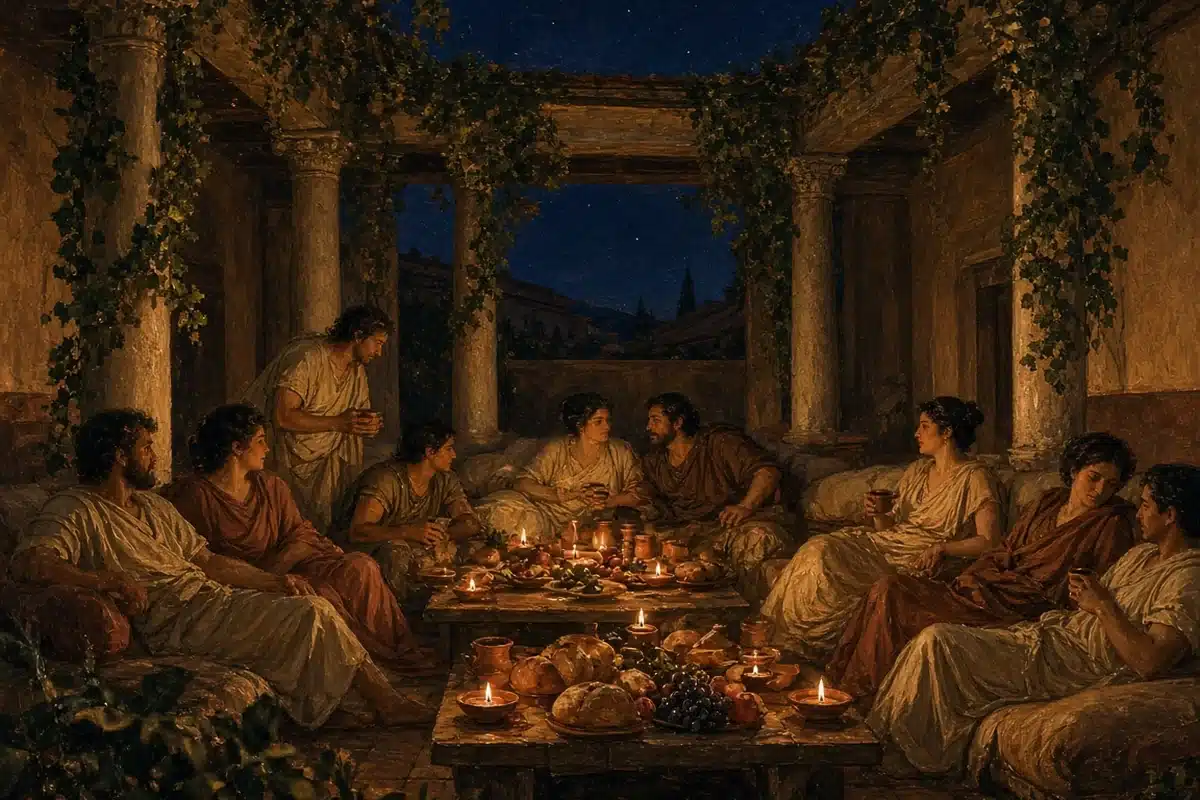
The best-known of these winter festivals is the Roman Saturnalia. It honored Saturn, the god of agriculture, and it ran for several days in the second half of December. It was the most popular holiday of the Roman year. Courts and schools closed, business stopped, and the whole city gave itself to feasting. Romans visited one another’s homes, sang in the streets, lit candles, and exchanged small gifts. One of the strangest features of the festival was the reversal of roles, in which masters served meals to their slaves and everyone wore the soft felt cap that normally marked a freed slave.

Closely connected to this season was December 25 itself. By the fourth century, and probably earlier, Romans were celebrating that day as the birthday of the Unconquered Sun. The logic is easy to see. After the solstice, the sun begins to climb again and the days begin to lengthen, and so the sun appears to win its battle against the night. Put Saturnalia and the birthday of the sun together, and you have a season full of lights, songs, gifts, feasting, and hope that the darkness will not last forever. Much of what we now think of as Christmas was already part of that season, long before it had anything to do with the birth of Jesus.

How Saturnalia Became Christmas

In the early fourth century, the Emperor Constantine embraced Christianity, and over the following generations the faith went from persecuted minority to favored religion of the empire. This created a practical problem. What should the church do with all the festivals that people loved? The church could have tried to cancel them, but that rarely works with a holiday people have celebrated their whole lives. So instead, Christians gave the old festivals new meaning. The earliest record we have of Christians celebrating the birth of Jesus on December 25 comes from a Roman calendar in AD 336.

Over time, the symbols of the winter festival were, in a sense, baptized. Lights that once celebrated the return of the sun came to celebrate the coming of the Son, who said, “I am the light of the world” (John 8:12). Gifts that once marked a season of merriment came to remind us of the gift of God in Jesus. Evergreens that once spoke of life surviving the winter came to speak of eternal life. Historians still debate how deliberate all of this was, and some argue the date came from early Christian calculations rather than from Saturnalia. But either way, the church did not invent its Christmas customs out of nothing. It took what was already there and pointed it toward Jesus.

Was Jesus Born on December 25?

Probably not. The shepherds were living out in the fields with their flocks at night (Luke 2:8), which fits the warmer months better than the middle of winter. When we put that together with the timing of Zacharias’s priestly service (Luke 1:5, 8-9) and Elizabeth’s pregnancy (Luke 1:24-26, 36), I believe the evidence points to the early fall, around the Feast of Tabernacles. It is fitting that John describes the incarnation this way: “And the Word became flesh and dwelt among us” (John 1:14). The Greek word for “dwelt” is skēnoō, “to pitch a tent” or “to tabernacle.” I have written more about when Jesus was actually born, so I will not repeat it all here.

But if Jesus was born in the fall, then December 25 lands close to the time when He was conceived, near Hanukkah, the Jewish Festival of Lights. Hanukkah is not one of the feasts God commanded in the Law of Moses, and yet Jesus went to the temple during the Feast of Dedication (John 10:22) and declared Himself to be the Light of the World. I believe this is very significant. If Jesus could fill a non-biblical holiday with His own meaning, then there is no reason He cannot do the same with a pagan one. I explore Jesus and Hanukkah in another post.

The Christmas Tree and Jeremiah 10

A lit Christmas tree with gifts beneath it in a cozy family living room in the evening

The most common argument against Christmas comes from Jeremiah 10. The prophet writes that “one cuts a tree from the forest, the work of the hands of the workman, with the ax. They decorate it with silver and gold” (Jer 10:3-4). Many sincere Christians read this and conclude that God condemns the Christmas tree. But read one more verse. These objects “cannot speak; they must be carried, because they cannot go by themselves” (Jer 10:5). Jeremiah is not describing a living tree with lights on it. He is describing a craftsman who cuts down a tree, carves an idol from the wood, overlays it with silver and gold, and fastens it so it will not fall over.

The rest of the prophets describe the same process (Isa 40:19-20; 44:9-20; Hab 2:18-19). So the Christmas tree is not an idol unless someone worships it, and very few people bow down before their Christmas tree. Of course, anything can become an idol. The Apostle Paul writes of people “whose god is their belly” (Php 3:19), but we do not stop eating because some people worship food. The problem is not the object, but the heart. I once had a church member threaten to leave over the tree in our sanctuary, and I tell that story in Are Christmas trees idols?

Jesus Redeems People, and He Redeems Holidays Too

Quote by J. D. Myers over a candle and frosted evergreens: "Jesus does not throw it away. He redeems it."

So why should Christians celebrate a holiday with pagan roots? Because redemption is what Jesus does. To redeem something is to buy it back, so that it comes under new ownership. Scripture says that “the creation itself also will be delivered from the bondage of corruption into the glorious liberty of the children of God” (Rom 8:21), and that through Jesus, God is reconciling “all things to Himself … whether things on earth or things in heaven” (Col 1:20). If Jesus is redeeming all things, then He is redeeming culture too, including the stories, songs, and festivals people have created.

This is the same thing Jesus does with us. Paul lists the sins that once marked the believers in Corinth, and then he writes, “And such were some of you. But you were washed, but you were sanctified, but you were justified in the name of the Lord Jesus and by the Spirit of our God” (1 Cor 6:11). None of us came to Jesus with a clean history. All of us have pagan roots. If Jesus can take a sinner and make him a child of God, then taking a winter festival and turning it into a celebration of His birth is a small thing by comparison. I have argued before that pagan holidays point to Christ, because the longings behind them are only fulfilled in Him.

If We Reject Everything with Pagan Roots

We should also be honest about where the objection leads. Christians gather for worship on Sunday, a day named for the sun. We meet in buildings shaped by older temple architecture, follow a calendar in which many of the months honor Roman gods, and sing some hymns set to tunes that were once sung in taverns. Paul himself, when he preached in Athens, began with an altar to an unknown god and said, “the One whom you worship without knowing, Him I proclaim to you” (Acts 17:23). If we reject everything with pagan roots, we will have to reject almost everything. I have shown elsewhere that the same logic would also keep us from using a calendar.

So Should Christians Celebrate Christmas?

Not all Christians have thought so. The Puritans in Massachusetts went so far as to outlaw Christmas from 1659 to 1681, and some Christians today still refuse to celebrate it. We should not look down on them. Paul says that “one person esteems one day above another; another esteems every day alike. Let each be fully convinced in his own mind” (Rom 14:5). If a brother or sister cannot celebrate Christmas with a clear conscience, we can love them and respect their choice without making it the rule for everyone else.

But for most of us, the better way is not to retreat from Christmas, but to celebrate it on purpose. Put up the lights, and let them remind you that Jesus is the Light of the World and that He calls us “the light of the world” too (Matt 5:14). Give gifts, because God gave the greatest gift. Decorate the tree, and remember the tree on which Jesus gave His life. Feast, sing, and visit friends, because the reversal of roles that Saturnalia only played at for a few days is what Jesus actually did when the Lord of all became a servant. The pagan roots of Christmas do not take anything away from this. They only show how far redemption reaches.

Have Yourself a Redeemed Christmas

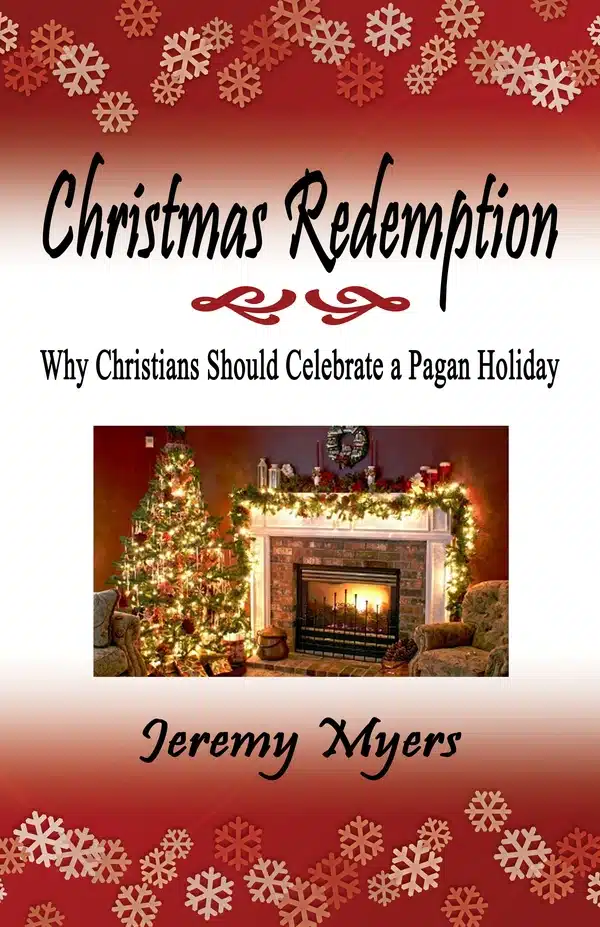
Cover of Christmas Redemption by Jeremy Myers

So is Christmas pagan? In its roots, yes, and it always will be. But that is not the end of the story, any more than our own pagan roots are the end of ours. Christmas is a pagan holiday that has been bought back by Jesus, and every year it gives us the chance to show our neighbors what a redeemed life looks like. We do not need to be afraid of Christmas, and we do not need to rescue it. We simply need to celebrate it as people who have been redeemed by the One it points to.

If you would like to go deeper, I cover all of this in more detail in my short book, Christmas Redemption: Why Christians Should Celebrate a Pagan Holiday. It looks more closely at the feasts of Israel and the date of Jesus’ birth, at Hanukkah, and at the symbols of Christmas, including the tree, the lights, the gifts, and even Santa Claus. It is a quick read, and it might make a good gift for the friend who keeps sending you articles about Saturnalia. Get Christmas Redemption on Amazon, and have yourself a merry Christmas.

Affiliate Disclosure: As an Amazon Associate I earn from qualifying purchases. Thank you for supporting my work in this way!

God is Redeeming Books, Redeeming Life, Redeeming Theology Bible & Theology Topics: Christmas, Christmas Redemption, December 25, holidays, pagan, redemption

Advertisement

Carl Jung and Learning About Your Soul

By Jeremy Myers
Leave a Comment

Carl Jung and Learning About Your Soul

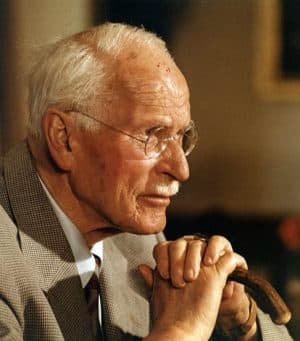
Lots of Christians think Carl Jung was a heretic. I’ll be the first to admit he does write some pretty provocative ideas. But I have also found great spiritual truths and insights into the nature of God, the person and work of Jesus Christ, and helpful ways of reading Scripture with better understanding.


Most of all, I have found in the writings of Jung some of the deepest help for my soul. His life work was to map out the psyche (the soul), and his work in this regard can be greatly beneficial for Christians as we seek to tune our soul to the working of the Holy Spirit and the presence of God in the world.

I recently found the following article online at the website of Lambert Dolphin (someone I have respected and learned from for years), and it resonated with me, so I am re-posting it below. See the Bibliography at the end for links to referenced books. One volume not mentioned in the article below, which I have found quite helpful, is Jung and the Bible by Wayne Rollins.


INDIVIDUATION
AND THE BIBLICAL CONCEPT OF WHOLENESS

By Kenny Ammann

What is life really about? Why on earth are we here? While it is true that many have discovered there is more to life than meets the eye, surprisingly few people are really concerned about these questions. Yet each of us has been given just one human lifetime to discover who we are, why we are here, and where we are going.

Perhaps the reason that seemingly few seek answers to such issues is that many believe there are no answers. Personally I find myself plagued with these thoughts every day. I think this is the reason I find Jung’s concept of individuation so fascinating. I believe becoming whole and understanding oneself rates first among priorities.

I agree with Jung, who seems to say the unconscious is not our enemy, but is always striving to produce wholeness. Evidence of this may be found in the lives of people, in which people often seem to be consciously or unconsciously searching for some kind of meaning. Much of our humanity depends on having purpose in who we are and what we do. Unfortunately, many who look to the world for answers fail in their depressing search, because the world produces conformity. Individuation is the idea of leaving the the collective thinking of one’s upbringing and embarking on a path leading to an understanding of one’s own self and appropriate relation to others, such that both the individual and others will benefit. Jung’s concept of individuation is not an easy process to define, especially when one attempts to do so from solely a Western, Judeo-Christian paradigm. None of Jung’s teachings are limited to this viewpoint. Instead, Jung accomplishes the extraordinary task of bridging East and West by successfully integrating both drastically different paradigms into the way of individuation. He seems to see the heart of Eastern and Western viewpoints as complementary toward one another, much as male and female persons perceive truth and set their priorities in different ways, both of which are valid.

In order to examine the Jungian bridge between East and West, I will stereotype the cultures. This in no way is an attempt to minimize or limit either philosophy, but merely an effort to further understand the Jungian paradigm. Western civilization originates from Greek and Roman ideas, values, philosophy, and government. When one thinks of Western culture, one thinks of science, industry, technology, progress (or what Westerners tend to think is progress), exploitation of resources, carelessness toward nature and naivete with regard to man’s relationship with nature. Second, Eastern stereotypes include contemplation, meditation, mysticism, and harmony with nature. In the same way that the West would be considered experts on outer space, East could be considered experts on “inner space.” Western thought is primarily concerned with analytical knowledge, while Eastern thought prefers inner, mystical knowledge- for example, the path of the Eastern guru. In Eastern philosophy there is the concept of the Tao, the way of harmony between opposites. Thus, Zen Buddhists seek to live in a way where there is harmony between heaven and earth-for example, the path of harmony between the King and his people, between male and female, or between heaven (yang) and earth (yin). These concepts are illustrated in the Chinese book of philosophy, the I Ching.

Jung seems to see religion necessary in the process of individuation; not in the confessional or creedal sense such as being a Baptist or a Buddhist, but rather in the experiential sense. He writes,

“I want to make clear that by the term ‘religion’ I do not mean a creed. It is, however, true that on the one hand every confession is originally based upon the experience of the numinous and on the other hand upon the loyalty, trust, and confidence toward a definitely experienced numinous effect and the subsequent alteration of consciousness: the conversion of Paul is a striking example of this. ‘Religion,’ it might be said, is the term that designates the attitude peculiar to a consciousness which has been altered by the experience of the numinous” (Psychology & Religion; C. G. Jung, pg. 6).

Therefore Jung integrates religion into the process of individuation from both Eastern Unitarian thought and his own concept of God from his European upbringing. Morton T. Kelsey, in the twelfth chapter of his book entitled Psychology, Medicine & Christian Healing, shows how it was Jung who integrated religious experience into psychological thought more fully than any other psychologist. Kelsey explains how “Jung lived to be almost 86 and wrote until three weeks before his death; during the final 15 years of his life-from the time of a nearly fatal illness until his death-Jung’s main preoccupation was the significance of religious experience for psychiatry and psychology” (Psychology, Medicine & Christian Healing; Morton T. Kelsey, pg. 241). Furthermore, in 1932 Jung gave a talk to the Alsatian Pastoral Conference entitled “Psychotherapists or the Clergy.” In it he said that for more than thirty years people had been coming to him from all the civilized countries of the world, and writes,

“Among all my patients in the second half of life-that is to say, over thirty-five-there has not been one whose problem in the last resort was not that of finding a religious outlook on life. It is safe to say that every one of them fell ill because he had lost what the living religions of every age have given to their followers, and none of them has been really healed who did not regain his religious outlook” (Collected Works, Vol. 11(1958), pg. 334).

Although religious experience is a part of Jung’s theory of individuation, it certainly does not constitute its entirety. Individuation, rather, is “the possibility, ingrained in the human species and present in everyone, whereby the individual psyche can attain its full development and completion” (A Critical Dictionary of Jungian Analysis, Samuels; pg. 76). In an essay in which Jung set forth the individuation process called “The Relations between the Ego and the Unconscious,” he defines individuation as, “becoming an ‘in-dividual’, and, in so far as ‘individuality’ embraces our innermost, last, and incomparable uniqueness, it also implies becoming one’s own self. We could therefore translate individuation as … ‘self-realization’ “(Two Essays on Analytical Psychology, C.G. Jung; pg. 173).

The individuation process means the realization and integration of all the immanent possibilities of the individual. It seems to be opposed to any kind of conformity with the collective, and it even demands the rejection of conventional attitudes with which most people would like to live. June Singer writes in her novel of the works of Jung, called Boundaries of the Soul, that,

“Individuation offers the possibility that everyone can have his won direction, his special purpose, and it can attach a sense of value to the lives of those who suffer from the feeling that they are unable to measure up to collective norms and collective ideals. To those who are not recognized by the collective, who are rejected and even despised, this process offers the potentiality of restoring faith and dignity and assures them of their place in the world.”

In order to discover one’s place in the world, however, the process of individuation begins with breaking away from collective norms and ideals. People conform to their parents’ values, they conform to others’ expectations, and they conform to what is taught in the educational system and what is accepted by the culture. While it is safe and comfortable to remain a part of the flock and passively remain a follower, the idea of individuation is breaking away from the comfort zone and no longer being controlled by collective thinking. Only after one leaves the herd will s/he come to an understanding of his/her own unique potentials.

Once a person takes the initial step of breaking away from the collective norm, the path of understanding continues where the secret of the true self lies-in the complicated world of the unconscious. The unconscious consists of personal and collective data. Unlike Freud, Jung does not regard the unconscious as solely a repository of repressed, infantile, or personal experiences. He also viewed it as “a locus of psychological activity which differs from and is more objective than personal experience, since it relates directly to the instinctual bases of the human race” (Two Essays; pg. 127). The personal unconscious is seen more as resting upon the collective unconscious. The potentials for an individual’s wholeness lie in the personal unconscious, which Jung defines as “the materials of a personal nature in so far as they have the character partly of acquisitions derived from the individual’s life and partly of psychological factors which could just as well be conscious” (Two Essays; pg. 135). Jung argues that knowledge of the personal unconscious is actually knowledge of the self.

The contents of the collective reflect archetypal processes, which are the inherited portion of the psyche. Archetypes are recognizable in outer behaviors, especially those clustering around the universally cultural experiences of life such as marriage, motherhood, death and separation, and also reveal themselves by way of such inner figures as animus, shadow, persona, and so forth (Samuels; pg. 26). Freud’s view expresses an overall fear of the of the unconscious. He considers it a “Pandora’s box,” that is, if one were to open up the unconscious, a flood of evil would be let out upon the world. Jung, however, sees the unconscious as spontaneously working toward wholeness and striving toward healing of the person. Taking a much more positive outlook, Jung sees the unconscious as a potential friend due to its tendency toward wholeness. Jung insists that the unconscious is the “matrix, the artesian well from which all creativity springs” (He: Understanding Masculine Psychology, Robert A. Johnson; pg. 14). Thus the journey through this unfamiliar world may be a valuable one, because transformation is a spontaneous motion, and if one does not inhibit the unconscious but rather removes the roadblocks, the unconscious will be helpful towards healing.

As one begins to delve into the many layers of the unconscious, what he or she will find at the threshold is the shadow. In 1945 Jung gave a most direct and clear-cut definition of the shadow: “the thing a person has no wish to be” (The Collective Works of C.G. Jung 16, para. 470). In this simple statement is subsumed the many-sided and repeated references to shadow as, “a repository in the unconscious of all the things one cannot accept about oneself, the sum of all the unpleasant qualities one wants to hide, the inferior and primitive side of man’s nature, or simply, the dark side of one’s personality” (Samuels, pg. 138). An extreme example of shadow is Robert Louis Stevenson’s story of Dr. Jekyll and Mr. Hyde, whereupon Jekyll views himself as an extremely good and moral person. By thinking of himself as solely a kind, loving, and accepting doctor, he remains dishonest in facing himself as he really is, and the stronger shadow progressively dominates until Jekyll becomes a murderer. This would not have come about if contradictions in the inner self were resolved. The shadow therefore can be either a friend or one’s enemy.

According to Jungian theory, the shadow develops as one grows up and develops a self-image. Everything that does not correspond to this image or does not fit into one’s own ideal of masculinity is repressed to the unconscious, where they will reappear in dreams, biases, bigotry, etc. One example is a bigoted individual who projects his or her own feelings of inadequacy onto another individual or group. The shadow in this type of person may show up in dreams in the form of an Indian or black man who is murderous or sexually promiscuous. Another example is that of a “jock.” “Jocks” tend to think they are fairly masculine, as well as viewing themselves as highly moralistic. The shadow of this type of individual will be very embarrassing to him/her. Examples of real life shadows include Hitler and Saddam Hussein, who may reflect the shadow of an entire culture.

According to Samuels et al, the aim of psychotherapy as far as shadow is concerned is to develop an awareness of those images and situations most likely to produce shadow projections in one’s individual life (Ibid; pg. 139.). The dangers of shadow projections are evident-social and racial biases, as well as other unhealthy attitudes toward others. Thus admitting the shadow is the crucial step in breaking its compulsive hold (Ibid; pg. 139.).

In addition to his concern of harmony between East and West, the conscious and the unconscious, Jung is also extremely aware of the necessity of harmonious functioning of the masculine and feminine characteristics of the individual. This relationship between the masculine and feminine is a great mystery, but is among the further stages in the process of individuation and one of the most fascinating. Jung appears to teach that every man and every woman has both “masculine” and “feminine” traits. In the male, masculine priorities are usually dominant on the surface and feminine qualities are recessive. In women the opposite is true. Men who suppress their feminine heritage (passed on from the mother, as it were) and live out only masculine qualities are cold, insensitive, calculating, domineering, overly rational, harshly aggressive, and too self-assertive (Jesus: Lord of Time and Space, Lambert T. Dolphin; pg. 145.). Conversely, totally “feminine” women tend to be thought of as wall-flowers in their passivity, governed by emotions or intuition and hopelessly dependent, unable to take the initiative in the smallest matters (Ibid.; pg. 145.). Beginning the first of two essays entitled, Animus and Anima, Emma Jung writes,

“The anima and the animus are two archetypal figures of especially great importance. They belong on the one hand to the individual consciousness and on the other hand are rooted in the collective unconscious, thus forming a connecting link or bridge between the personal and the impersonal, the conscious and the unconscious. It is because one is feminine and the other is masculine that C. G. Jung has called them anima and animus respectively. He understands these figures to be function complexes behaving in ways compensatory to the outer personality, that is, behaving as if they were inner personalities and exhibiting the characteristics which are lacking in the outer, and manifest, conscious personality. In a man, these are feminine characteristics, in a woman, masculine. Normally both are always present, to a certain degree, but find no place in the person’s outwardly directed functioning because they disturb his outer adaptation, his established ideal image of himself.”

It should be clear that a yin/yang relationship between many of these complementary sets of priorities exists in every one of us, and it is therefore important to understand ourselves. To become whole, however, means to successfully know and relate to the opposite sex, to live in harmony with the other’s values and priorities. Thus when a man gets in touch with his anima he ought to become more loving, gentle, receptive, and emotional. When a woman discovers her animus and accepts these qualities, she should develop poise, dignity, self-confidence, and stature. In either case, the man is thought of to be more manly and the woman, more regal in stature, attaining character traits everyone recognizes and admires as marks of a well-integrated personality (Dolphin; pg. 147.).
Robert A. Johnson, in his two books on understanding masculine and feminine psychology entitled He and She, explains through the use of myth how the masculine and feminine relate and complement one another. He writes,

“Few women understand how great is the hunger in a man to be near femininity. This should not be a burden for a woman and she will not have to bear this in such a solitary manner all of her life. As a man discovers his own inner femininity, he will not rely so heavily on the outer woman to live this out for him. But if a woman wishes to give a most precious gift to a man, if she would truly feed his greatest masculine hunger ( a hunger which he will seldom show but is often there), she will be very feminine when her man is mutely asking for that precious quality. It is especially true that when a man is in a mood he needs true femininity from his woman so that he may get his bearings and be a man again” (She, Robert A. Johnson; pg. 33).

Johnson also comments on the potential of projection in reference to the masculine and feminine relationship:

“We often project our relationship, or lack of one, with our inner femininity onto an outer flesh-and-blood woman…Man has only two alternatives for relationship to his inner woman: either he rejects her and she turns against him in the form of bad moods and undermining seductions, or he accepts her and finds within a companion who walks through life with him giving him warmth and strength” (He; pg 33-34).

The results of projection Johnson discusses may occur as an individual dates or marries someone that is very similar to the opposite-sexed parent (I find this true in my life). This is not, however, a necessarily negative situation, for an individual may desire to be with someone that the anima/animus is comfortable with. But it may be problematic or potentially unhealthy when the opposite-sexed parent is overly domineering or in other ways dysfunctional.

One would conclude then that archetypes can be helpful in the process of individuation but do contain positive and negative aspects. The anima/animus relationship is a good example of this. For instance, a man’s anima could be that of a nagging wife, an overprotective mother, a witch with her spells and charms, or a seductive prostitute. Conversely, the anima may express itself as a nurse (healer), a loving wife, a mother, a sister, or a source of wisdom. When one opposes or declares war on the unconscious by not accepting oneself, he or she will see the negative side of the archetypes of the unconscious. The difficulty is that the shadow archetypes are stronger than the conscious will, as in the case of Jekyll and Hyde. An example of this is a mousy, hen-pecked husband with an overbearing, nagging wife. This kind of man is under the spell of the anima. However, individuation teaches that if people are willing to learn more of their own unconscious and accept what is really there, not just what s/he wishes to believe to be present, archetypes may serve the individual in a positive manner.

This theory of archetypes also occurs in the case of friendship, for people who truly love another will inform them of the truth about themselves. Although this truth is often painful, I believe it is helpful toward the growth of the individual.

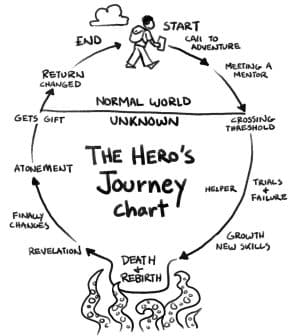
Perhaps one of the most interesting archetypes of Jungian psychology is the concept of the hero myth. On page 170 of Two Essays on Analytical Psychology, Jung says of the hero,

“…if a man is a hero, he is a hero because, in the final reckoning, he did not let the monster devour him, but subdued it, not once but many times. Victory over the collective psyche alone yields the true value- the capture of the hoard, the invincible weapon, the magic talisman, or whatever it be that the myth deems most desirable. Anyone who identifies with the collective psyche- or, in mythological terms, lets himself be devoured by the monster- and vanishes in it, attains the treasure that the dragon guards, but he does so in spite of himself and to his own greatest harm.”

Certainly every culture has its own mythologies of “the hero.” The hero may start out as someone who is inferior or insignificant. The hero may be the “boy in the village,” or the orphan, or perhaps he or she might be mentally or physically handicapped. Simply, the hero is often the last person in the world one would expect to amount to anything.

A hero myth might go something like this: There is a village living under the enslavement of a great and terrible dragon. The dragon raids the people, takes their gold, and burns their crops with fire. The terrible dragon lives high on a mountain in a cave, sitting on and delighting in his treasure hoard. All the people in the village have long since given up hope on killing the dragon, since all the bravest fighters have perished in their attempts to do so. However, the boy who is to be the hero announces that he is going to go off and slay the dragon, which results in great laughter and also dismay to those in the village who realize they will never see him again. So the boy leaves with a few meager provisions-a sack with some stale food and water. In Jungian theory, leaving the village is the first and crucial step of individuation. The hero is the commoner who simply refuses to conform to the patterns of his/her society, and sets out to find oneself.


The hero has now left everything behind, and as he journeys he goes into the forest. Now as he was growing up, the hero heard many tales of the awful enemies of the forest. However, once in the forest he discovers many friends, animals who begin to help him. According to Jung’s way of individuation, this going into the forest is the actual delving into the unconscious. The individual is receptive to the unconscious so the unconscious begins to equip the individual. There are dangerous animals in the forest, but they don’t destroy him like everyone told him back in the village. Instead, they teach him wisdom, give him special weapons and resources, and the boy learns how to destroy the dragon. This illustrates that if one chooses to experience the unconscious realm and accept what is there, he/she will the unconscious helpful toward wholeness.

The story concludes after many adventures and the boy single-handedly killing the dragon. Thus in destroying the dragon he liberates his people (much as a person who has become whole would benefit those around him/her) and recovers the treasure. The treasure seems to be extremely important to Jungian thought. The treasure is life itself-unlived and unfulfilled life. It is only by taking the initial bold step of leaving the comfort of the village and facing the potential enemies of the forest that one acquires the knowledge of how to experience the treasures of life.

Individuation is for the common person-the person of ordinary stature or less. Someone famous, rich and successful is more likely to be comfortable in that situation and have less of a desire to become individuated. Another example of the individuation aimed at the common person through use of myth is the hero waking up the sleeping princess. The princess is under a spell and the hero goes through many steps to free the princess. Here the princess is the anima. The hero has nothing going for him until he learns how to awaken the feminine beauty that lies before him. This notion of the hero myth is saturated in our modern culture, and may be a timeless fascination of the human race.

Up to this point I have been discussing the Jungian concept of individuation as I understand it to be. At this point I would like to give my understanding of the Biblical view of wholeness as defined in the Bible and in relation to my own personal experiences. Even though the Jungian theory of individuation and what the Bible defines as wholeness are in some ways different, they are in many ways extremely similar due to the fact that there are numerous scriptures paralleling Jung’s view. For example, the theme of a believer’s pilgrimage through life as “strangers and exiles on the earth” begins with Abraham and the Patriarchs in the book of Genesis, and continues through the Bible into the New Testament. Like the boy who leaves his village in the hero myth, so Jesus taught that “If anyone wishes to come after me, let him deny himself, and take up his cross, and follow me. For whoever wishes to save his life shall lose it; but whoever loses his life for my sake and the gospel’s shall save it” (Mark 8: 34b-35). This notion of breaking away from conformity is also found in Paul’s epistle to the Romans, which is perhaps the most relevant passage in the Scriptures in relation to wholeness . The Apostle writes,

“I urge you therefore, brethren, by the mercies of God, to present your bodies as a living sacrifice, wholly acceptable to God, which is your spiritual service of worship. And do not be conformed to this world, but be transformed by the renewing of your mind, that you may prove what the will of God is, that which is good and acceptable and perfect” (Romans 12:1-2; NASB).

The first thing Paul asks the Christians to do in Rome is to offer their bodies as living sacrifices to God. The idea here is the same as the Old Testament picture of sacrifice being burned up on the altar. The Christian is to be totally consumed, giving everything to God, including body, soul, and spirit-allowing God to begin the process of wholeness in the individual. Paul does not tell those in Rome to improve themselves, or “clean up their acts” and then God will accept them. Rather, Paul says to bring oneself just as s/he is, and God will make them whole. This is one Biblical picture of worship-that is, giving to God your entire being. Like individuation, the process of becoming whole is not completed in a day, but is a lifelong process containing many struggles.

This idea is also similar to the Old Testament story of the burning bush, whereupon the fire does not destroy the bush, but rather gives it great light. The bush in and of itself is not deserving or really good for anything, for any old bush will do. However, if God dwells in the thorn bush, the bush is glorified.

Paul explains that the way one becomes whole is two-fold: first, he says not to conform to the pattern of the world, and second, one’s mind must be transformed. Like Jung, Paul believes the world produces conformity. In the Christian paradigm, humility is a very necessary precedent to begin and continue the way of wholeness. Humility is also a logical result of understanding the character of God. However, the prevailing attitude of the world is self-centeredness. Paul instructs not to conform to that philosophy, but to “be transformed by the renewing of their minds.” Because of the pressure the world puts on individuals to conform, he says the way to avoid conformity is to have your mind renewed.

In his novel called Symbols of Transformation, Jung makes reference to the notion that it is the spirit who gives life-and that dead orthodoxy is certainly not sufficient. Paul says the Spirit of God is necessary for a renewed mind and a spirit of life and peace:
“For those who live according to the flesh set their minds on the things of the flesh, but those who live according to the Spirit set their minds on the things of the Spirit. To set the mind on the flesh is death, but to set the mind on the Spirit is life and peace. For the mind that is set on the flesh is hostile to God; it does not submit to God’s law, indeed it cannot; and those who are in the flesh cannot please God. But you are not in the flesh, you are in the Spirit, if in fact the Spirit of God dwells in you. Any one who does not have the Spirit of Christ does not belong to him. But if Christ is in you, although your bodies are dead because of sin, your spirits are alive because of righteousness” (Romans 8: 5-10).

Paul phrases this notion again in his epistle to the Galatians,

“I have been crucified with Christ; and it is no longer I who live, but Christ lives in me; and the life which I now live in the flesh I live by faith in the Son of God, who loved me, and delivered Himself up for me. I do not nullify the grace of God; for if righteousness comes through the Law, then Christ died needlessly” (Galatians 2:20-21).

The danger to many is that once Christ takes over, an individual will no longer be him/herself any longer. However, according to the Bible and my own experiences, the opposite is true. Humility and service in no way implies depleting one’s own personality and becoming a clone. That is conformity, the very thing Paul is telling us to avoid. The Biblical view of wholeness means you are more yourself than ever before. The way to become our true selves as the God of the Bible intended is to yield ourselves to Him. Jesus said, “I came that you might have life, and life more abundantly.”

This abundant life (wholeness) appears also to be just Jung is primarily concerned with.

Perhaps the most helpful book on the subject of masculinity and femininity is The Song of Solomon. The most common interpretations of this book include a love story of a man and woman who grow and mature as their relationship progresses, and a picture of Yahweh’s love for Israel or Christ’s love for the church. Yet there is a third interpretation, one which perhaps Jung would be extremely comfortable with: Solomon is a male Hebrew name derived from shalom, but Shulamite is a feminine name, also derived from shalom (Dolphin; pg. 148). Therefore one could interpret that this is a story of the same person seen from two different viewpoints-one outward and one inward-and so the book could therefore be a study of personal wholeness in relation with God (Ibid; pg 148).

These views are in conjunction with what Jung described as “the union of opposites,” the goal of individuation. In his own way, Jung attempted to understand how we all must understand the masculine and feminine principles in life, and in God Himself, in order to be whole persons.

Jung does not appear to have problems with what Christianity really is, but instead his famous vision of God defecating on the church in his autobiography seems to be more related to his extreme displeasure with the dry religious orthodoxy he grew up with. This dead religion that so much plagued Europe in Jung’s day may be found in all cultures, and Jung happened to grow up in this type if setting.

When one is sensitive to Jung’s situation, he is much more clearly understood. Morton Kelsey is such an individual. He writes,

“…the greatest problem that Christians have in reading Jung is that Jung is ambivalent about institutional Christianity and about its belief in the resurrection of Jesus and its saving power. He was raised by a father who was a minister in the Swiss Reformed Church. His father’s intellectual faith was not based in experience and was different from his unconscious belief. Jung believed that his father’s inner split led to his early death. Jung’s father expected his son to accept faith on authority, without discussion. Jung was a deeply religious boy and young man, but he was scarred by this relationship. So even though Jung thought of himself as a Christian, he did not see the importance for himself of the saving action of Jesus’s death and resurrection” (Kelsey; pg. 255).

In spite of all this, Jung’s last written statement about religion is found in his autobiography:

“Man can try to name love, showering upon it all the names at his command, but still he will involve himself in endless self-deceptions. If he possesses a grain of wisdom, he will lay down his arms and name the unknown by the more unknown, ignotum per ignotius-that is, by the name of God. That is a confession of his subjection, his imperfection, and his dependence; but at the same time a testimony to his freedom to choose between truth and error” (Memories, Dreams, Reflections; 1963, pg. 354).

In response to this statement, Kelsey states that, “This is the same conclusion reached by some of the greatest Christian saints. I think that Jung was far more Christian than he himself knew. I wish more Christian theologians were as clear about the nature of God as Jung is in this passage” (Kelsey; pg. 255).

As Kelsey points out, individuation and the Biblical conception of wholeness are extremely parallel, for Jung was “more Christian than he himself knew.” Although I consider myself much more informed after reading the works of Jung, I disagree with him on a few points. For instance, Jung’s writing about evil is ambiguous-at times, as in The Answer to Job, he portrayed evil as a part of God, while in Aion (1968) he made no reference to this idea (Kelsey; pg. 249). The Bible is clear that “God is light, and in Him there is no darkness at all” (1 John 1:5), and, “Every good thing bestowed and every perfect gift is from above, coming down from, the Father of lights, with whom there is no variation or shifting shadow” (James 1:17). Thus according to Christian theology, I differ from Jung’s dualistic approach and I believe that evil comes not from the Creator, but from the created when we choose to rebel against Him.


However, the Bible does not teach man is inherently evil, for men and women are created in God’s image and are therefore of immeasurable worth. Instead, Paul teaches in Romans chapter one that mankind is stained with sin (different than evil), and is in desperate need of the Savior-and that sin oftentimes may result in evil actions.

I also believe Jesus is the only way to the Father, a statement which is not my own but rather one which Jesus himself made in John chapter fourteen-a statement I may choose to accept or reject. Nevertheless, I have greatly benefited from my new knowledge of Carl Jung and his teachings in the field of psychology. I find his ideas incredibly refreshing. Furthermore, he has helped me see the scriptures in a new light, and I feel I am a more individuated person as a result of his influence.

BIBLIOGRAPHY (Amazon Affiliate Link)

1. Psychology & Religion, C. G. Jung; Yale Press, 1938.

2. Psychology, Medicine & Christian Healing; Morton T. Kelsey, Harper & Row, San Francisco, Ca. 1966.

3. The Collective Works of C.G. Jung, Vol. 11 &16.

4. A Critical Dictionary of Jungian Analysis, Samuels et al; London, 1986.

5. Two Essays on Analytical Psychology, C.G. Jung; Bollingen Foundation, Inc., N. Y., New York, 1953.

6. Boundaries of the Soul, June Singer; Rowins Inc., N. Y., New York, 1974.

7. He: Understanding Masculine Psychology, Robert A. Johnson; Harper & Row Publishers, N. Y., New York, 1989.

8. She: Understanding Feminine Psychology, Robert A. Johnson; Harper & Row Publishers, N. Y., New York, 1989.

9. Animus and Anima: Two Essays by Emma Jung, Emma Jung; Spring Publications Inc., Dallas, Texas, 1957.

10. Jesus: Lord of Time and Space, Lambert T. Dolphin; New Leaf Press, Green Forest, Arkansas, 1988.

11. New American Standard Bible; Harper & Row Publishers, N. Y., New York, 1952.

12. Memories, Dreams, Reflections, C. G. Jung; Random House Inc., N. Y., New York, 1961.


November 29, 1990, revised September 24, 1995, October 22, 1996, February 26, 1997. July 26, 2004

Ken Ammann is a graduate of Stanford University with a B.S. Degree in Psychology, and an M.S. degree from San Jose State University. He is presently Head Basketball Coach at Concordia University in Irvine, California.

Affiliate Disclosure: As an Amazon Associate I earn from qualifying purchases. Thank you for supporting my work in this way!

God is Redeeming Life, Redeeming Theology Bible & Theology Topics: Carl Jung, psyche, soul

Advertisement

The Rich Young Ruler and You (Matthew 19:16-24)

By Jeremy Myers
2 Comments

The Rich Young Ruler and You (Matthew 19:16-24)

https://media.blubrry.com/one_verse/feeds.soundcloud.com/stream/983722510-redeeminggod-the-rich-young-ruler-and-you-matthew-1916-24.mp3

Money! Money! Money! It’s the money episode! In this podcast study, I talk about cryptocurrency, a reader email about tithing, and the story of the Rich Young Ruler in Matthew 19:16-24. We see that Jesus was NOT telling the young man that he had to give up all his money in order to go to heaven. The story is about something else entirely.

Cryptocurrency like Bitcoin and Dogecoin are in the News!

Have you heard of cryptocurrency? They’re in the news a lot this week, so I decided to talk a a bit about them. I explain what they are, why they’re important and gainin widespread acceptance, and how to get some if you want. Ten years ago, Bitcoin was $1. It hit $48,000 today. Dogecoin is the most entertaining cryptocurrency, which causes many to believe it will be the most successful. It currently sits at $.07, and many believe it will hit $1 this year. Where will it be in ten years?

I personally bought a tiny fraction of one Bitcoin and several hundred Dogecoins this past week.

Best and easiest is Coinbase. Use my link to get $10 of free Bitcoin if you buy at least $100. That’s 10% instant profit though, so you might as well take it.

But Coinbase doesn’t sell Dogecoin. So if you want Dogecoin, use Robinhood. Use that Robinhood link to get a free stock when you sign up.

Reader Email about Tithing

A reader sent me a question about tithing this week. He wanted to know if he is really supposed to tithe 10% to his church or not.

Collection PlateI have written a lot about this before. There’s a whole section on tithing in my book (#AmazonAdLink) Church is More than Bodies, Bucks, & Bricks. Here are some links on my site you can read as well:
  • The Tithing Tax
  • Malachi 3 and Tithing
  • Modern Tithing
  • Tithe for Your Right to Party
  • Tithe 3% to your church
  • What Jesus taught about Tithing
  • Render To Caesar
  • The Widow’s Mite
  • Devouring Widow’s Houses
  • Don’t Tithe to a Decaying Temple

The bottom line truth about tithing is that most of what we have been taught in our churches about tithing is flat-out wrong. In the Bible, tithing is closer to what you and I would think of as income tax. But even then, the tithe went to help local people, rather than to nameless and faceless governmental programs. Most surprisingly of all, that 10% tithe we so often hear about from our pulpits was primarily for the purpose of hosting a large community party for everyone who came. It was to help pay for everybody to come together once a year for a giant music, arts, and food festival.

There’s a lot more to it than that, but there is nothing in Scripture to support the practice we have today of paying 10% of your annual income to cover the costs of an expensive church building and staff salaries. This doesn’t mean you can’t have buildings and church staff. You can. But what you cannot do is defend the practice from the Bible.

Anyway, the bottom line answer to the question is this: “No, the Bible does not command us to give 10% of our income to the local church.” It is smart to use some of your money to support people, ministries, and causes that you believe in, and to help the poor and needy in your community, but also make sure you are using some of your money to make memories with your spouse and children, and to also enjoy life a bit.

Read some of the articles linked to above (or just get the book) to learn more about what the Bible teaches about tithing.

The Rich Young Ruler Matthew 19

The Rich Young Ruler in Matthew 19:16-24

I have previously taught about the Rich Young Ruler here and here.

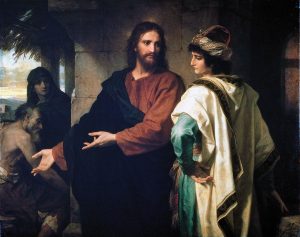
The passages of Matthew 19:16-24, Mark 10:17-31, and Luke 18:18-30 all tell the account of a rich, young ruler coming to Jesus to ask how he can have eternal life. Jesus tells him to give all his wealth away, and then come follow Jesus. The young man went away sorrowful, because he was very rich. After his departure, Jesus and His disciples have a discussion about wealth and the kingdom of heaven.

This is a confusing text for many Christians because many people think that the term “kingdom of heaven” refers to heaven itself. And so many believe that when Jesus taught about how difficult it is for a rich man to enter the kingdom of heaven, He was saying that it is difficult for the rich to receive eternal life and go to heaven when they die.

Thus, it is taught, the rich must give away their wealth in order to have a chance at eternal life.

But this is a works-based message of eternal life and is completely contrary to the free offer of eternal life found everywhere in Scripture.

If eternal life is freely given to anyone and everyone who simply and only believes in Jesus for it, it would be a biblical contradiction for Jesus to also say that the rich must give away their wealth to receive eternal life.

Thankfully, a proper understanding of the concept of the kingdom of heaven helps explain this apparent contradiction. When Jesus teaches about the dangers of wealth, He is not referring to the difficulty the rich will have in receiving eternal life, but to the difficulty they will have in experiencing the rule and reign of God in their life here and now on this earth.

The Kingdom of God is about the Rule and Reign of God in our life NOW

Rich Young RulerThe context of these passages provides numerous lines of evidence to show that Jesus is talking about experiencing eternal life in our present life through the rule and reign of God, rather than about how to receive eternal life and go to heaven when we die.

For example, other than the initial question by the rich, young ruler in Matthew 19:16, the rest of the passage is about inheriting eternal life, following Jesus on the path of discipleship, and entering the kingdom of heaven. So despite how the rich, young ruler phrased his initial question, Jesus answer a more important question for this particular person.

The Gospel authors understood this, and so the parallel versions in Mark 10:17-31 and Luke 18:18-30 have the rich young ruler have the rich, young ruler asking how to “inherit” eternal life. Furthermore, Jesus later clarifies in Matthew 19:29 that He is only talking about inheriting eternal life (which refers to the present age experience of eternal life), Mark and Luke use the word inherit for consistency’s sake when they record the question from the rich young ruler (Mark 10:17; Luke 18:18).

Now which question did the rich, young ruler originally ask? It is difficult to say. Probably he spoke in Hebrew or Aramaic, and so Matthew translated the man’s word one way while Mark and Luke translated it another. But regardless of what was in the mind of the rich, young ruler, however, Jesus answered his question in a way that reached to the heart of the issue, and the heart of the young man.

Wealth in Jewish society

In Jewish society, wealth was a sign of God’s divine blessing. Due to various promises in the Hebrew Scriptures, it was assumed that if a person was observing the law and was wealthy, God had blessed them with their wealth because of how successful they were in observing the law. This belief would obviously not apply to someone like Zacchaeus, who was clearly making no effort to observe the law, but would absolutely apply to someone like this young ruler.

He believed that he had observed the entire law since his youth (Matt 19:20), and everyone else believed it also (cf. Matthew 19:25).

When Jesus instructed the rich, young ruler to give away all his wealth and then come follow Him, Jesus was challenging this entire way of thinking about the connection between God’s law and human wealth. Jesus was showing that there is no true connection between the two. Wealth is not an outward sign of inner righteousness.

Jesus wanted to show this young man, as well as the disciples, how to truly live in righteousness, which comes through following Jesus in discipleship and living in light of the kingdom of God. But Jesus cannot do this as long as a person is looking to their own ability to be righteous, or to their own wealth as a sign of personal righteousness. So he tells the young man to discard all evidence or thought of personal righteousness and then come follow Him to see what righteous living truly looked like. But the young man went away because he was unwilling to do this.

The Kingdom of God is Entered Through Discipleship

So the answer from Jesus is not about how to receive, gain, or have eternal life, but how to inherit or experience God’s will, purpose, and blessings for our life here and now on this earth. As we follow Jesus on the path of discipleship in this life we will experience the life God wants for us now and also gain treasure for our future life in eternity (Mark 10:21: Luke 18:22).

All of this is about entering into the kingdom of God (Mark 10:23-25; Luke 18:24-25), which is shorthand for entering into the experience of the rule and reign of God in our lives here and now on this earth.

But what about the word “saved”?

Note that the disciples use the word “saved” (Mark 10:26; Luke 18:26), which also causes confusion in the minds of some. But when we recognize that the word “saved” also does not refer to receiving eternal life or going to heaven when we die, then the passage retains its message. Jesus is talking about being delivered and rescued from the problems that wealth brings, so that His followers can experience the rule and reign of God in their life now.

The surrounding context makes it clear that Jesus and the disciples are talking about discipleship and eternal reward rather than justification and receiving eternal life (Mark 10:28-30; Luke 18:28-29).

What Jesus Might Say to Us Today

In modern, Western culture, while some people see wealth as a sign of God’s blessing on a person who is fully obedient to Him, this is not a widely held view. If Jesus were physically walking the earth today, I can imagine a scenario in which a well-known, young pastor comes to Jesus and says, “Good teacher, what must I do to experience God’s life?” The young pastor only asks this because he thinks he is already experiencing God’s life, and believes Jesus will praise Him for his great success at such a young age.

Instead, Jesus says, “Well, what is it that you teach from your pulpit and write about in your books?”

The young pastor would respond, “People must attend church regularly, tithe 10% of their income, read the Bible and pray every day, and not be given to alcohol or drugs. They should also be a good witness at their job by wearing Christian t-shirts, a cross-shaped necklace, and never laugh at crude jokes. Instead, they must hand out Gospel tracts and invite people to church.”

Jesus would respond, “Okay. Go do all of that then.”

To which the young man would proudly boast, “I’ve done all this since I was a kid.”

Pastoral power authority“Well done!” Jesus would say. “Only one thing is left. Resign as pastor. Stop selling books. Quit preaching. Throw out all your gospel tracts and Christian clothes. Stop tithing to the church. Put your Bible on a shelf for a while, and go have a beer at the local pub. Then come follow Me and we’ll see what’s next.” But the young pastor would go away, thinking that Jesus was a false teacher, for the young man had it all figured out.


In this text, Jesus is showing that there is no such thing as an outward manifestation of inward righteousness. However, if we want to truly experience the life of God in us, and all the riches and blessings that entails, we can stop following religion and instead follow Jesus into a life of discipleship. While Jesus always leads in surprising directions, but also leads us toward a true life with God.

Matthew 19:16-24 therefore, is not about how to receive eternal life, but about how to get rid of the things in our life that we rely on as evidence that we are “good” Christians, and instead just follow Jesus wherever He leads. What things do you look to for proof that God loves and accepts you? That you are doing a “good job” for Jesus? Get rid of such things, and then come to Jesus empty-handed, saying, “Wherever You lead, I’ll follow.”

When you do this, Jesus will lead you into a full experience of the kingdom of God.

Affiliate Disclosure: As an Amazon Associate I earn from qualifying purchases. Thank you for supporting my work in this way!

God is Redeeming Church, Redeeming God, Redeeming Life, Redeeming Scripture, z Bible & Theology Topics: eternal life, kingdom of god, kingdom of heaven, Luke 18:18-30, Mark 10:17-31, Matthew 19:16-21, Matthew 19:16-24, Rich Young ruler, salvation, tithing

Advertisement

Should I vote in the election?

By Jeremy Myers
16 Comments

Should I vote in the election?

Should you vote in the election? Should I vote in the election? This is the question that many Christians are asking.

The United States midterm elections are one week away. In light of this, I have begun to see more and more Facebook articles and Twitter messages instructing Christians to not vote.

I strongly object. I believe that Christians have an obligation and moral responsibility to vote.

should I vote

Yet since there are numerous arguments given for the idea that Christians should not vote, I want to address a few of these arguments in this post as a way of encouraging you to get out and vote this year. The article will close with a few suggestions or ideas about how to decide who to vote for.

Argument 1: We serve the Kingdom, and the Kingdom is not of this World

Some Christians argue that since we are citizen of the Kingdom of God, and this Kingdom is not of the world, we should not get involved in the politics and government of this world.

It is true that we are citizens of the Kingdom of God and that the Kingdom is not of this world.

But what these Christians who say this seem to forget is that while the kingdom if not of this world, it is definitely for this world. The Kingdom of God has come down from heaven to earth in the person and work of Jesus Christ to transform this world so that God’s will is done on earth, just as it is in heaven.

The kingdom of God is the rule and reign of God on earth. And while voting is not going to be the only way (or even the primary way) for the rule and reign of God to spread upon the earth, it is certainly one way that can help. Leaders of worldly governments who have similar goals and values as Jesus Christ can certainly do more for the Kingdom of God than can worldly leaders who value only power, riches, glory, and fame, all of which belong to the kingdom of darkness.

So one way for the Kingdom of God to come upon this earth is for us to be involved in politics so that we can affect change and move the kingdoms of this world a little closer to the Kingdom of God. Voting is the smallest and easiest way for this to happen. It shouldn’t be the only thing we do, but it is a start.

Argument 2: Jesus and Paul didn’t vote; so neither should we!

I am not making this argument up. I have heard people use it.

Yes, of course Jesus and Paul didn’t vote, but this was because the Roman Empire was not a democracy. Voting wasn’t an option for Jesus and Paul. They didn’t vote because they weren’t allowed to.

But this doesn’t mean that Jesus and Paul were apolitical, that they had no political views and never taught anything about the politicians or political climate of their day. Quite the contrary, both Jesus and Paul were outspoken about the abuses of those who held political power, and even called upon leaders to conform their rulings to the will and values of God. They also paid taxes and encouraged their followers to do so, as well as teaching them to obey the ruling authorities, who were place into their positions by God.

In light of these things, I believe that if Jesus and Paul had been given the opportunity to vote, they would have seen it as one more way to make their voice heard.

Furthermore, many of the people in Scripture whom God used greatly were involved in politics, and even raised up to such positions “for such a time as this.” Joseph helped saved millions of lives through his position in Egypt. King David and King Solomon led the nation of Israel into peace and prosperity. Daniel was a wise and godly counselor in the royal courts of Babylon. Esther used her position to rescue her people from annihilation.

So it is completely false to say that Jesus, Paul, or any of the godly people of Scripture were not involved in politics and would not vote. The opposite is actually true. God wants all of us to get involved in how this world is governed, whether it is in large or small ways. The smallest of these is voting, and if that is what you can do, then that is what you should do.

Argument 3: Politics is so divisive! It sickens me to get involved

Some Christians don’t want to vote because of how divisive politics have become. To get involved with the issues makes them feel dirty.

I understand the feeling. There is much filth in the realm of politics.

However, isn’t this exactly why we are here on earth? Isn’t the anger and malice that is found in much of the political realm the exact reason we should be involved?

Rather than retreat from the darkness, let us be a light in the darkness, providing a voice of love, hope, peace, healing, and forgiveness rather than hate and anger.

Voting, and getting involved in politics, provides an opportunity for us to show the world a better way of standing up for what we believe while peacefully disagreeing with others. So cast your vote, and do it with love toward those who have different views.

Argument 4: Jesus is My President!

I especially hear this during a presidential election. “I’m not voting,” the person says, “because Jesus is my President.”

Fine. I don’t disagree. Jesus alone is our only Lord, Ruler, King, and Master. Call Him your “President” if you wish.

Jesus for presidentBut what does this have to do with voting? Voting is not an oath of fealty. Voting is not a stamp of approval on everything the person you vote for has said and done, or will say and do. Voting is not a promise to obey, support, and defend everything this person says or does.

In fact, voting is the opposite of such things. Voting gives you the right to disagree and voice your disapproval.

I am so tired of people who do not vote feeling like they then have the right to criticize the decisions of the person in office. I feel that if you have the opportunity to choose who is in office by voting, and you forsake that right, then you should also forsake your right to oppose or criticize the decisions of those who are in office.

dont vote dont complainVoting is a way to make your voice heard. And if you don’t want to make your voice heard through voting, then you should also not make your voice heard after the voting is over. When you vote, according to the values and principles of your only sovereign, Jesus Christ, this is what gives you the subsequent right to raise your voice in prophetic warning about the poor decisions that the leaders are making, whether or not you voted for them.

So yes, Jesus is your president. And guess what? He’s calling you to vote … but not for Him. He doesn’t get put into office by voting. He is in His position for all eternity, regardless of which human is in which political office or role.

As Christians, we are invited by God to call our political leaders to follow the will and ways of God, and one way we can do this is by voting. If we love justice and mercy, then we are to be involved and active in every battle that helps bring more justice and mercy into the world. Voting and political activity is one way to make this happen.

Argument 5: My Vote Doesn’t Matter

I hear this all the time. “I don’t vote because my vote doesn’t matter. I’m just one small voice in a sea of people who disagree with me.”

I live in Oregon, which is mostly dominated by liberal Portland and the I-5 corridor down through Corvallis and Eugene. But other than these areas, most of Oregon is politically conservative. I think I heard that by numbers alone, the majority of Oregon is conservative.

Yet every election year, less than 25% of the conservative people come out to vote. Why? Because they think their vote doesn’t matter. They see the powerful and loud voting block in Portland and Eugene, and think, “There’s no way my little vote can overcome that giant.”

So they stay home.

And then they complain all the time about how Oregon passes terrible laws, such as the law that use our tax dollars to fund abortions.

But if even half of the people conservative parts of the state voted, they would be able to have more say and direction in the state, and might even gain a majority in the state congress.

I had a short twitter conversation about this very thing with my friend Dan Kent yesterday. Here is a bit of the thread:

[tweet 1056902724342685696 hide_thread=’true’]

[tweet 1056951075603795970 hide_thread=’true’]

[tweet 1056952493048037377 hide_thread=’true’]

[tweet 1056955840270225410 hide_thread=’true’]

[tweet 1056956230244003841 hide_thread=’true’]

[tweet 1056956437669273601 hide_thread=’true’]

I think that what Dan is saying is that if you feel strongly about the direction of our country and how it is led, you should do more than just vote. You should also raise your voice. And I agree with that.

Of course, I also think that if you didn’t vote, you have no right to raise your voice.

I think a vote is the very first word of you raising your voice to have a say in the direction and leadership of the country.

So should you vote? I say YES! Get out and vote.

your vote your voice

But who should you vote for?

I’m not going to tell you. That is, I’m not going to give you names or a political party to vote for. Instead, I will provide some values and ideas to help inform your decisions.

As Christians, we must look for candidates that help bring to reality the values that Jesus taught and lived. Especially those of Luke 4:18-19. Jesus said that He came to this earth to help the poor, heal the brokenhearted, give liberty to captives, restore sight to the blind, and set free those who are oppressed.

Obviously, all political candidates from all political parties claim that they will do these sorts of things. All candidates from all political parties in every political race I have ever seen or heard claims that they are fighting for the rights of the poor, the week, and forgotten, the neglected, the oppressed, and the overlooked.

Teaching of Jesus in Luke 4 If you really listen to what all candidates say, this is exactly the sorts of things they all promise.


So what are we to do?

The answer is to not look at what politicians say, but rather at what they actually have done. Nearly all politicians have a history of whether or not they have helped people. A state governor or senator doesn’t start out campaigning for that political office. They will have always worked their way up from smaller city or regional offices.

As a result, we can look at their history of what promises they have made, and whether or not they have actually kept these promises. We can look at the poor, the oppressed, the neglected, the forgotten, and the overlooked in the communities in which they served to see if, during their time in office, the conditions of these people got better or worse.

If conditions got worse, then this candidate does not deserve your vote. If they improved in tangible, verifiable, measurable ways, then maybe this candidate does deserve your vote. Again, all candidates will SAY things improved under their leadership, but you must verify the actual numbers and results to see if this is so.

Don’t just listen to the words that people say. What people DO is always more important than what they SAY. Politicians promise all sorts of things, but what they have actually done for the people they serve is the best indicator of whether you should vote for them or not.

Here are some questions to consider about any candidate:

-Is crime going down in the area in which they governed?

-Are homelessness and poverty levels decreasing?

-Is the unemployment level decreasing?

-Is the standard of living generally increasing?

-How do they respond toward political opponents? Do they call for violence and hate, or love and acceptance?

-What have they actually done (not promised to do!) to protect the weak and give a voice to the voiceless? This not only includes immigrants, but also the poor and sick of our own country, and especially the weakest and most voiceless of all: unborn children.

(I am not a single issue voter, but I have always wondered how any Christian can support the killing of unborn children. I agree that a woman has the right to do what she wants with her own body, but a baby is not her own body. The body of the baby belongs to the baby. I am pro-choice for the baby as well. I want the baby to have a choice.)

Don’t think about such questions as a Republican or Democrat. Think about these questions from the perspective of a citizen of heaven, and how you can bring the will of God down to earth.

Let me be specific.

And for this, I’m going to talk about Trump.

I know I said I wasn’t going to tell you who to vote for, but he is not running for office this year, so I can talk about him.

Trump made many promises during his campaign in 2016. He promised to bring back jobs, reduce crime, move toward peace with various countries around the world (like North Korea), enact prison sentencing reform, increase the income of the average American, and help restore our health care system to take care of the sick and needy in our midst.

Since Trump had never held political office, it was difficult to know if he could be trusted to keep his promises, or if he even knew what he was talking about. But, regardless of what you think about him, he was elected as the President of the United States.

The past two years have shown that he did indeed know how to accomplish the things he promised. Here is a short list of how he has helped millions of people in the last two years:

  • Almost 4 million jobs have been created.
  • New unemployment claims at a 49-year low.
  • African-American, Hispanic-American, and Asian-American unemployment is at an all-time low.
  • Women’s unemployment rate hit a 65-year low.
  • Economic growth last quarter hit 4.2 percent (3.5% this quarter), higher than any time during the previous administration.
  • Median household income has hit highest level ever recorded.
  • 3.9 million Americans have been lifted off food stamps since the election.
  • Small businesses have the lowest top marginal tax rate in more than 80 years.
  • The FDA approved more affordable generic drugs, linking drug prices to the cheap drugs that people pay in other countries.
  • The Medicare program was revamped to stop hospitals from overcharging low-income seniors on their drugs—saving seniors hundreds of millions of dollars this year alone.
  • Budgeted $6 billion in NEW funding to fight the opioid epidemic, and have reduced high-dose opioid prescriptions by 16 percent.
  • Moved U.S. Embassy to Jerusalem, showing support for Israel.
  • Re-worked trade deals with Mexico, Canada, and the EU
  • Helped improve communications between North Korea and the US, while bringing an end to the firing of test missiles by North Korea.
  • Began the process of reforming prison sentencing guidelines which have previously led to high incarceration rates among African-Americans.

This is the sort of thing I am thinking about in this article. These are tangible and positive benefits that have come from the Trump administration, all of which help the poor, neglected, sick, and needy of our country. Whether you like Trump or not, we can all agree that these positive benefits are good for the people of our country, which will also, in turn, be good for the entire world.

You can look for similar things in the politicians you vote for next week, and in future elections. Make sure you think through the issues. Don’t just vote Democrat or Republican because that’s what you’ve always done. Consider the facts and statistics, and make the best and most informed decision that you can. Then get out and vote, making your voice heard in a small but significant way.

When all the Christian voices add up, we make a decisive block of people who can let our voices be heard.

So should you vote? I say YES! Get out and vote!

go out and vote

This post is part of the October 2018 Synchroblog. See what others have to say about the topic of voting by reading the articles from the other contributors below:

  • Red, Blue, Green, or Neither? – Scott Sloan
  • Voting is Violence … So Vote! – Tim Nichols
  • Who Should we Vote For if We Vote At All? – Mike Edwards

Affiliate Disclosure: As an Amazon Associate I earn from qualifying purchases. Thank you for supporting my work in this way!

God is Redeeming Life, z Bible & Theology Topics: politics, synchroblog, voting

Advertisement

  • « Previous Page
  • 1
  • 2
  • 3
  • 4
  • …
  • 35
  • Next Page »

My New Book is Out!

Get your copy on Amazon today!
Learn about the gospel and how to share it

Take my new course:

The Gospel According to Scripture
Best Books Every Christian Should Read
Study Scripture with me
Subscribe to my Podcast on iTunes
Subscribe to my Podcast on Amazon

Do you like my blog?
Try one of my books:

Click the image below to see what books are available.

Books by Jeremy Myers

My New Book is Out!

Get your copy on Amazon today!

Theological Study Archives

  • Theology – General
  • Theology Introduction
  • Theology of the Bible
  • Theology of God
  • Theology of Man
  • Theology of Sin
  • Theology of Jesus
  • Theology of Salvation
  • Theology of the Holy Spirit
  • Theology of the Church
  • Theology of Angels
  • Theology of the End Times
  • Theology Q&A

Bible Study Archives

  • Bible Studies on Genesis
  • Bible Studies on Esther
  • Bible Studies on Psalms
  • Bible Studies on Jonah
  • Bible Studies on Matthew
  • Bible Studies on Luke
  • Bible Studies on Romans
  • Bible Studies on Ephesians
  • Miscellaneous Bible Studies

Advertise or Donate

  • Advertise on RedeemingGod.com
  • Donate to Jeremy Myers

Search (and you Shall Find)

Get Books by Jeremy Myers

Books by Jeremy Myers

Schedule Jeremy for an interview

Click here to Contact Me!

Follow me on X

© 2026 Redeeming God · All Rights Reserved · Powered by Knownhost and the Genesis Framework